Ask ten cat owners how often to clean the box and you get two answers, delivered with equal confidence. Scoop twice a day, or the cat will find somewhere better. Change the whole thing weekly, or it is a biohazard.
Both numbers trace back to the same document, and that document says something looser than either of them. What decides whether your box is a problem this week is not the interval on the calendar. It is how much floor the waste has taken.
What the guidelines actually say
The 2014 house-soiling guidelines from the American Association of Feline Practitioners and the International Society of Feline Medicine are the source most veterinary advice descends from (Carney et al., Journal of Feline Medicine and Surgery 16(7):579–598, DOI 10.1177/1098612X14539092). Their litter box section reads, in full:
Remove waste a minimum of once a day and add litter as needed. Wash the litter box every 1–4 weeks. Some behaviorists feel that weekly washing and replacing the litter is optimal. Others find that every 2–4 weeks does not compromise the cat’s response and is more readily accepted by owners.
So the floor is once a day, and the full change is anywhere from weekly to monthly. The document records that some behaviourists think weekly is optimal, and that others find every two to four weeks does not upset the cat and is easier to keep up. What is being allowed for is adherence, not the interval.
The same document contains a line that gets quoted far less, and it reframes everything: unless the owner can remove soiled litter at least once every two hours to stop odour building up, many commercial litter boxes are too small.
Two hours. Nobody does that. The guidelines are describing a box too small for the job, and scooping is what compensates.
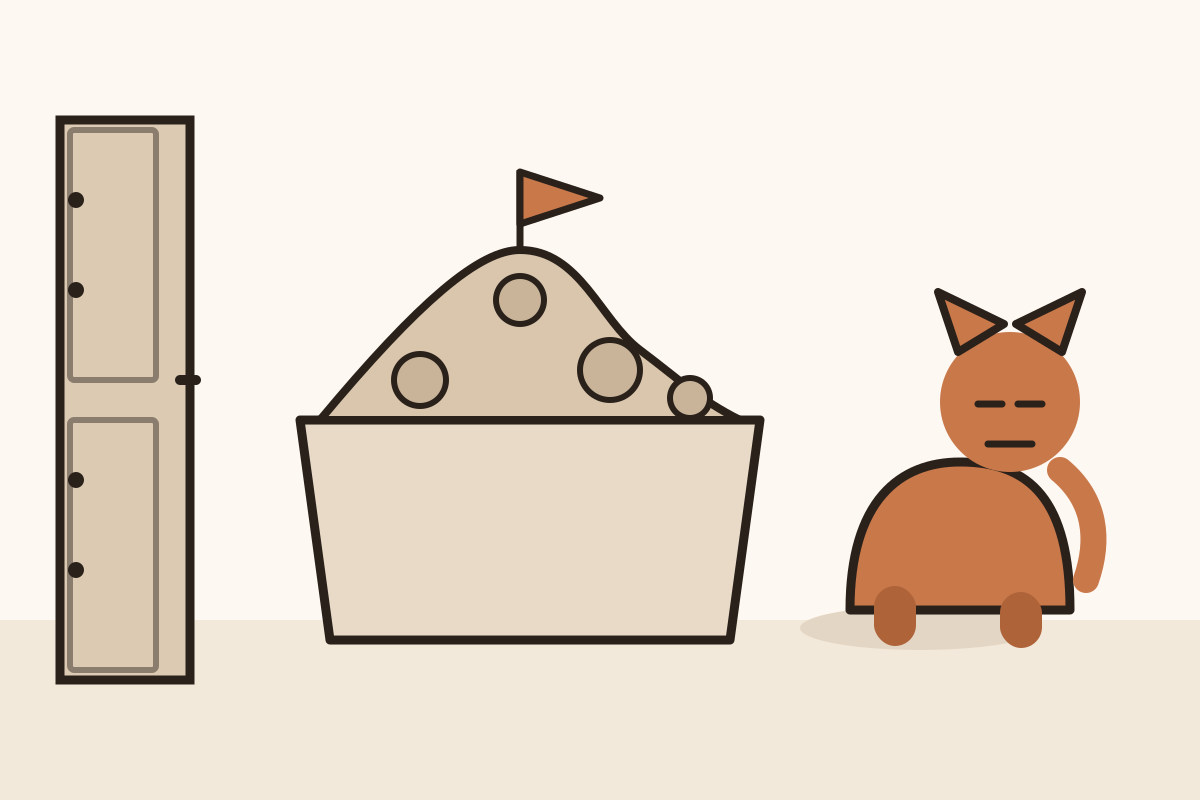
The flag is not in the guidelines.
The study that says cats mind the mess, not the smell
If you want to know why a cat avoids a box, the useful study is not about cleaning intervals. It is about what makes a box unappealing in the first place.
Ellis, McGowan and Martin published it in Behavioural Processes in 2017 (141:284–290, DOI 10.1016/j.beproc.2017.02.008). They set out to test the assumption everyone repeats: that cats avoid litter someone else has used, especially in a multi-cat house, and that this is why cleaning matters.
The result split in an unexpected place. Cats preferred a clean box to a dirty one. But who had used the box before made no difference at all. And the smell of real urine and faeces did not change their preference either.
What did change it was waste with no smell at all. Odourless fake urine and fake faeces altered which box the cats chose, and fake faeces were preferred over fake urine.
The authors read that as follows: neither malodour nor chemical communication is driving the choice. What the cats were responding to is the physical, visible obstruction — the thing in the way of a clean surface to stand on.
The practical reading is that the box that stinks but looks empty is less of a problem than the box that looks like a gravel pit with a rockfall in it, even if you can barely smell it. It also means “how often” is really a question about how fast the surface fills up.
Two caveats, and they are not small. The study comes from the Behaviour and Welfare Section at Nestlé Purina Research, so the authors were employed by a pet food company, which is disclosed in the affiliations and worth knowing. And it is a laboratory study of preference, not a field study of cats urinating on rugs. Preference in a test room is a proxy for the real thing, not the real thing.
The arithmetic of one week
Urine volume has been measured directly, at least in laboratory cats. Robbins and colleagues put sixteen cats on a dry diet and collected their urine; fourteen finished, eleven produced usable urine data, and the mean was 15.5 ml per kilogram per day, range 11.3 to 24.6. A 4.5 kg cat therefore produces somewhere around 70 ml of urine a day, and closer to 110 at the top of that range.
Split across three visits, that is roughly 23 ml a time. Clumping litter binds roughly its own volume, so the lump is somewhat bigger than the liquid; how much bigger depends on the litter.
The rest is our own arithmetic, and it rests on three stated assumptions: three urinations a day, one stool a day, and clumps five centimetres across. Three a day for a week is twenty-one lumps. Add the stools, at one a day, and you have twenty-eight objects, covering about 550 cm².
In an 86 × 39 cm box, the size the same guideline names as preferred, that is under a fifth of the floor. In an ordinary 50 × 35 cm box the same waste covers closer to a third — roughly double the share. The spacing is the part that matters. Twenty-eight objects spread over the wide box sit about six centimetres apart on average; over the narrow one, about three, which is narrower than a paw.
At one week neither box looks like a disaster, and that is why a weekly scoop passes for a while. Run the same box to two weeks without scooping and the narrow one is around two-thirds covered. That is the point at which a tidy cat stops using it, and the complaint arrives as a behaviour problem rather than a cleaning problem.
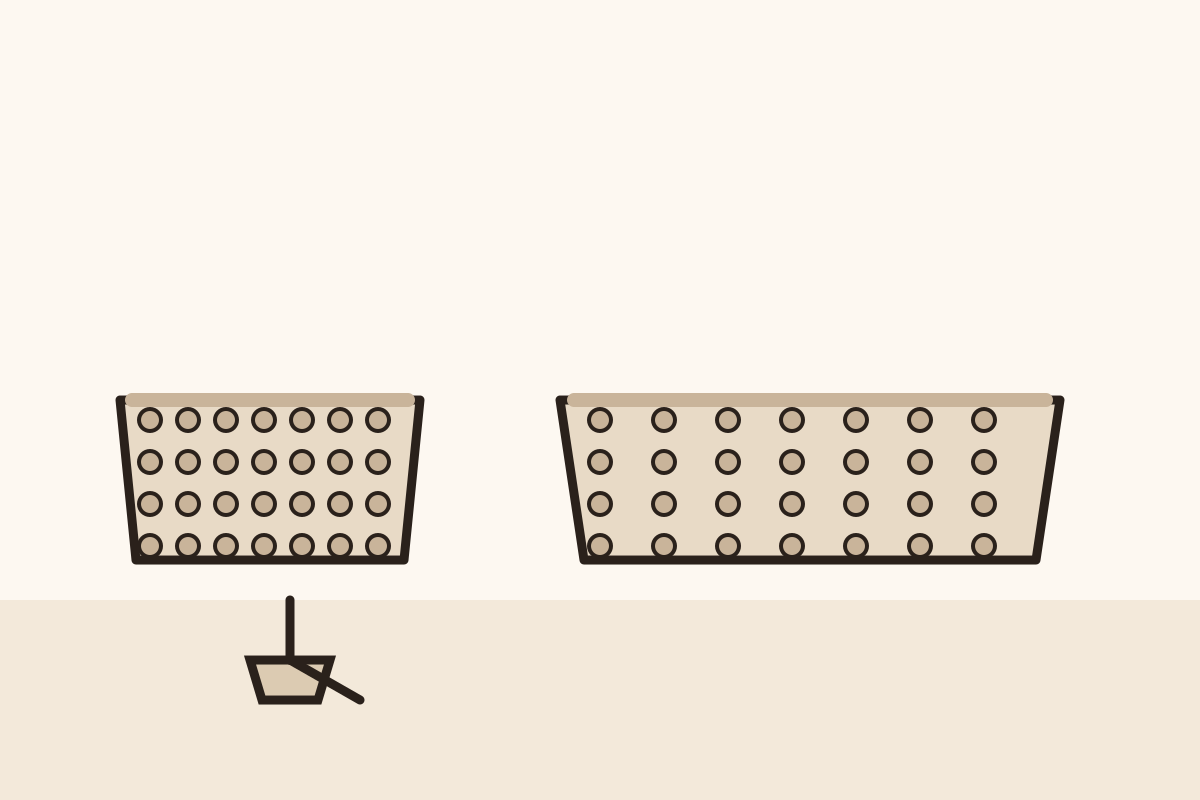
The same twenty-eight objects in each box. On the left the gaps are narrower than a paw.
This is the argument for buying a bigger box rather than scooping more often, and it is the same argument the 2014 guidelines make when they recommend a box 1.5 times the cat’s length from nose to base of tail. If you widen the surface, each clump costs proportionally less of it.
Size and frequency are one dial
Once you see the box as a surface that fills, the two recommendations stop competing. They are the same recommendation expressed in different units.
A big box buys you days. A small box costs you hours. The guidelines’ two-hour figure is what a small box demands; a box the size of a storage tub is what makes a daily scoop sufficient.
That is why the advice “scoop twice a day” sounds excessive in one house and insufficient in another, and why people argue about it online with such heat. They are describing different boxes.
If you want a rule that survives contact with a real week: scoop once a day, and when a full week of scooping leaves the surface more than about half covered at the moment you get to it, the box is too small — not the scooping too infrequent.
What actually smells, and what to wash
The smell in the room is mostly ammonia, and ammonia comes from urea sitting in the litter, not from the lumps you can see. That is the one place where the cat’s preference and the human’s nose genuinely diverge: the cat is judging the surface, you are judging the air, and both readings are correct about different things.
Plastic matters here. Clumping litter scratches the base, and those scratches hold urine and bacteria that a rinse does not reach. A box that smelled fine for two years can start smelling a week after a wash, and no amount of scrubbing fixes a scored base.
The guidelines are unusually specific here: use soap and hot water only, and avoid strong chemicals or any ammonia-based products, because ammonia reads to a cat as urine. Rinse thoroughly and let the box dry before refilling; residual detergent and damp both put cats off. Skip anything perfumed for the same reason. A scented box is a box that smells wrong to the animal you are trying to please. If the base is visibly scratched, replace the box. They are cheap, and replacing one costs less than a bag of litter.
The case where daily protects a person
There is a genuine health reason to remove waste every day, and it has nothing to do with the cat’s opinion.
Toxoplasma gondii oocysts are shed in cat faeces, and they are not infectious when they come out. They need time in the environment to sporulate. The CDC gives one to five days; Cornell’s feline health centre puts the minimum at 24 hours. A stool removed the same day has not had time to become infectious. One left for a day may already have. One left until the weekend certainly has. For a pregnant person, or anyone immunosuppressed, that difference is the whole reason the “scoop daily” advice exists in the form it does. It is also why the standard advice is that someone else does the scooping during pregnancy, or the job is done with gloves and followed by hand washing — not because the cat is dangerous, but because the timing is controllable and cheap to control.
This is not an argument that the cat is dangerous. Most cats shed oocysts once and briefly, after a primary infection, and indoor cats on cooked or commercial food rarely meet the parasite at all.
The cheapest fix is usually another box
The 2014 guidelines recommend two boxes in two separate locations even in a one-cat household, and one more box than cats in a multi-cat house — while noting that the second part is a rule of thumb rather than a requirement, and that “socially affiliated cats may be more willing to share litter boxes” — their phrase, not a finding about bonded pairs.
Two boxes in two rooms does something a bigger box cannot: it doubles the clear surface without moving the box you already have, and it gives the cat a second option on the day one of them is due. In a house with stairs, it also removes the reason a cat gives up and uses the landing.
The cost is a box, some litter, and the extra scooping. Set against replacing a rug or a sofa, it is not close.
What to buy, briefly
A metal scoop with slots, because plastic ones crack at the weld and a broken scoop means a hand in the litter. Cheap, and it lasts years.
A box you can measure inside, not outside. Wall thickness and a high rim eat several centimetres of the number on the label, and the difference matters once the cat is lying down in it.
Unscented fine clumping litter, which the 2014 guidelines name as the texture cats most commonly prefer. Scented litter is sold for the human nose, and the study above suggests the human nose is not what the cat is judging.
A mat in front of the box, if tracking is the complaint. It does not affect the cat at all; it affects whether you keep the box where it works best.
An automatic box is worth it only if the manual version is failing for a mechanical reason — you travel, or a disability makes bending and scooping hard. It does not fix a box that is too small or in the wrong place, and every automatic model still needs the litter changed and the mechanism cleaned. Buying one to solve a size problem is the expensive version of not solving it.
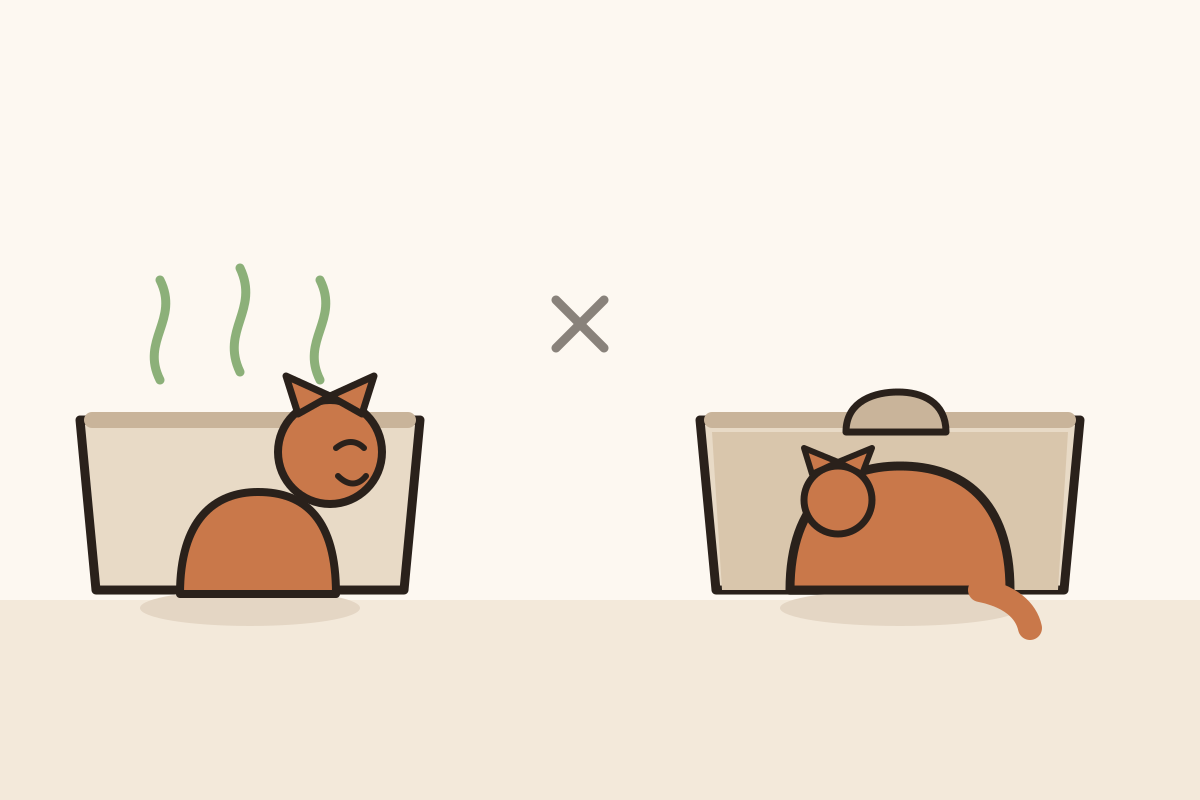
The nose on the left, the eyes on the right. The 2017 study puts the cat on the right.
A routine that survives a normal week
Scoop once a day, at a fixed time, into a lidded bin you empty weekly. Top up the litter to the depth the box needs rather than to a line on the bag. Wash the box every two to four weeks, and immediately after any accident that leaves it soiled beyond a scoop. Replace it when the base is scratched.
If the cat starts going elsewhere, the order to check things is: is the box big enough, is there a second one, is it clean today, has the litter changed, is another cat guarding it, and only then is the cat unwell. That order is not arbitrary — the first four are cheap to fix and account for most of the cases.
The number worth remembering is two hours. That is what a small box asks of you, according to the people who wrote the guidelines, and it is why most of the arguing about daily versus weekly is really an argument about a box that should have been wider.