A lot of the cheap single posts in pet shops are about 40 cm tall. A cat is roughly 45 cm from nose to the base of its tail. Which means the average post on the shelf is shorter than the animal it is for, and the scratch has to finish somewhere other than the post.
You can watch this happen. A cat that wants to scratch stands up, hooks its front claws in, and pulls down and back with its whole body. That is the movement. If the post runs out before the cat runs out, the cat ends up with its paws over the top and its back in a shape it did not ask for. Some cats do it anyway. Most use the sofa instead, and the sofa does not run out.
What 4,331 owners actually reported
The study with the most owners behind it is a survey rather than an experiment, which matters for what it can tell you. Wilson and colleagues published it in the Journal of Feline Medicine and Surgery in 2016: 4,331 respondents across 39 countries, mostly the US, Canada and the UK, describing what their cats did at home (DOI 10.1177/1098612X15594414).
The finding that gets quoted is this: cats scratched the preferred substrate more often when the post was a simple upright type, or a cat tree with two or more levels and at least three feet high. Three feet is about 91 cm.
The finding that gets quoted less is more useful. Owners offered rope, cardboard, carpet and wood. Carpet was the substrate offered most often; rope was the one cats used most when it was offered. So the market sells what people buy, and people buy what looks like furniture fabric, and the cats would rather have had sisal.
Two more results from the same survey, both odd enough to be worth knowing. Narrower posts were used more often than wide ones. And inappropriate scratching got less common with age — but cats between ten and fourteen preferred carpet, while every other age group preferred rope.
That last one is not a reason to buy carpet for an old cat. It is a reason to stop treating “cats prefer sisal” as a law of nature. Fourteen-year-old cats also move differently, and a stiff old cat may find a broad carpeted surface easier than a narrow rope column.
Where the three feet comes from
The survey gives a threshold. It does not give a mechanism, so here is the arithmetic, and it is ours rather than the paper’s.
A post has to let the cat complete the scratch without hitting the end. The cat stands on its hind legs and reaches up; the front claws need somewhere to go at the top of that reach. Working from a typical adult cat at 45 cm nose to tail base, stretched up it covers roughly twice that vertically, and ninety centimetres fits. The doubling is our rule and the 45 cm is our working figure; a big cat runs to 50 cm and beyond, and the answer scales with it. That is also why the survey’s three feet and the anatomy land in the same place.
Measure your cat. Nose to tail base, then double it. That is the number to shop against, and it will be wrong for a very large cat and generous for a small one, which is the correct way round for a piece of furniture the cat will use for years.
The other half of the geometry is diameter, and here the survey’s second result bites. Narrow posts were used more than wide ones. A cat wants to get its claws around something. The survey does not say how narrow, so treat this as a shopping rule rather than anatomy: something a hand can close around, roughly 8 to 9 cm across for rope-wrapped posts. Much wider and the claws skid instead of catching.
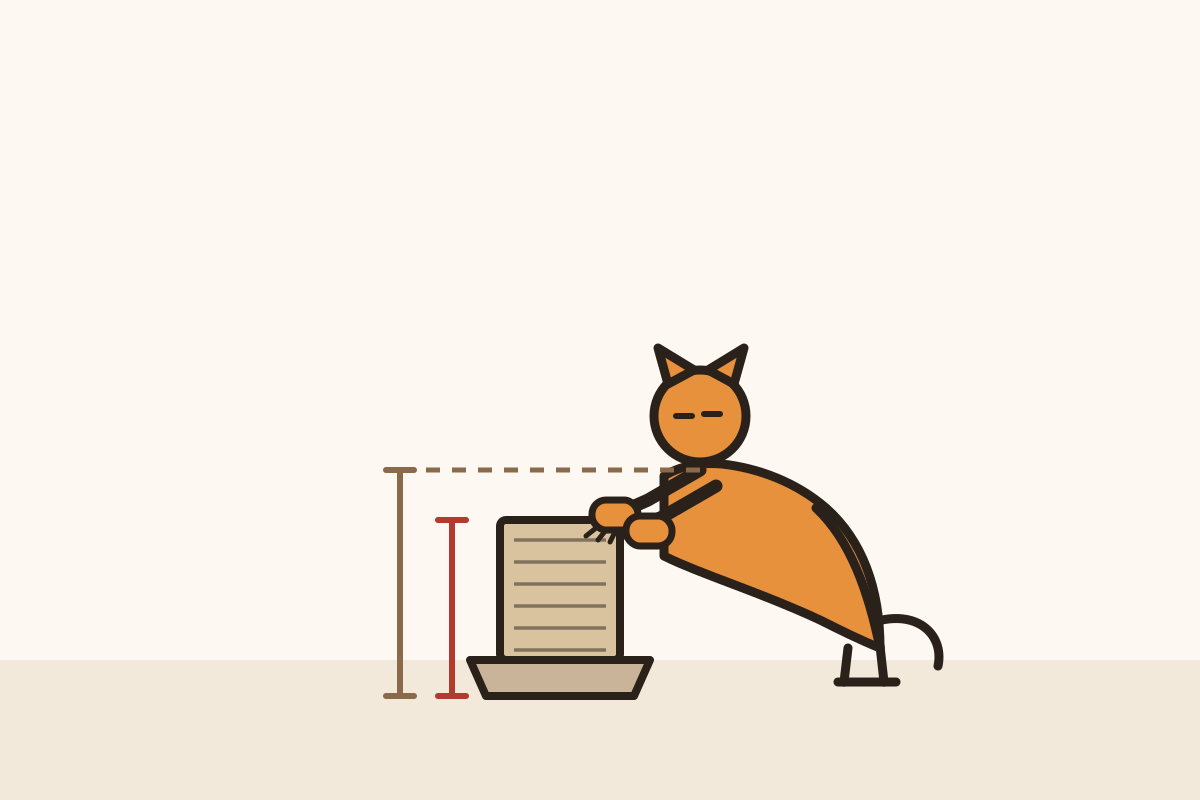
The post ran out before the cat did.
What the cats chose when someone offered a choice
Surveys tell you what people have in their houses. To find out what cats actually prefer, you need a test where the cat picks.
Zhang, Plummer and McGlone ran one with 40 kittens under eight weeks old, published in the same journal in 2019 (DOI 10.1177/1098612X18795258). Each kitten went into a simulated living room with two scratchers for twenty minutes, and the researchers filmed which one got scratched.
The results are unusually specific:
- An S-shaped cardboard scratcher beat a hemp post with a toy on top.
- The same cardboard beat a raised scratcher covered in window screen, and beat one covered in carpet. Window screen and carpet did not differ from each other.
- The window-screen scratcher set upright beat the identical scratcher laid flat on the floor.
- Long-fibre carpet was not significantly worse than the cardboard. Short-fibre carpet was.
- Cardboard beat bubble wrap.
- Dried catnip, catnip oil spray and hair from other cats changed nothing.
That third point is the one to keep. Set upright versus laid flat, same material, and the kittens preferred upright. That is one material, though: window screen. It does not prove orientation beats surface in general.
And the last point is worth sitting with, because it contradicts a large amount of product packaging. Catnip did not increase scratching in this study. Neither did the smell of other cats. The catch is the age: these were kittens under eight weeks, and the catnip response does not usually appear until three to six months, so the null tells you nothing about an adult cat that does respond. What it does establish is that other cats’ smell moves nothing.
The tension you should know about
The kitten study says upright beats flat. A 2022 survey of 2,465 owners in the US and Canada says something slightly different: reports of unwanted scratching were less common among owners who provided flat scratching surfaces, and also among those who provided sisal rope (Cisneros et al., Animals 12:2551).
Both can be true. The kitten study measured which scratcher a kitten chose in a room with two options. The survey measured whether an owner complained about damage. A flat scratcher on the floor is easy to add, cheap, and gets used; a tall post is better for the cat’s back but takes up floor space the owner may not have.
The practical reading: offer both, and do not expect one to cover the other. The same survey found 58% of owners reported problem scratching, so this is not a rare failure.
The base is the problem nobody mentions
A post tall enough to be useful is tall enough to fall over. This is where most tall posts fail, and it is why people buy short ones: a 90 cm post with a 30 cm base is a lever, and a cat launching itself at the top of it will find out.
What to look for is a base wide and heavy enough that you cannot tip the post with one hand at the top. If it moves, either the base is too small, or the post needs to be against a wall or screwed to one. A post that wobbles gets abandoned, and the cat goes back to the sofa.
This is also why cat trees tend to work better than a bare post. The survey found that on cat trees with two or more levels, cats scratched their preferred material more. A tree usually spreads its mass across a wider footprint than a single post, though some commercial models wobble just as badly.
What to do about the sofa
Scratching is not a behaviour you remove. It is maintenance — claws, shoulders, scent marking — and a cat that stops doing it has usually been given nowhere to do it, not cured. It can also be a cat in pain, and a cat that suddenly stops scratching is worth a vet visit before it is worth new furniture.
The 2022 survey found fewer reports of unwanted scratching among owners who rewarded the cat for using the right thing, put an attractant on the preferred item, and restricted access to the wrong one. All three are cheap and none of them are punishment.
The one people skip is restricting access. A sofa corner that has been scratched already smells right; a cat returns to it because it worked last time. Blocking it for a fortnight while the new post proves itself is the whole trick, and it is tedious rather than difficult.
Then put the post where the cat already scratches, not where it looks good. Cats scratch on waking and when they come in, so the end of the sofa, the doorway and the side of the bed are the three places a post earns its keep. A tall post in a spare room is a tall post nobody uses.
What to buy, briefly
Height first. Twice your cat, nose to tail base, and a base you cannot tip with one hand. If those two cannot both be had in one product, the post needs a wall.
Sisal rope over carpet. An old, stiff cat is the exception, as above. Not because carpet is cruel, but because rope was the substrate cats used most when it was on offer, and it lasts longer than the short-fibre carpet most posts are wrapped in.
A narrow column, around 8 to 9 cm, rather than a broad upholstered pillar.
Something upright and something flat. A cheap cardboard flat scratcher costs less than the catnip spray you were going to buy and does a different job.
No controlled trial has tested catnip as a scratching promoter in adult cats. The only one here used kittens too young to respond to it. Whether it makes an adult cat scratch more is simply unmeasured. Putting an attractant on something the cat already likes is a different matter, and that did come with fewer complaints in the 2022 survey.
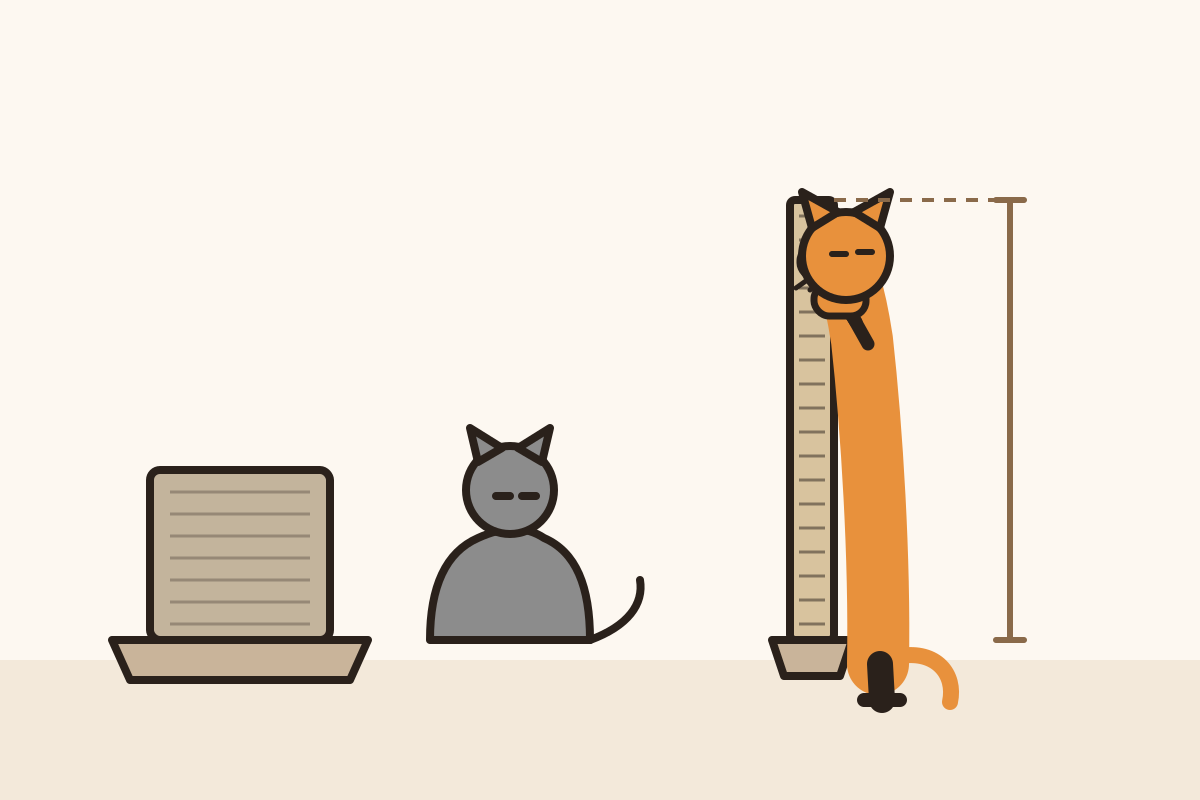
Two cats, two posts. The tall one is ninety centimetres high and eight wide; the short one is neither.
A two-week test
Put the tall post where the damage already is. Put a flat scratcher on the floor beside it. Move the cat’s paws down the post once, gently, so the claws catch, and then leave. Do not hold the cat against the post — a cat that is being pressed into something learns to avoid it.
Watch which one gets used and at what time of day. If neither gets used after two weeks, the post is in the wrong place, not the wrong material. If one gets used and the other does not, you have learned something about your cat that no review could tell you, and you can buy the second one accordingly.
And if your cat is fifteen and has decided the carpeted post is the good one, let it. The survey found exactly that preference in that age group, and the point of the post is that the sofa survives.
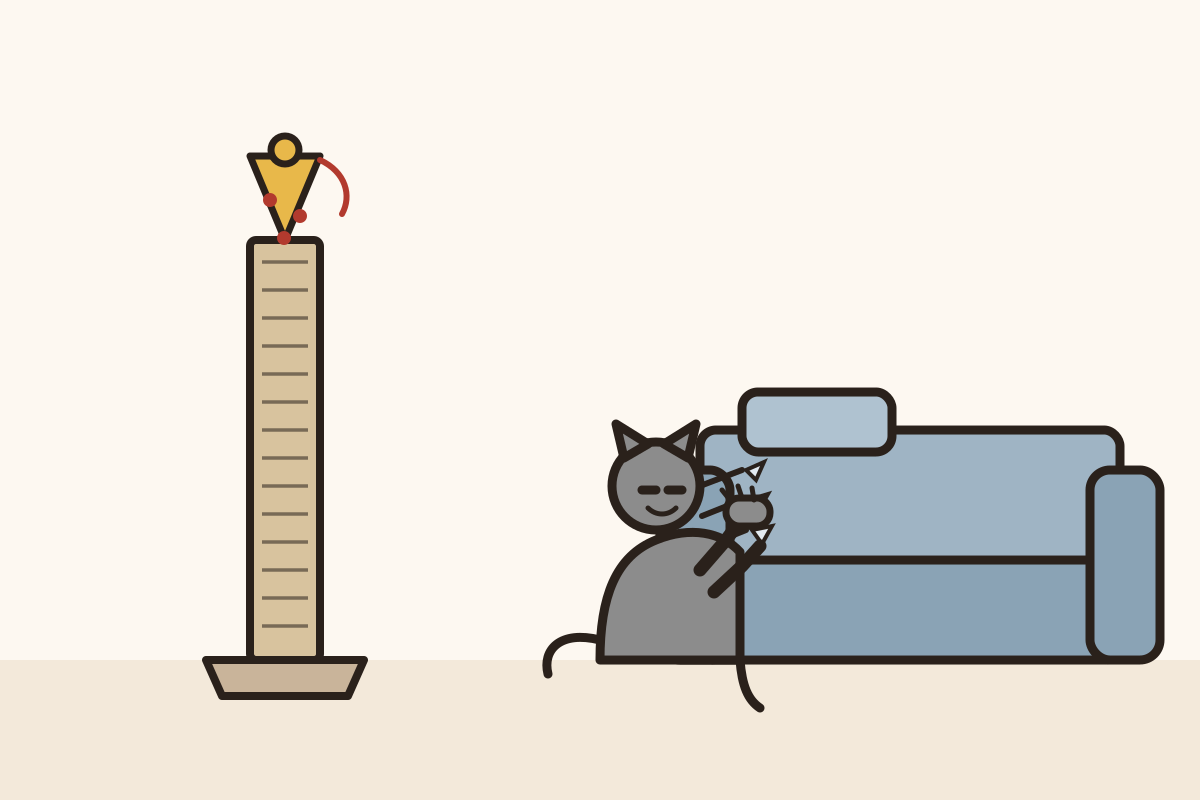
The hat was ready. The cat was not.