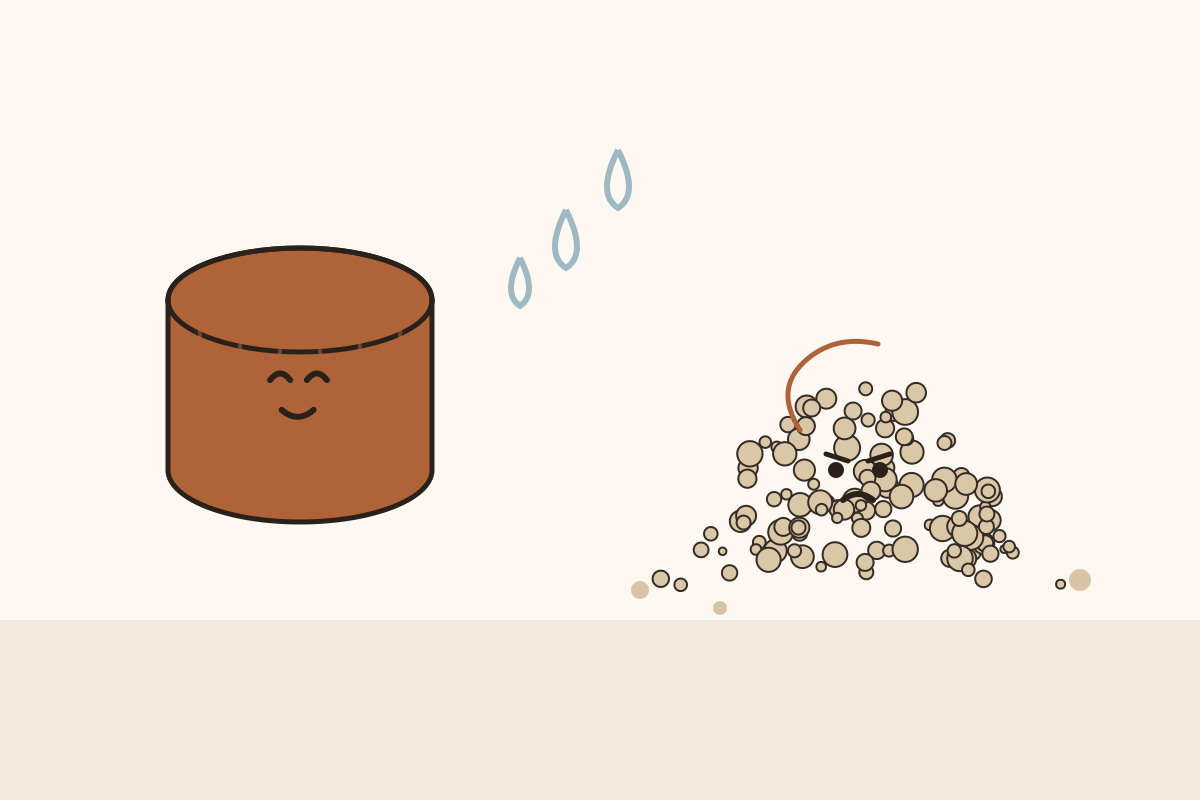
You have a bag of pine pellets in the hallway. It will not clump, and no better bag fixes that, because the reason sits in how the pellet is made.
Clumping clay lets you lift the urine out and keep going. Pellets send the urine down, the pellet at the bottom gives up, and what comes up on the scoop is the start of a compost heap.
Pellets are still worth buying. Know this before the bag is open.
Why a pine pellet cannot clump
A pellet is sawdust that has been squeezed. Wood flour goes into a die under heat and enormous pressure and comes out as a hard little cylinder about six millimeters across, a quarter inch.
The thing holding it together is lignin, the natural polymer that stiffens wood in the first place. Heat and enormous pressure make it flow between the wood particles, and where it flows it bonds them. No additive is needed to make that bond.
Then water arrives, which is not part of the pellet’s plan. Lignin needs heat to soften, so urine at body heat cannot re-soften it or make the pellet sticky. The water gets between the compressed fibers and swells them. The pellet loses its shape and falls apart into the sawdust it started as.
Sodium bentonite is a clay that swells when wet and gels into a lump you can lift. Wood-based clumping litters skip the clay and use a plant gum to do the same job. Both depend on a binder that responds to water. A pine pellet’s binder responds to heat.
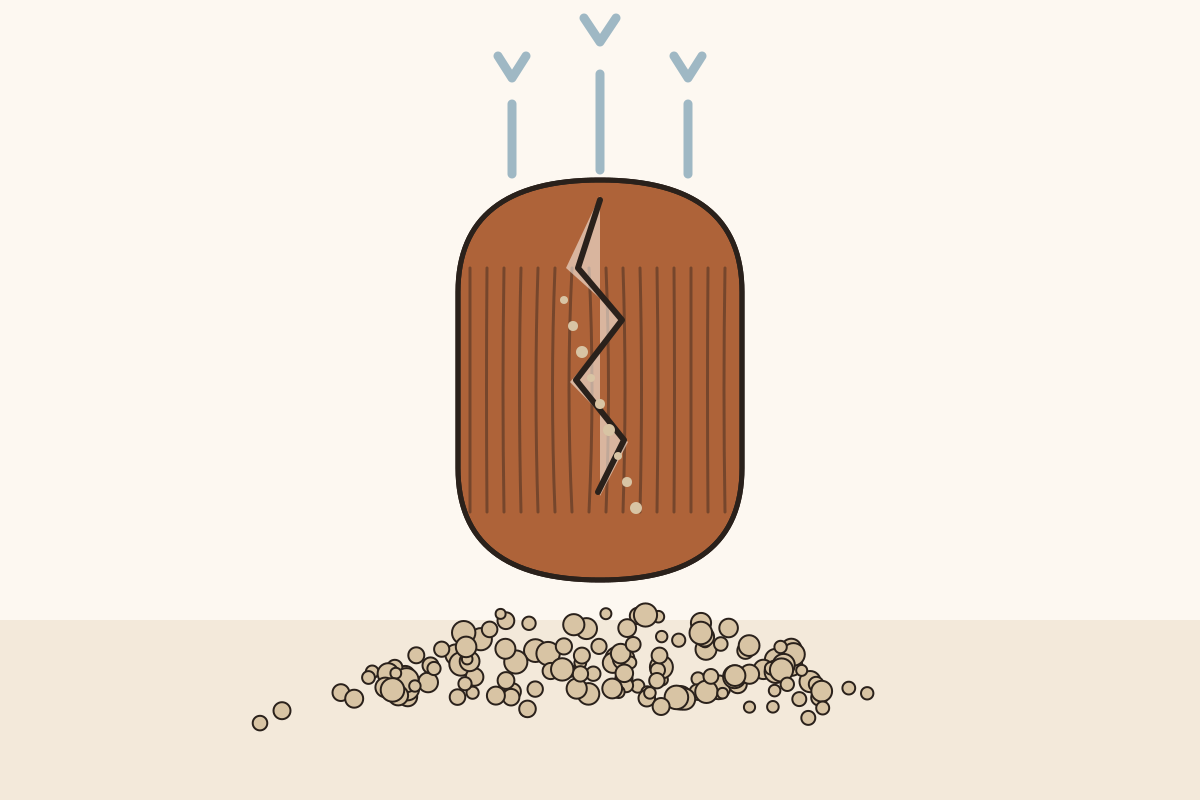
Water gets into the gaps between fibers. Nothing glues them back together, so the pellet does not grip. It resigns.
Where the urine actually goes
Pellets are big. A six-millimeter hard cylinder cannot pack tight, so real gaps open between neighbors and liquid takes the easiest path through them. Down is the way it goes.
The pellets it meets first are the ones that give up first, so the surface goes patchy instead of staying neat. Underneath, the liquid keeps moving down through the gaps, and the dust it leaves behind settles into a band that thickens day by day.
The water consumes the pellet. What is left sitting down there is the liquid, wearing sawdust as a disguise.
This is why the box smells fine on Monday and wrong on Thursday. The surface you are looking at is not where the problem is.
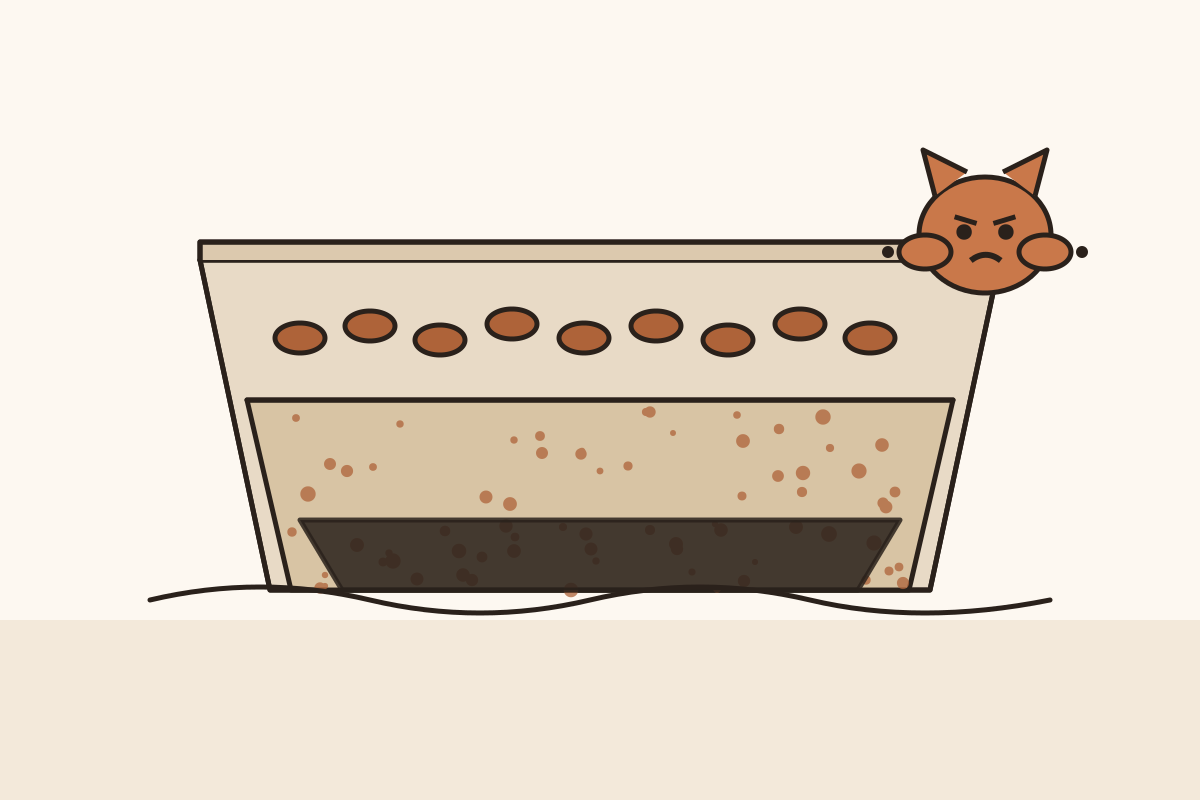
Three layers, one of them doing all the work. The cat in the corner is supervising none of it.
Your scoop stops being the tool
Go through your normal routine on a pellet box and something is missing. There is nothing to scoop except the solids.
Solids come out daily, same as before. No change there, and no excuse to skip it.
The sawdust gets sifted. A sifting litter box has a slotted tray that lifts out; you shake it and the sawdust drops into the tray below while the intact pellets stay on top. Some people run two plain trays nested and lift the top one. Either way, the tool is a sieve, and it is the only new thing you need.
The whole box gets changed when the sawdust wins. No study gives you a number here, so treat any confident figure as somebody’s habit — including the depth recommendation a few paragraphs down. The practical signal is the sawdust line: once it has climbed to roughly a third of the depth, the box holds mostly spent material and stirring will not save it.
Box size and cleaning interval are one dial between them, and the article on how often to clean a litter box is about turning it.
Depth does a different job with pellets
With clumping clay, depth is mostly about giving the cat something to dig in. With pellets it is also about the path the liquid takes. Too thin a bed and the urine reaches the plastic in one shot, sits there, and the smell has nowhere to go but up.
Start around five centimeters, about two inches, and adjust to what you find when you sift. Five centimeters of pellets is not five centimeters of clay: the same depth holds less material and binds less, so the number is a starting line rather than a target. If the bottom tray comes up soaked rather than dusty after a couple of days, your bed was too thin. The depth article sets out why the figure is not the same for both substrates, and why two weeks of watching beats any number on a blog.
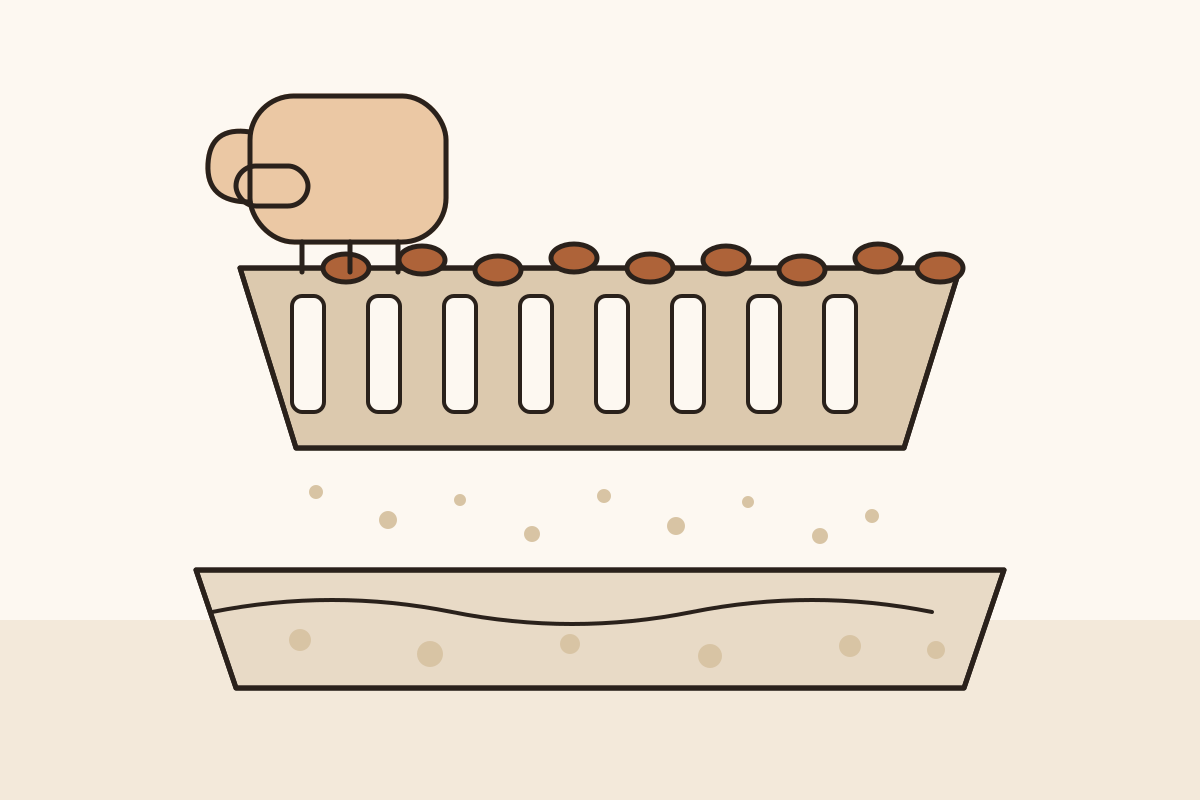
The sawdust falls through. The pellets get a second week.
Reading the bag before you buy it
Cheapness is decided by what is in the bag and what is on the label.
One hundred percent wood. Some fuel pellets are blends, cut with agricultural residue or other biomass to hit a price. Fine in a burner, and not what you want under a cat.
No additives, no accelerants, no fragrance. A pellet advertised as lighting faster has been adjusted to light faster, whether through dryness, size or wood mix. Scented pellets add a smell to cover a smell.
Kiln-dried, if the bag says so. Drying before pressing controls moisture, which is basic to making a pellet at all, so the claim mostly tells you the mill watched that step. It says nothing about whether the wood is safe, and nothing about how the pellet behaves once it is wet.
Pine contains aromatic compounds, and there is a long-running worry that pine shavings are bad for small animals. I could not find a study that measures what pine pellets do to cats in a litter box. The concerns I did find are about shavings and industrial contamination — not about kiln-dried pellets. That is not proof either way. If your cat has asthma or another respiratory condition, ask your vet before you switch, and watch the dust first.
The cat has read the bag. The cat has doubts.
Where pellets are genuinely better
Dust and tracking. Pellets do not stick to paws the way fine clay does, and they do not billow when poured. If you have been finding gray footprints on the bed, that is the reason.
Weight and stairs. A bag of pellets weighs less than the same volume of clumping clay, because a pellet is mostly fiber and air where clay is mineral. The material runs around 600 to 750 kilograms per cubic meter, roughly 37 to 47 pounds per cubic foot. Get a bag wet and it is ruined, but it fails into sawdust, not mud.
Cost per week, sometimes. The bag is cheap. Whether the week is cheap depends on how fast the box fills with sawdust, which depends on the cat. One cat and a big box can make pellets the cheapest thing on the shelf. Three cats and a small box will eat the difference.
A cat who already uses them. The best reason on the list. Some cats genuinely do not care, and if yours is one of them, do not fix what is working. That cat has made his position clear and it happens to agree with yours.
Who should not switch
If your cat has been urinating outside the box, stop. Changing substrate is a stressor, and a cat with a urinary problem needs a vet and a stable box, in that order. Pine Pellets vs Clumping Clay sets out what changing the substrate does and does not fix, and it is worth reading before you touch the box.
If you cannot sift every day or two, pellets will punish you faster than clay. Clay forgives a missed scoop for a while. A pellet box that is not sifted becomes a wet sawdust floor, and cats are honest about what they think of a wet sawdust floor.
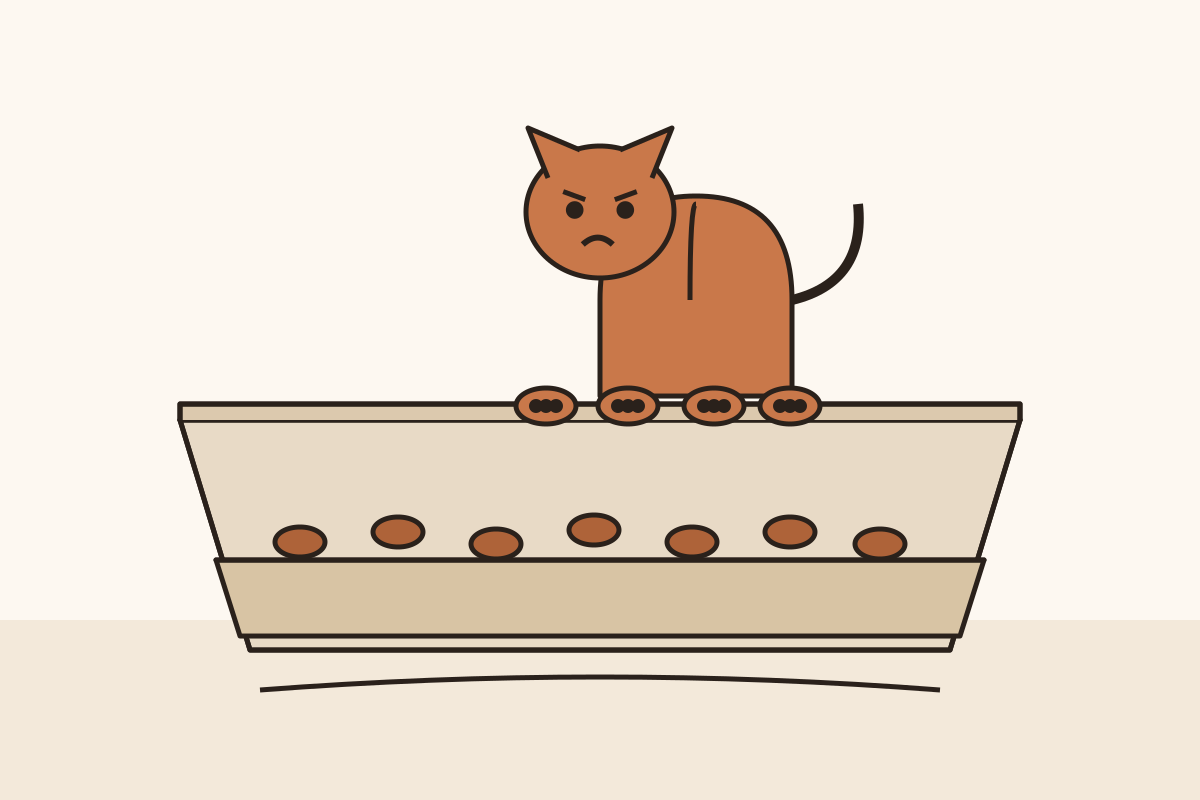
Four paws on the rim. One star.
What to buy, and what actually matters
A sifting litter box. Nothing else here works without it. Get one where the slotted tray sits above a solid tray with clearance for a few days of sawdust.
Plain kiln-dried pine pellets, sold as fuel or as bedding. Read the bag for the three things above. The pet-store version costs more for a smaller bag of the same material.
A second box. With no urine clump to remove, a spare box lets you swap and wash instead of racing the sawdust. Two boxes also give the cat a choice, which is the cheapest behavior insurance there is.
Not a covered box, at first. A pellet bed drains the liquid to the bottom, so the wet layer sits under a loose dry surface and the humidity collects down there. A lid holds that humidity in. If a dog makes the lid necessary, add it once the routine works.
How to tell it is going wrong
The smell arrives before the mess does. A pellet box that smells of ammonia three days after a full change is not holding the liquid it gets. The bed is too thin, the box is too small, or the cat is passing more urine than usual. That last one is a vet question.
The other signal is the bottom tray. Dust is what you want down there. A puddle is a message.
Sift, change, keep a spare
Sift the sawdust through every day or two. Change the whole box when it reaches about a third of the depth. Keep a second box so wash day is not a crisis.
None of them is difficult. The hard part is doing them before the sawdust tells you to.
Sources
-
Lignin as what binds a wood pellet, and heat as what starts it: A study of bonding and failure mechanisms in fuel pellets from different biomass resources, Biomass and Bioenergy 35(2) 910–918, 2011 (Stelte et al.). Pellets of beech, spruce and straw, no additive listed. Pressed at 100 °C (212 °F), beech came out strongest and its fracture surfaces showed cohesive failure, which the authors attribute to lignin flowing and inter-diffusing between adjacent wood particles — absent in spruce and straw. The paper treats moisture as an input near 10 percent, not as something that later hits a finished pellet, and it does not test cat litter.
-
Water destroying pellets rather than setting them: The Impact of Rain Exposure During Loading of Wood Pellets for Ocean Shipment, Transactions of the ASABE 64, 2021 (Lee, Sokhansanj, Lau, Lim). Measured as durability loss after rain exposure, which is the closest published equivalent to a wet litter box.
-
Plant gum as the clumping agent in some biodegradable cat litters: Evaluation of alternatives to guar gum as tackifiers for hydromulch and as clumping agents for biodegradable cat litter, Industrial Crops and Products 43:798–801, 2013 (Vaughn et al.). Guar gum is the benchmark the alternatives are measured against. The paper does not call the litter wood-based; that step is mine.
-
Pellet diameter: ISO 17225-2:2021 puts solid fuel pellets in 6 mm or 8 mm classes with a tolerance, which is where the six-millimeter figure comes from. Cited as the standard’s classification.
-
On respiratory risk: I found no study measuring pine pellet litter against respiratory outcomes in cats. The work that exists is about shavings and about human occupational exposure, which is not the same question.