A cat that starts urinating over the rim of its box, or standing with its rear end outside it, is often telling you the box is too small. That is one possibility among several, and not the one to check first. A cat that has suddenly turned against a box it used to accept may have a urinary or kidney problem, and more floor space will not touch those. Ask a veterinarian to rule out a medical cause before you go shopping.
If the cat has been cleared, or has always been particular about where it eliminates, size is worth a look. There is a rule that a litter box should be about one and a half times the length of your cat, and it has been in feline veterinary guidelines for years. The study below tested that heuristic against a body measurement that does not shift with posture. The paper is free to read. The number it lands on is smaller than the rule implies, and past a certain width the extra centimeters stop buying anything.
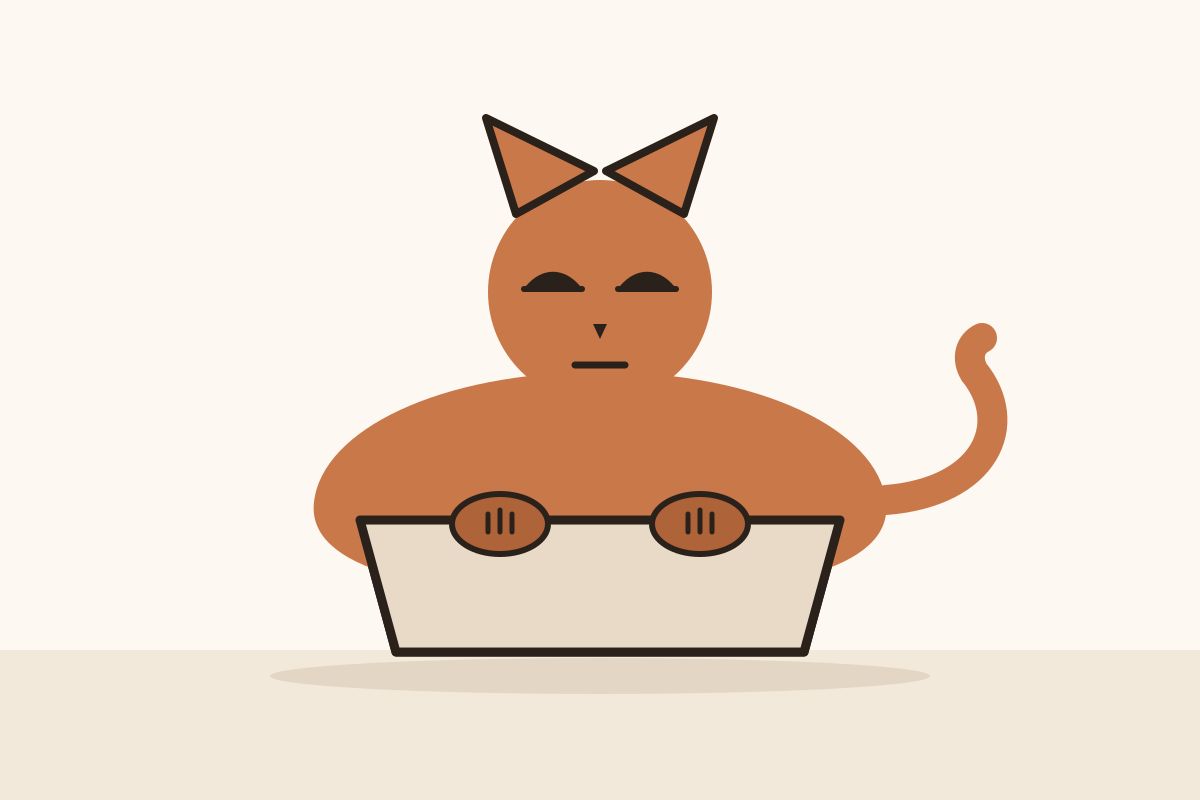
Everything in this picture is within spec except the tray.
The rule, and how the study handled it
The one-and-a-half figure is not new. The paper cites two earlier guidelines that state it, one as 1.5 times the length from the base of the tail and one as at least 1.5 times the body length. What the authors added was a way to apply it that does not depend on how a cat happens to be standing.
They measured the thoracic and lumbar spine in 102 cats, 78 living in cat cafés and 24 that had visited a veterinary center in Tokyo. A veterinarian palpated the vertebrae and ran a tape measure along the back while each cat stood upright. The average came out at 35.3 centimeters.
The spine was chosen over nose-to-tail length because it varies less between cats and is not stretched or compressed by posture. One and a half times 35.3 is 52.95, and the researchers used 50 centimeters as their reference size, which they describe as approximately 1.5 times the average. Fifty divided by 35.3 is 1.42, so the reference box sits slightly under the ratio rather than at it.
The rule therefore holds up, but it is measured on a different body part from the one people usually picture. One and a half times the spine, from behind the shoulder blades to the hips, gives a smaller number than one and a half times the cat from nose to tail base. For an average cat the answer lands close to 50 centimeters, which is roughly 20 inches.
Three boxes in a cat café
Seventy-eight adult cats in three rooms at three cat cafés, holding 50, 17 and 11 cats. Testing happened outside business hours so that customers were not in the way, and each room ran for three days.
Three uncovered cardboard boxes, all 20 centimeters high and 35 centimeters deep, with widths of 40, 50 and 60 centimeters. All held the same cylindrical clumping clay litter at a depth of five centimeters. The boxes stood in the middle of the room and the researchers rotated their positions daily, so that no box sat in a favored corner and collected visits by location alone.
Each facility also kept its own box, with its own litter, exactly where it normally stood. Switching a cat’s litter abruptly is stressful in itself, and the researchers did not want a stress response leaking into the size comparison.
Then they counted. A camera ran for three days and every elimination was tallied by which box it happened in.
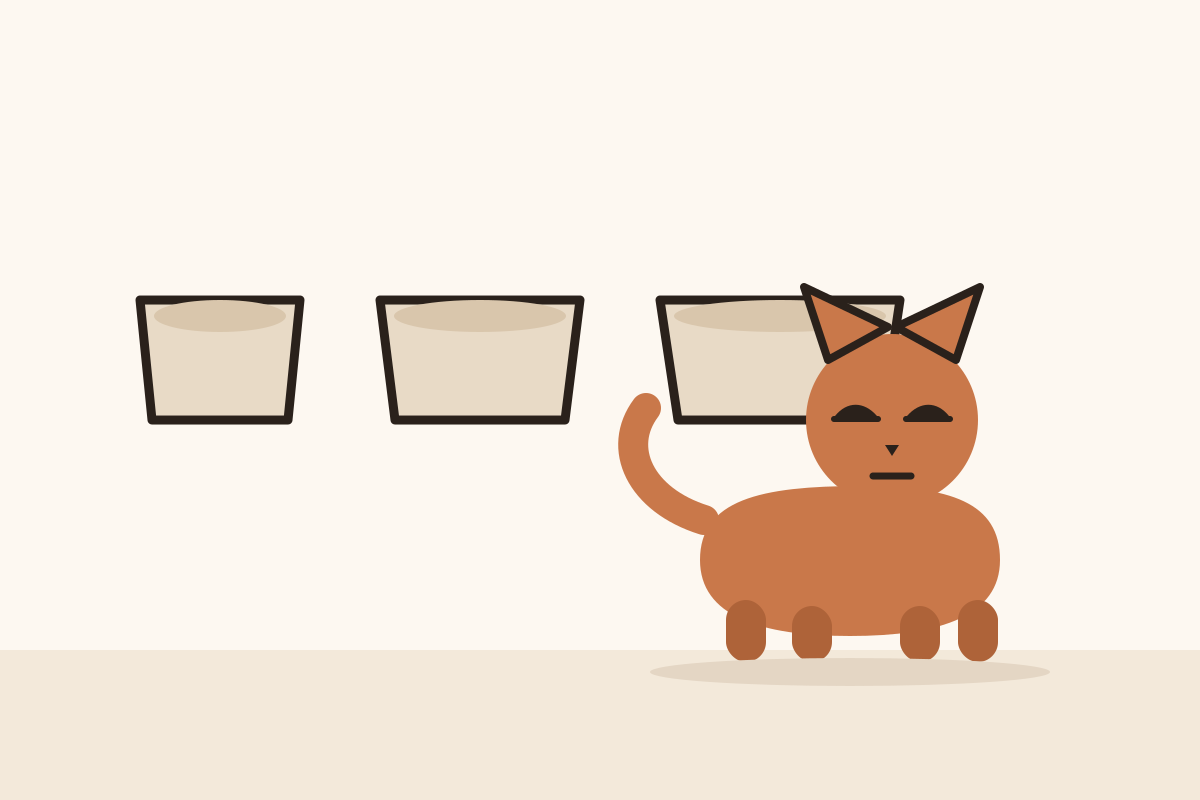
Forty, fifty, sixty centimeters. The paper notes that boxes sold in shops run smaller than what cats actually pick.
Why the area adjustment matters
A bigger box takes up more floor, so a cat choosing at random would use it more often. A study that skipped this step would report that cats prefer large boxes whether or not size had anything to do with it.
These authors adjusted for it. They calculated each box’s share of the total floor area, multiplied by the total number of eliminations, and compared that expected count against what happened. What survives the correction is a preference that is not simply proportional to floor area.
Across all three rooms, the boxes recorded 39 eliminations for the 40 centimeter box, 82 for the 50 and 83 for the 60. As shares of all eliminations, including the facility’s own box, that is 16.9 percent, 35.5 and 35.9. Fisher’s exact test put the overall deviation at P < 0.0001.
The expected shares are the part worth putting next to them. Counting the facility’s own box in the total area, each box’s floor area entitled it to 19.0 percent of the eliminations if it were 40 centimeters, 23.8 if it were 50, and 28.6 if it were 60. The facility boxes came out near 28 percent too, since one of them had the same floor area as the 60 centimeter box.
Set expected against measured and the pattern is blunt. The 50 centimeter box took half again more traffic than its floor entitled it to, 35.5 against 23.8. The 40 took slightly less than its share, 16.9 against 19.0. The 60 took a little more, 35.9 against 28.6.
The sharpest comparison is the pair at the end. The 60 centimeter cardboard box and one of the two described facility boxes both had 2100 square centimeters of floor. The cardboard took 83 eliminations. The facility boxes, pooled across three rooms and left in place rather than rotated, took 27 between them, which is 11.7 percent against roughly the 28 percent their area predicted.
Why 60 centimeters did not beat 50
Among the three test boxes alone, floor area would predict about 27 percent of eliminations for the 40 centimeter box, 33 for the 50 and 40 for the 60. The cats produced 19, 40 and 41 percent of them.
So the 40 centimeter box underperformed what its area earned, the 50 overperformed by a comfortable margin, and the 60 landed within a point of its area share. Extra width past 50 centimeters did not buy extra use.
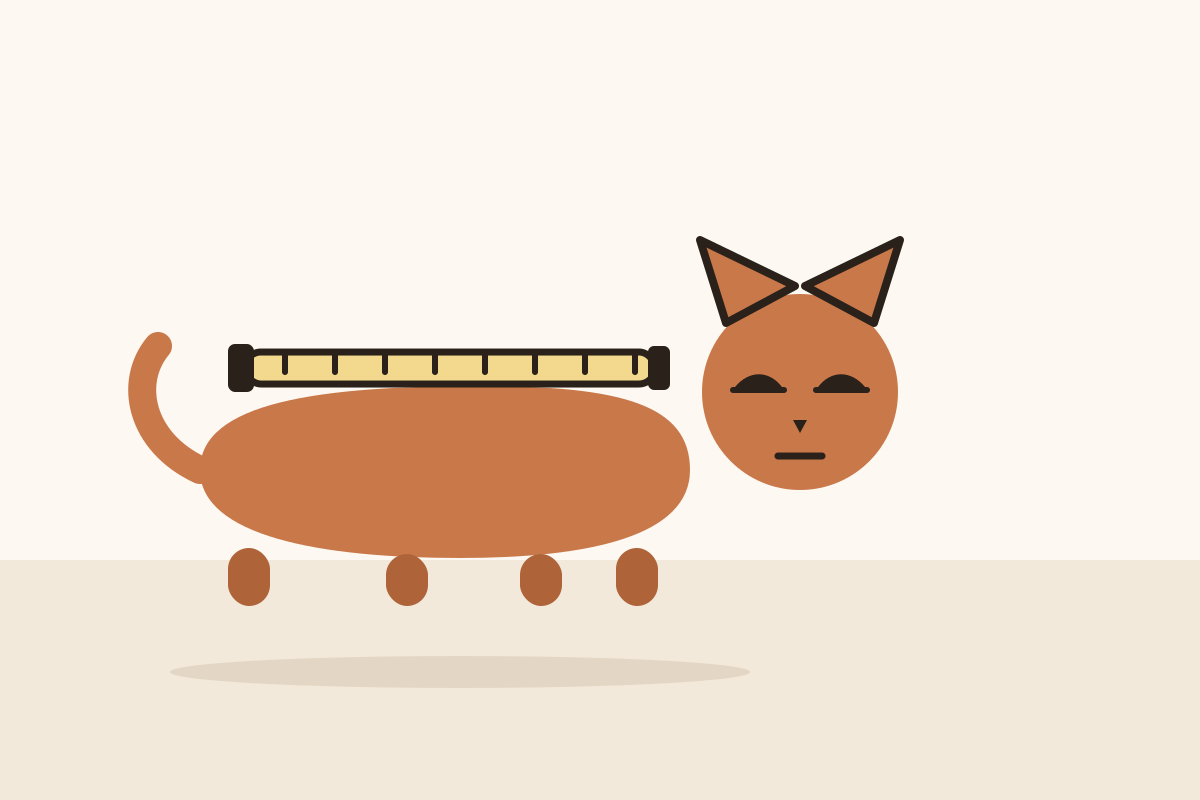
The measurement that matters runs from the shoulder blades to the hips, which is shorter than the cat and always will be.
One reading of that gap is novelty: the three cardboard boxes were new, the facility’s box was not, so perhaps cats simply like new things. The authors propose a different explanation. The two facilities whose boxes the methods describe were both using a litter that did not harden, one a cylindrical wood pellet and one a pebble clay, and the authors write that they think this difference in litter could have affected preference. Their own second experiment is worth mentioning here with a caveat: it found clumping clay beat clumping wood and clumping paper, so it points the same direction, but the non-clumping litters these facilities used were never among the products tested.
Novelty does not survive the dimensions. The two facility boxes measured 40 by 52.5 and 40.5 by 50.5 centimeters. Large in area, and only about 40 centimeters across the axis that the experiment varied, which puts them in the same category as the test box the cats mostly avoided. Same floor space as the winner, same narrow dimension as the loser, and it performed like the loser. What that argues about is which dimension carries the weight, not how much floor there is, and it is consistent with these numbers rather than proved by them.
Among the three test boxes novelty cancels out entirely. All were unfamiliar cardboard, all the same depth and height, laid out together and rotated daily, so novelty was held equal and only width varied. That comparison is where the 40-to-50 step lives.
One statistical caveat belongs with it. The Fisher tests treat 231 eliminations from 78 cats in three rooms as independent observations, which they are not, so the exact significance levels are optimistic. The ordering of the three boxes, 40 well behind 50 with 60 level, does not depend on that.
Urine and stool did not agree
The size effect came almost entirely from urination. The overall bias was significant at P < 0.0001, and urination on its own at P < 0.01. Defecation showed no significant deviation.
The counts explain why. The four boxes together recorded 40 defecations against 191 urinations, and only 33 of those defecations fell in the three test boxes, the other 7 landing in the facility’s own. That is not evidence that cats are indifferent to size when they defecate. Forty events across four boxes gives a test very little to work with, and the direction ran the same way as the urine counts: 2 for the 40 centimeter box, 14 for the 50, 17 for the 60.
The paper offers a general reason cats want room, which is turning space: a cat turns its torso after eliminating and prefers to see out while it does. That rationale applies to both urination and defecation, so it does not explain why only the urine counts moved. The authors do offer one, though they write it while discussing the home trial rather than this one. They held everything except box size constant on purpose, and they suggest that the conditions they held constant may matter more for defecation than for urination, which would account for the stool counts not moving. For the three-box experiment specifically, there is no separate explanation. The thin total, 40 events across four boxes, is a second reason a difference would have been hard to see either way.
The litter result was larger, and less clean
The same team ran a second experiment with 46 cats in four rooms across three cafés, holding the box constant at 20 by 57.5 by 38 centimeters and varying only the contents. Three clumping litters, all filled to five centimeters: clay, wood, and paper.
The counts were not close. Clay took 258 eliminations, wood 152, and paper 66, with each pairing significantly different on a Steel-Dwass comparison at P < 0.05. Clay also carried the most defecation, 71 events against 48 for wood and 9 for paper.
Two things belong next to that number. The wood litter was a product the paper describes as not available commercially, so the material that placed second is not something you can go buy. And all three litters, plus the box used in the later experiment, are made by Lion Pet. The paper discloses this plainly in a single line: “Yumi Iwabuchi-Inoue is an employee of Lion Pet Co., Ltd.” The other two authors are at the Tokyo Feline Medical Center and Azabu University.
The ethics approval for the work came from Lion Pet’s own committee as well, numbers 2018-02 and 2020-03. A company’s clay beating the same company’s wood and paper is a real result about those three products. It is a smaller claim than clay beating the category, and the disclosure is the reason you can weigh it yourself.
What happened in actual homes
A third experiment moved out of the cafés. Twenty adult cats in ordinary households, all with an elimination problem, screened by a veterinarian through history, urinalysis, X-rays and ultrasound. Cats with a disease closely tied to elimination problems and an unclear cause were excluded. Cats whose illnesses were unrelated stayed on their regular treatment and took part anyway.
The cats were small by design. Entry required a spine of 34 centimeters or less, or a body weight of 4.5 kilograms or lower at a body condition score of 3. The box they were given, 57.5 by 38 centimeters, was therefore well over one and a half times their spine length, around 1.7 times for a cat with a 34 centimeter spine.
Each household received that box filled with the winning clay litter to five centimeters, with the same number of boxes in the same positions as before, so the only change was box and litter. The homes were divided between two orders over four weeks: some used their old setup for two weeks and then the new one, some did the reverse.
Owners logged urination and defecation inside and outside the box, plus four categories of unhappy behavior, scoring each on a five-point scale of 0, 20, 50, 75 or 100 percent.
Urination inside the box rose significantly (P < 0.0001, Wilcoxon signed-rank). Urination outside, defecation outside, and three of the unhappy-behavior categories, labeled A, B1 and B2, all fell at P < 0.005 or better.
They logged four behaviours that signal dissatisfaction: paws on the rim while going, scratching the air, scratching the rim or the floor, and skipping the dig-and-cover routine. The first one is where the change lives, with its upper quartile moving from 4 on the old setup to 0 on the new one, which is a change in the spread rather than a median that had nowhere to go. Two of the other categories sat at zero in every quartile in both conditions, so their p-values rest on a handful of households rather than on a group-wide improvement. Owners were not blinded, since they knew which box was which, and they scored the behavior themselves. Twenty cats is a small group to carry that.
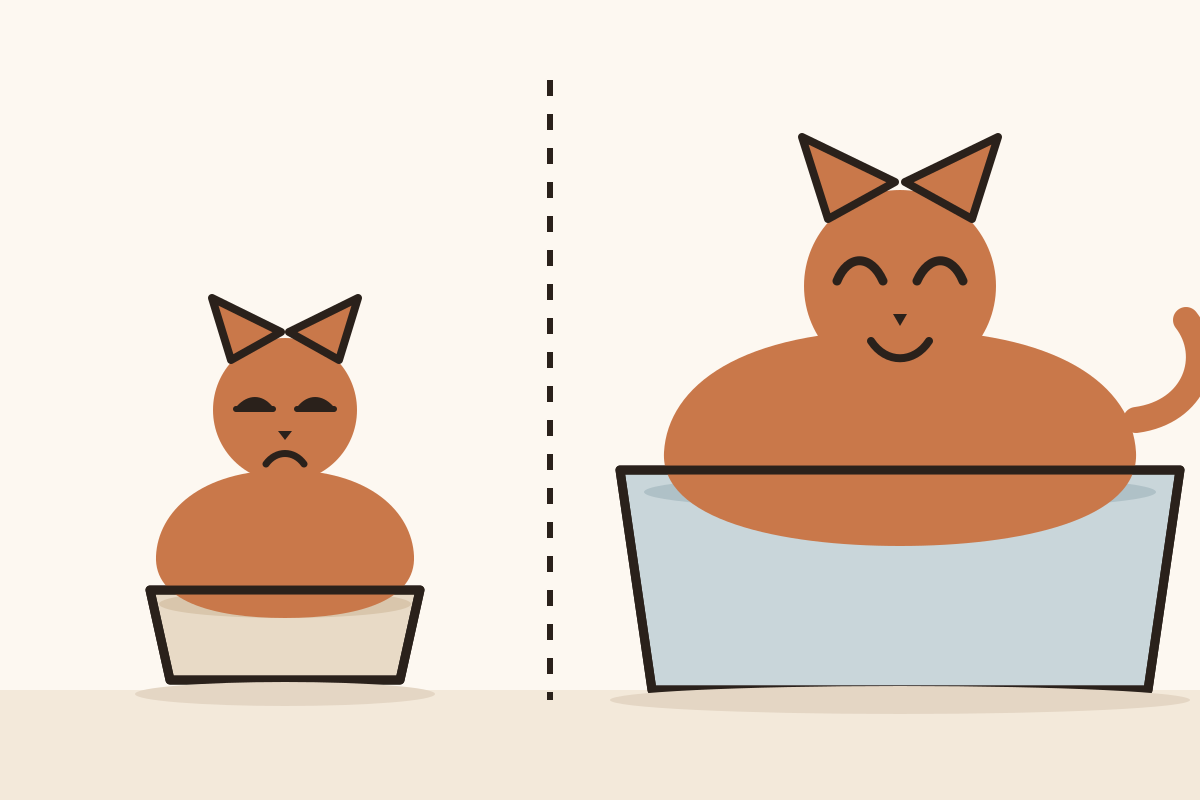
Two trays, two cats. In the home trial the litter changed as well, so the box is not the whole story.
What the authors decline to claim
The discussion is explicit about boundaries. The authors note that an earlier covered-versus-uncovered trial, which found no preference, used a box 82.5 centimeters long, and say directly that whether its result transfers to the 57.5 centimeter box in their own study needs further confirmation.
They also repeat, without testing it, the familiar recommendation to place one more box than you have cats. That advice comes from prior sources, not from this data, and the paper puts no number on the effect.
Sizing a box for the cat you have
The study varied one dimension, width, and held depth at 35 centimeters. A box in the proportions they tested is 50 centimeters across and 35 deep, and that pair is the target to look for.
If you want to work it out for an unusually large or small cat, measure from behind the shoulder blades to the hips and multiply by one and a half. A cat with a 36 centimeter spine wants about 54 centimeters. Forty was the smallest box tested and it was under-used relative to its floor area; anything between 40 and 50 went untested, so 50 is the only figure here with evidence behind it.
Compare interior dimensions, not the exterior footprint. Hoods and raised rims add outside inches without adding floor a cat can stand on.
What to buy instead
A plastic storage tub with a doorway cut into one side is the cheap route to 50 centimeters, and it is close to what the researchers themselves used. Their test boxes were plain cardboard, not pet products.
A purpose-built box works if the interior measures at least 50 centimeters one way and 35 the other, with a low entry. Anything walled high on all four sides makes the cat clear an obstacle every time, which is a separate question from floor space and one this study did not test.
The litter deserves as much attention as the box. Clumping clay beat wood and paper by a wide margin in that second experiment, with the caveat about who makes them already noted, and if your cat has been refusing the box since you switched to something more absorbent, the switch is a reasonable first suspect.
One more thing to change
Box size is one variable in a system. Litter depth, how often the box is scooped, where it sits, and whether it has a lid all interact, and the café experiments held most of those fixed precisely so that one thing could be isolated.
The size comparison is the better-controlled of the paper’s experiments, since the only thing that changed between boxes was width and the litter result carries a brand question. Start there because it is also the cheapest thing to replace. If a 50 centimeter box and a clumping clay litter have changed nothing, the problem is elsewhere, and the next thing to look at is how often the box is cleaned.