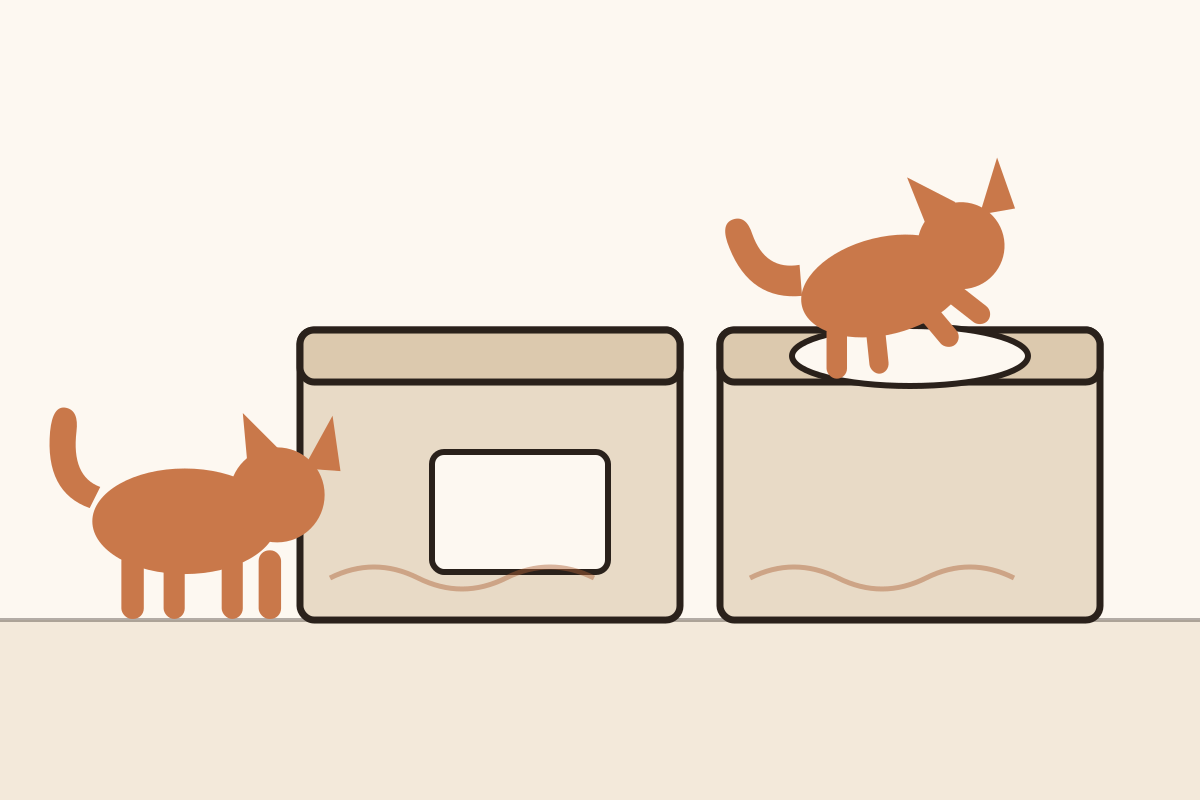
One box has a hole in the front wall. The other has a hole in the lid. Everything people argue about online follows from that.
I want to be careful about what I can and cannot tell you here. I could not find a single study that compared top-entry boxes to front-entry boxes. Not one that measured which cats used them, which refused, or what happened to the floor around them. So the comparison below is built from the measurements that do exist — how big a box cats actually choose, and what the veterinary guidelines say about getting in and out — plus the arithmetic of the boxes themselves. Where I am guessing, I will say so.
The case for a lid
Three things it actually does:
Litter is meant to stay in. A cat leaving a front-entry box carries granules on its paws across the lip and onto the floor. Coming out of a top hole, the cat has to jump, and some of what was stuck to its feet falls back into the box or lands on the lid. This is the whole reason the design sells. Whether the lid catches what the paws shed is something owners report rather than something anyone has measured, and I could not find a study that did.
Dogs stay out. A lid with a hole in it is a much better dog barrier than a hole at nose height, and no, I have not measured that one either. If you have a Labrador with an interest in cat waste, this alone can decide it.
The walls can be tall. A top-entry box is tall on all four sides without a door-sized gap, which matters for a cat that stands up to pee.
Now the cost. It is one thing, and it is not small: the cat has to jump in, and jump out, every single time, for the rest of its life. A cat uses a litter box three to five times a day — a figure everyone repeats and nobody seems to have measured. Two jumps per visit puts that between roughly 2,200 and 3,600 jumps a year, onto a surface that is by definition loose and shifting.
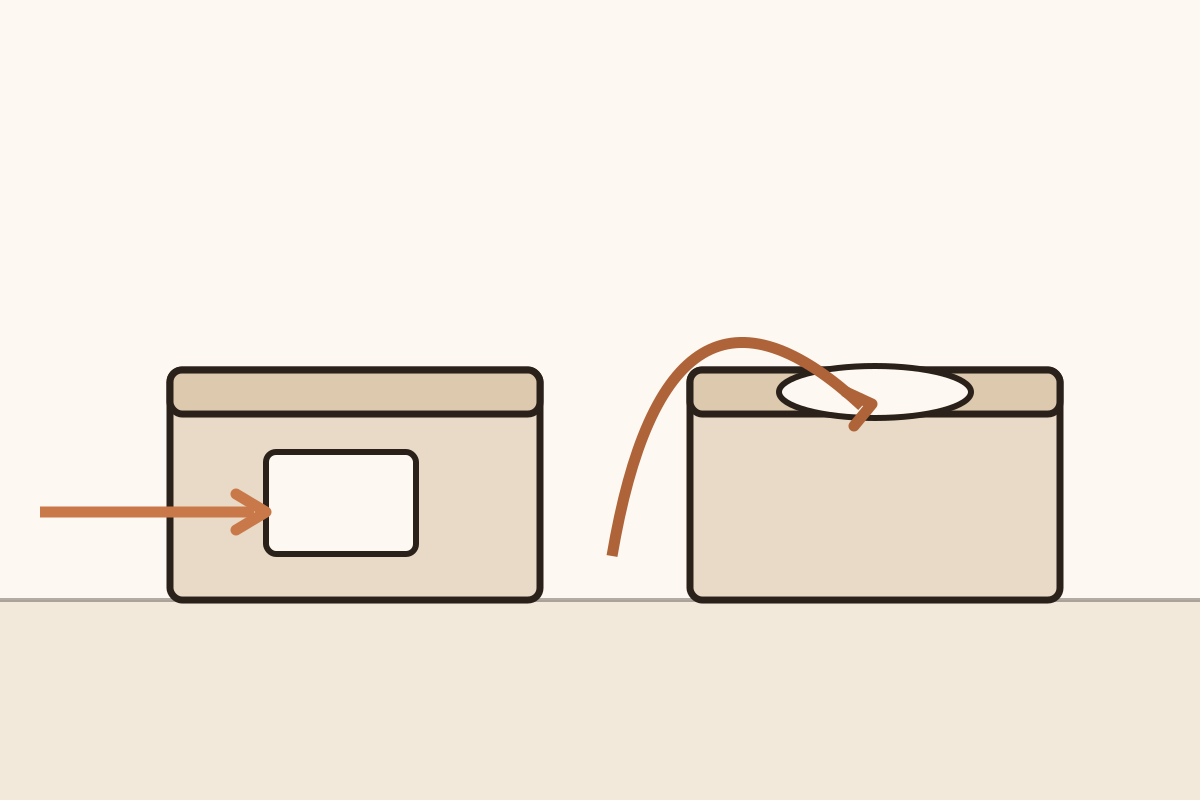
Same destination, two different journeys. One of these is a walk and the other is a jump with a landing.
The guidelines say one thing about the opening
The AAFP and ISFM house-soiling guidelines are the closest thing this topic has to an authority, and they spend pages on size, number, placement and cleaning. On the opening itself they give a single sentence:
“Regardless of design, the litter box opening should allow easy access.”
That is the whole rule. It is also the only rule you need, provided you are honest about what “easy” means for your particular cat. The same guidelines are blunt about who struggles: arthritis, muscle weakness and impaired vision all make it harder for older cats to reach a box, and the fix they recommend is putting boxes in more easily reached places, with night lights for the ones that cannot see well.
Note what that implies about a lid. Moving a box downstairs is a solvable problem. A hole ten inches off the ground is not a problem a cat with sore hips can solve.
Who this is genuinely fine for
A healthy adult cat between one and about eight years old, with normal sight, normal hips, and a body that fits through the opening with room to spare. For that cat, top-entry works, the litter stays in, and the jump is nothing — a cat that age clears a kitchen counter without thinking about it.
Kittens are a maybe. A confident eight-week-old will usually manage a jump onto a low lid, but a top-entry box with a swinging flap is another thing entirely: some kittens push through it, and some decide the whole thing is a trap and pick a corner instead.
Who it is not fine for
Cats with arthritis or hip problems. This is the big one, and it is not rare — the guidelines list arthritis among the conditions that make cats pee outside the box. A cat in pain does not reason its way through a jump. It looks for somewhere easier, and “easier” is usually a rug.
Senior cats. Same mechanism, plus weaker hind legs and worse eyesight. A cat that has used a top-entry box for six years can stop being able to, all at once, and the first sign is often a puddle beside the box rather than in it. Look at the hips before you look at the behavior.
Large cats. The opening is a fixed size. A big male Maine Coon may physically fit and still hate the fit. Worse is the landing zone: it has to land in a footprint not much bigger than itself and then turn around in it. Cats dig, reposition, and turn before they go. If the interior is too small to complete that sequence, the box is too small, whatever the lid allows.
Three-legged cats, or any cat missing a hind leg. They can jump. They land badly, and they know it.
Nervous cats. A 2023 survey of 3,049 cats found that fearful cats are more prone to both house soiling and what the authors call litter box fussiness. A new box with a lid and a jump is a bigger change than a new box without them. If your cat is already fussy, this is not the box to gamble on.
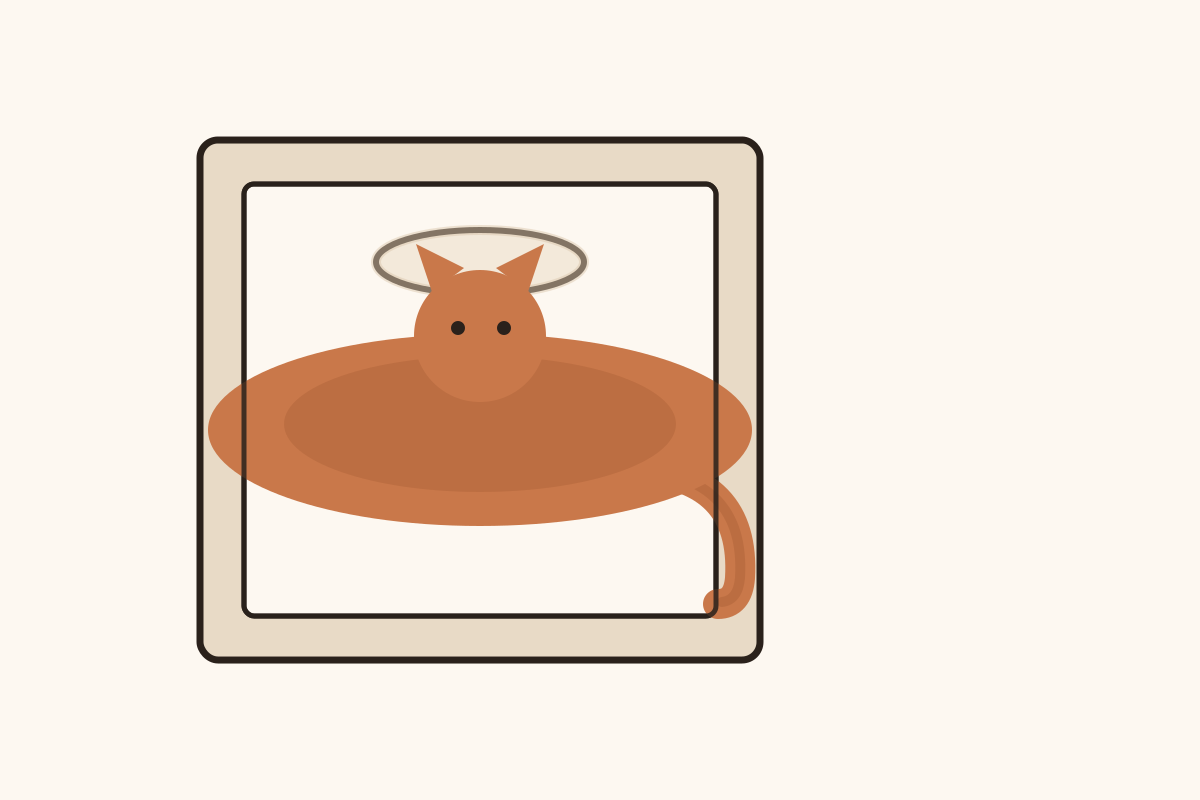
The footprint on the box is not the footprint inside it. Thick walls, a sloped roof and the lid’s rim account for the difference.
The size math nobody does before buying
The guidelines recommend a box 1.5 times the length of the cat from nose to base of tail. The preference study behind that recommendation is startling: given the choice, adult cats picked a box 34 by 15 inches — 86 by 39 centimeters — over a smaller one.
Now look at a typical top-entry box: often 24 by 18 inches on the outside. Take off the wall thickness, the roof overhang and the rim the cat has to clear, and the floor inside is commonly closer to 18 by 13 inches. That is roughly half the area of the box cats chose in that study, and it is the area your cat has to turn around in.
For width specifically, there is a 2025 study worth knowing: 78 cats, three boxes of different widths, and litter use climbed steeply with size — 16.9 percent of eliminations in the 40-centimeter box (about 16 inches wide), 35.5 in the 50, 35.9 in the 60. The authors put the threshold at 50 centimeters of width. A 24-inch box is 61 centimeters on the outside and considerably less on the inside.
So the honest summary is unkind to the design: a top-entry box is usually a small box with a big lid. If you want the litter containment without the jump, you can get most of it from a large front-entry box with high sides plus a mat at the door, and your cat keeps a box it can walk into.
The failure mode to watch for
It is not dramatic. There is no crash, no yowl. The cat simply uses the box less often, and with less enthusiasm, and then one day there is a puddle next to it.
Two versions:
Won’t go in. The jump is too much, or the flap is too much. The cat eliminates beside the box, on the nearest soft thing.
Gets in, can’t get out comfortably. This is the nastier one, because the cat is still using the box. Big cats and cats with hind-end pain can drop in and then struggle to climb out, and a cat that has had one bad exit may start holding it. A cat that holds it is a cat you end up at the vet with, and then you have a bladder question on top of a behavior question.
Both look like the cat being difficult. Neither is.
How to test it at home
You do not need to guess about your cat’s jump. You can measure it.
- Measure the cat. Nose to base of tail, along the spine, while it is standing. Multiply by 1.5. That is your target box length, and it is usually bigger than what you own.
- Put the box where the cat can be watched. You are watching for one thing: whether the entry is a stride or an effort.
- Watch one full visit. Cats dig, turn, squat or stand, cover, and leave. If any of those five steps looks abbreviated or rushed, the box is too small, and the entry is not the fix.
- Test the exit separately. Put a treat on the lid. A cat that hops up for it is fine. A cat that stretches, hesitates, or puts its front paws up and stops is telling you something.
- Take the lid off for a week. A top-entry box is almost always a front-entry box with the lid removed, and the walls are still tall. If the accidents stop, you have your answer, and it cost nothing.
If you are buying one today
If your cat is young, healthy and on the large side, a top-entry box is a reasonable purchase, and I would pick one whose lid comes off entirely rather than one with a swinging flap — the flap is the part cats argue with, and the lid is the part that is meant to keep the litter in.
If your cat is over ten, or stiff in the morning, or big, or nervous, buy the largest front-entry box you can fit, with sides high enough that a standing pee stays inside, and spend the difference on a mat at the door. You lose some litter containment. You keep a box the cat will still be using in five years.
Whichever you choose, the box needs to be big enough to turn around in, and that number comes from your cat’s spine, not from the lid.
Whether the box should be covered at all is a separate question — the evidence on that is thinner than the internet suggests, and I took that up in covered vs uncovered litter boxes.
Where this comes from
- Carney and colleagues, “AAFP and ISFM guidelines for diagnosing and solving house-soiling behavior in cats”, Journal of Feline Medicine and Surgery, 2014, PMC11148882. Source for the 1.5-times rule, the 34 by 15 inch preference result, the single line about the opening allowing easy access, the note that arthritis and muscle weakness impede older cats reaching a box, and the observation that covered boxes can trap odor.
- Iwabuchi-Inoue, Hattori and Kikusui, “Litter box size and litter type preference and their associated behavioral changes in cats”, Journal of Veterinary Medical Science, 2025, doi 10.1292/jvms.24-0468. 78 cats, three widths, 39 / 82 / 83 eliminations, 16.9 / 35.5 / 35.9 percent, P < 0.0001.
- JAVMA, “Feline litter box issues associate with cat personality, breed, and age at sterilization”, 2023, doi 10.2460/javma.22.10.0441. 3,049 cats, owner survey; two factors, house soiling and litter box fussiness; fearful cats more prone to both.
- Also my judgment, and flagged as such: the dog-barrier claim and the three-to-five-visits-a-day figure, which is the input to the jump arithmetic.
- Not from any study, and I looked: that there is no head-to-head comparison of top-entry and front-entry boxes — that is an absence of evidence, not evidence of no difference. The typical outside and inside dimensions of a 24 by 18 inch top-entry box come from product listings, not from a measurement study. The five-step watch test, the treat-on-the-lid test, the “take the lid off for a week” experiment and the recommendation to buy a removable lid are my own judgment. The figure for jumps a year is arithmetic on three to five visits a day with two jumps each, not a measured behavior, and the claim about the lid catching shed litter comes from owner accounts rather than a trial.