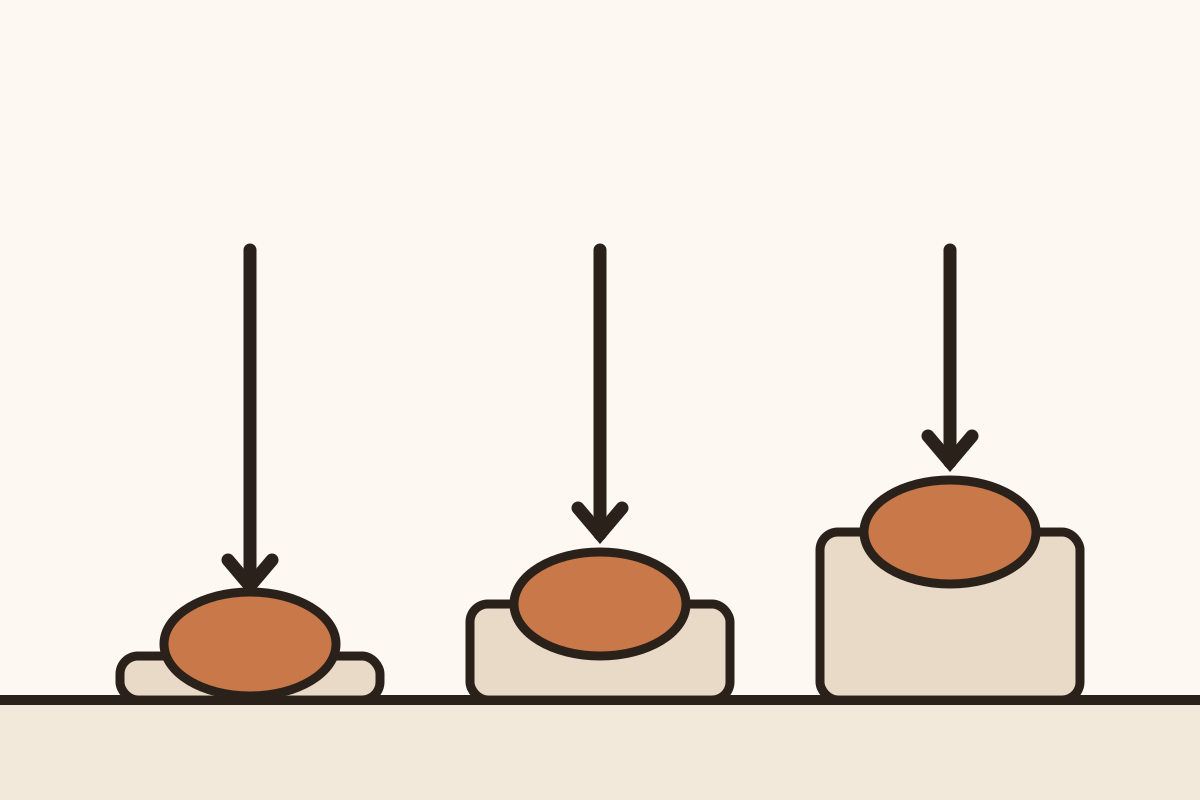
The mat you are looking at says 6 mm on the label, and it is being sold to you as “extra cushioning for joints”. Six millimeters of what, though. The number is a length. Cushioning is a stiffness. They are not the same quantity, and one of them is not printed anywhere on the box.
Here is the shortest version of the argument: for the same foam, twice the thickness is half as stiff. That is not a marketing claim, it is what a layer of elastic material does. So a 6 mm mat made of the same stuff as a 3 mm mat is genuinely twice as soft — and a dense 3 mm mat can be firmer than a soft 6 mm one from a different factory. The label tells you the length. It tells you nothing about which of those two you are holding.
What the numbers on the shelf mean
Standard mats are about 1/8 inch, which is 3.2 mm. The “thick” ones are about 1/4 inch, or 6.4 mm. Travel mats go down to 1–2 mm, and the padded ones sold for knee pain run to 10 mm and beyond. That range is from the manufacturers’ own descriptions, not from a standard.
Nobody regulates it. There is no body that decides what “extra thick” means, so 6 mm from one brand can be a firm sheet while 6 mm from another is a marshmallow. Both boxes will use the same adjective.
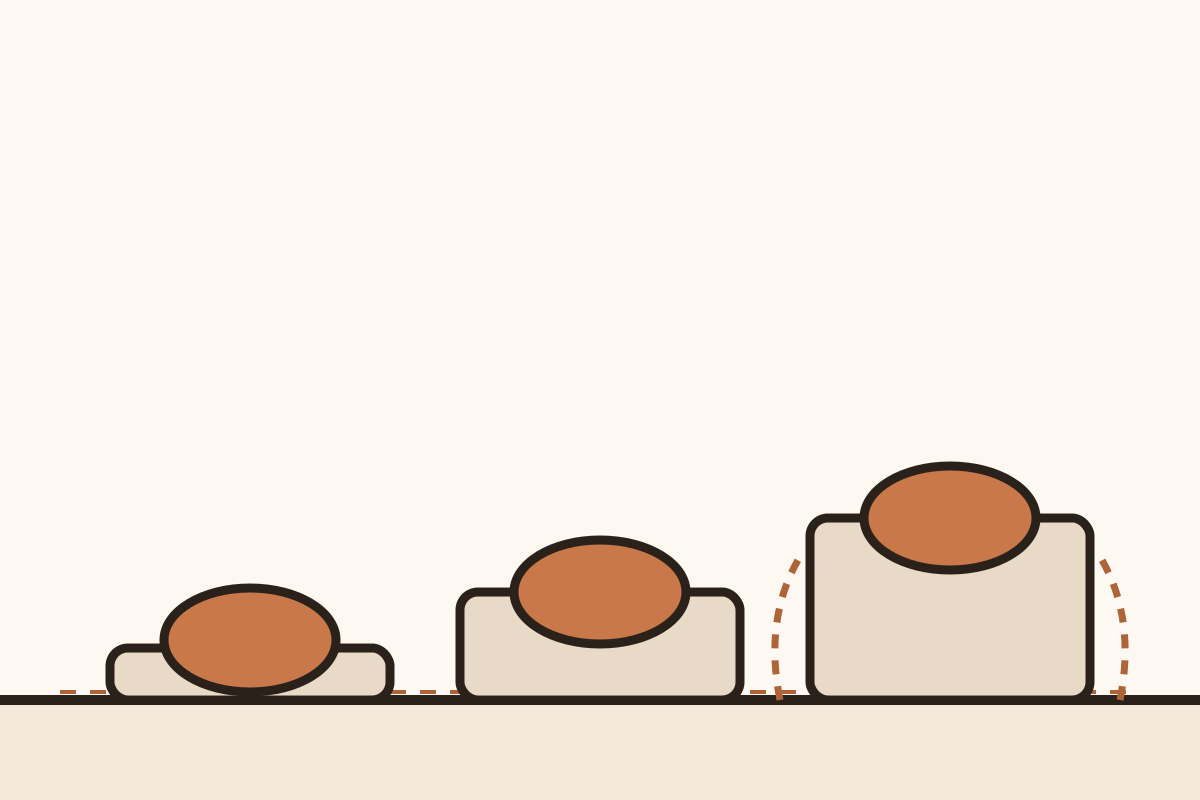
Same knee, three mats. The one on the right is not absorbing more force — it has simply run out of foam.
The one study that actually varied the thickness
There is one, and it is not what the marketing would have you expect.
Seven Pilates experts performed the teaser — the V-sit roll-up — on three mats of 0.6, 1.5 and 3.5 cm, lying on a force plate with EMG on four muscles (Woo, Lee and Park, Iranian Journal of Public Health, 2022). The thickest mat moved the least. Path length of the center of pressure fell from 3.20 cm on the thin mat to 2.79 cm on the 3.5 cm one; sway area fell from 0.56 cm² to 0.09 cm². The external oblique worked hardest on the thick mat, and the quadriceps and the erector spinae showed no significant change.
Read that as a shopper and you would order the thickest mat on the site. Read the rest of the paper first.
Seven people. A two-page letter to the editor, not a trial. One maneuver, performed lying down — it measures how much the body drifts while the weight is on the sit bones, not how a standing pose behaves. And 3.5 cm is not a yoga mat; it is a pad, about eleven times the 1/8 inch of a standard mat. One more thing worth knowing about how thin this evidence is: the authors’ own summary sentence credits a change in the erector spinae, and their table reports that muscle as not significant.
So the study shows that thickness is measurable. It does not show that a thicker mat makes your tree pose better, and the posture it tested is the one where a mat is most likely to help.
What the balance lab does say
The stronger evidence comes from clinical balance testing, and it points somewhere less convenient.
The modified Clinical Test of Sensory Interaction and Balance puts you on a foam pad on purpose, because the foam takes away the reliable information your feet get from a hard floor. That is the test’s design, not a finding. What the measurements show is that postural sway differs significantly by surface — a main effect of the foam across stance conditions (Doan and colleagues, Gait & Posture, 2023).
Then the part that should temper your shopping. A 2020 study ran the test on 184 older adults, mean age 69, with two foam pads a clinic would actually use. The researchers matched them deliberately — 12 cm and 13 cm thick, densities of 55 and 60 kg per cubic meter — then asked whether the pad in use changed the verdict on who had fallen before. It did not. Both reached an AUC of 0.93 to 0.95 and a posttest accuracy of 88 to 89 percent, and the authors call the two interchangeable with guidance (Boonsinsukh and colleagues, Hong Kong Physiotherapy Journal). Different pad, same answer.
Put those together and you get a modest, useful conclusion. The surface under your feet does change how you sway — that part is solid. But when two pads were built to be equivalent, the test could not tell them apart, which tells you the pad is a coarse lever rather than a switch. A few millimeters is unlikely to be the thing standing between you and a steadier tree pose.
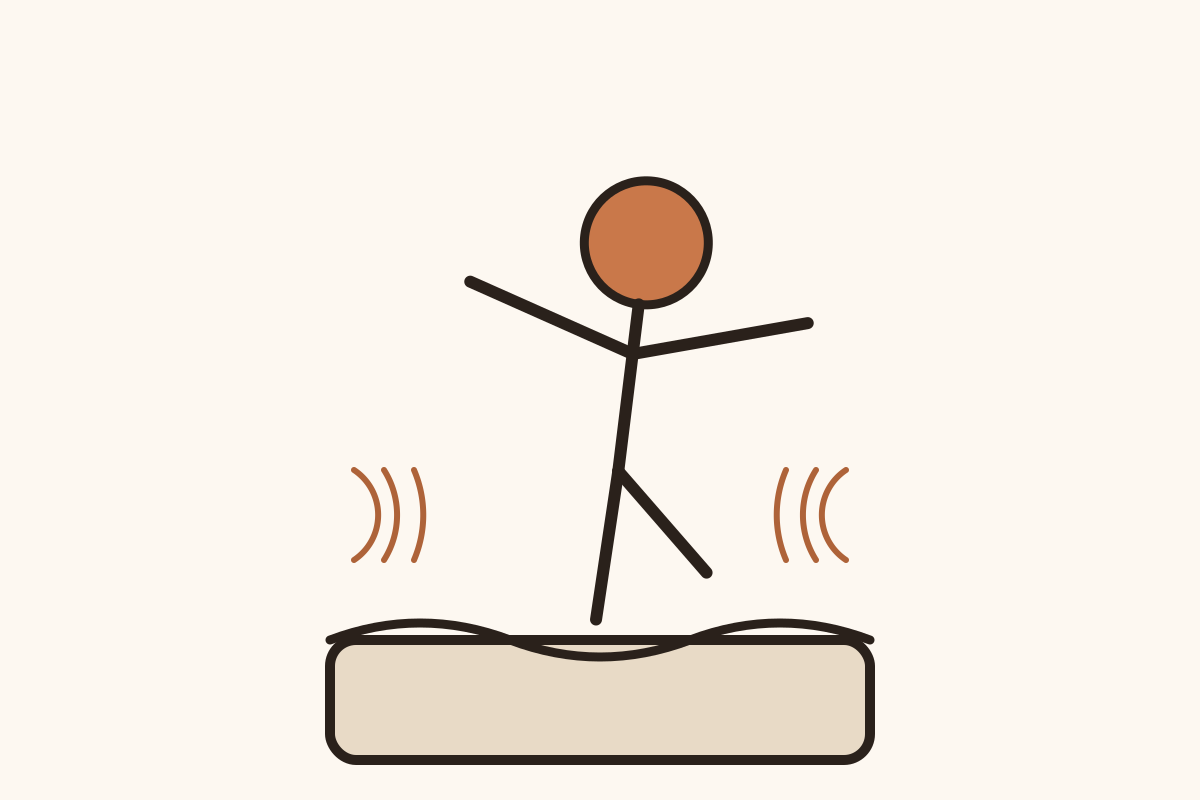
Compliant surfaces do change how you sway. How much is the argument, and nobody is selling you that number.
And the mat is not a passive floor
One more measurement, because it undercuts a different assumption — that the mat you stand on is scenery.
Researchers measured the rectus abdominis with ultrasound and surface EMG during a plank held on a table, on a yoga mat and on a stability ball. Here is the result, and it is not the one the blogs quote: there was no difference in muscle thickness change across the three surfaces, and activation was higher only in the first five seconds on the ball. Between the table and the yoga mat, nothing (Devorski and colleagues, Journal of Ultrasound, 2024).
So a stability ball — far more compliant than any mat you would buy — barely moved the needle, and only for five seconds. If a ball the size of a beach toy does that little, six millimeters of foam is not transforming your core workout.
The knee side, where thickness does help — briefly
Kneeling is a different problem, and here thickness earns its place. Your knee cap presses a small area, so the pressure is high, and a soft layer spreads that load over more area. That is real relief, and it is why the 10 mm mats exist.
But it only works while the foam can still compress. Once it has squashed to its limit — the point where the cell walls are all folded together — it stops being a cushion and becomes a hard sheet with a soft surface. Press your thumb into a cheap thick mat and you can feel the moment it goes solid, usually less than half an inch in. After that, more thickness buys you nothing at the knee, and you carry the extra bulk and squish for nothing.
This is also why “10 mm for knee pain” so often disappoints: the buyer gets a mat that is soft at the start of the compression and bottomed out under a knee, plus an ankle with more soft material under it in every standing pose. The fix is usually not a thicker mat. It is a denser one, or a folded blanket under the knees, which you can move out of the way for standing poses.
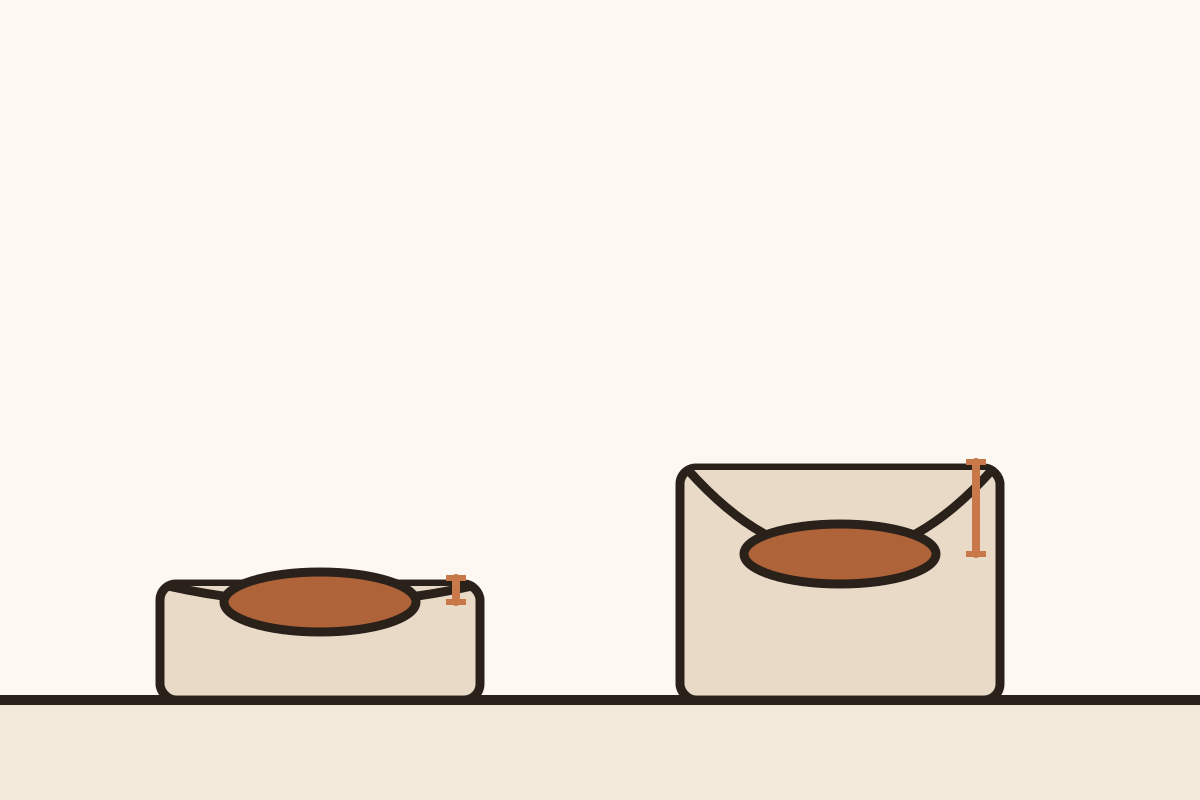
The only chart in this article, and the only one you need: same foam, double the thickness, half the stiffness.
So pick by what you actually do on it
Vinyasa, standing poses, balance work. 3–4 mm and dense. You want your foot to feel the floor through the mat, not to float above it. If your ankles wobble in tree pose, a thinner mat is the cheaper thing to try first — though the evidence above suggests the mat is the smaller half of that problem, and the practice is the other half.
Yin, restorative, floor work, ab work. 6 mm dense, or 3 mm plus a blanket under the hips and knees. This is where the extra depth is doing something you can feel.
Hot yoga. Thinner than you think, and grip matters more than cushioning. A wet soft mat is a slip hazard, and no amount of thickness fixes a slippery top surface.
Travel. 1–2 mm. You are buying a barrier against a hotel carpet, not comfort.
Knee pain, real and specific. Stop shopping by millimeters. Take a mat you already own, kneel on it on a hard floor, and see whether your knee finds the floor through the foam. If it does, the mat is the wrong tool and a pad is the right one.
The thirty-second test in the shop
You cannot do this online. That is the honest cost of not buying blind.
- Press your thumb in hard. Does it stop, or does it bottom out almost immediately? A mat that bottoms out under a thumb will bottom out under a knee.
- Put it on the floor and stand on one foot, shoes off. Count how long you last before you need the other foot. Then do it on the other mat. The difference you feel in ten seconds is the difference the lab measures.
- Kneel on it. Not for a second — long enough for the foam to finish compressing. That is the state your knees will be in for the whole class.
- Run two fingers along the top surface. Slick rubber and slick PVC feel different when dry and completely different once you are sweaty, which is the only condition that matters.
What I would tell a friend
Buy one dense 4 mm mat and one folded blanket. That combination does everything a 10 mm mat promises, and the blanket can be moved. If you fall in love with a thick mat for restorative work, buy it as a second mat and keep the thin one for standing poses — the two jobs genuinely want different tools, and one mat that is mediocre at both is what most people end up owning.
Where this comes from
- Doan and colleagues, “Time of day and athlete status effects on the modified clinical test of sensory integration and balance (mCTSIB) and stability evaluation test (SET)”, Gait & Posture, 2023, doi 10.1016/j.gaitpost.2023.08.012. Source for a significant main effect of the foam surface on postural sway. The abstract reports the effect without its sign and the full text is paywalled, so this page does not claim a direction.
- Boonsinsukh and colleagues, “The effect of the type of foam pad used in the modified Clinical Test of Sensory Interaction and Balance (mCTSIB) on the accuracy in identifying older adults with fall history”, Hong Kong Physiotherapy Journal, 2020, doi 10.1142/S1013702520500134. Source for pad type not changing the classification: 184 older adults, matched pads, AUC 0.93-0.95, accuracy 88-89 percent.
- Devorski and colleagues, “Rectus abdominis muscle thickness change and activation increase during planks performed on different surfaces”, Journal of Ultrasound, 2024, doi 10.1007/s40477-022-00750-8. Source for the surface having almost no effect on rectus abdominis activation: only the first five seconds on the ball differed, and table versus mat did not.
- Thickness ranges. 1/8 inch and 1/4 inch for standard and thick mats come from manufacturers’ own descriptions, including Gaiam’s buying guide; that guide tops out at 1/4 inch and does not list a 10 mm mat, which is sold separately as a padded or “extra thick” product. Treat all of it as what is being sold, not as a standard.
- Woo, Lee and Park, “Biomechanical Analysis of Integrated EMG and Displacement of Cop According To Mat Thickness during Pilates Teaser Maneuver”, Iranian Journal of Public Health, 2022, doi 10.18502/ijph.v51i9.10571. Seven Pilates instructors, mats of 0.6, 1.5 and 3.5 cm, path length 3.20 / 3.30 / 2.79 cm and sway area 0.56 / 0.43 / 0.09 cm². A two-page letter, not a trial.
- Not from any study, and I looked: the 3–4 mm, 6 mm and 1–2 mm recommendations by discipline, the thirty-second test, the thumb test, the “less than half an inch” press test, and the “one dense mat plus a blanket” advice. Those are my judgment. The Woo 2022 letter is the only study I found that varies mat thickness and measures anything, and it tested a lying Pilates maneuver in seven people, not standing balance and not knee pressure.