
Search this question and you get confident numbers from people who have never tested one: two inches, three inches, four. They cannot all be right. I could not find one published study that varies litter depth and measures what cats do — and the surveys that come closest admit they never asked the question.
Look at how the research is actually run. The 2025 study that found cats prefer boxes at least 50 cm wide used five centimetres of clumping clay in the boxes it was testing, and held it there — because the variables were width and litter type, not depth. That is how the rest of this literature is built too. Depth is the control, not the treatment.
So this page will not hand you a number as if it were measured. It will tell you what depth does, give you a starting figure, and then give you a two-week test that lets your cat answer the question, because your cat is the only one who has been running the experiment.
What depth is actually for
Three jobs, and they pull in different directions.
It lets a clump form that lifts out whole. With clumping litter, urine has to soak into enough material to bind into a solid ball. Too little and the clump welds itself to the base — you scrape at it, it breaks, and the residue stays. How often the box needs a full change is a separate question from how deep it is filled.
It gives a digger somewhere to dig. Cats that excavate before squatting are not being fussy. Digging is part of the sequence, and a floor of litter two centimetres thick does not let them complete it.
It keeps waste off the surface you clean. Waste sitting on the plastic is waste you smell and waste the cat walks in.
Against that: more litter is heavier to lift, dustier, and it ends up on your floor. It is also a deeper hole for an old cat to wade through.
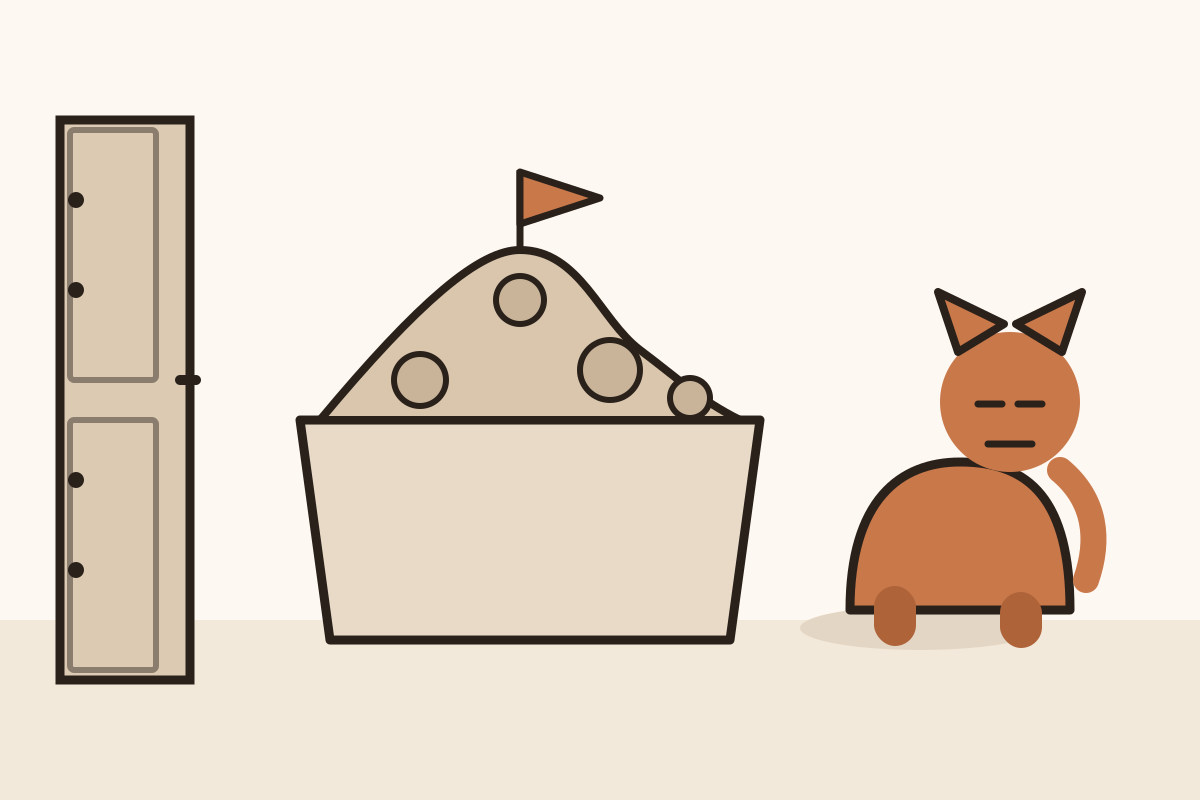
Five centimetres of clearance below the rim is roughly where a digger stops throwing litter onto the floor.
The number I would start at
Five centimetres, about two inches, of clumping clay. This is practice, not a measured optimum. It is also, awkwardly, the same number most handouts give: two inches, which is five centimetres. Neither of us measured it. What varies is the failure mode — a line that thin welds to the base in some boxes, and if you are scraping residue off the plastic, that is the symptom to chase. If your cat objects to a deeper line, take it back down.
Then adjust by cat:
- A digger — one who scrapes for ten seconds before every pee — usually wants more. Eight centimetres is not excessive for a big cat in a tall-sided box.
- A kitten, a senior, or an arthritic cat wants less, because wading through deep litter takes weight off the joints it is trying to keep steady. Three to four centimetres is plenty, and a low entry helps more than any depth.
- A cat who stands to urinate rather than squatting wants a shallow line and a high back wall. Adding depth does not fix aim, it just gives the urine further to travel when it misses.
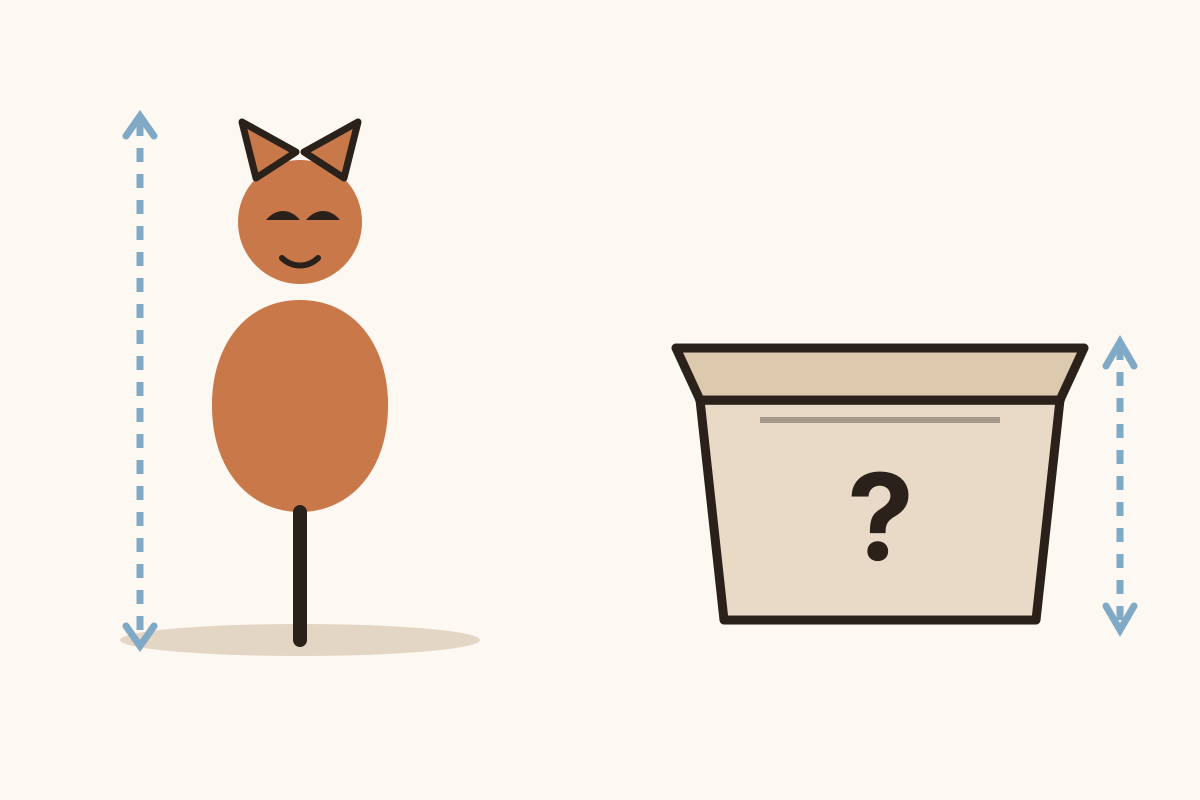
The gap matters as much as the depth. Diggers throw litter backwards, so five centimetres of clearance below the rim buys you a cleaner floor.
The two-week test
Do one change at a time, or you will learn nothing.
Week one: five centimetres. Level it, and watch three things after each use:
- Does the clump come out whole, or does it break and leave a patch on the base?
- Does the cat scrape at the base — a loud, plastic-scraping sound — before or after going?
- How much litter ends up on the floor outside the box?
Week two: add one centimetre. Same three questions. If the scraping stops and clumps lift cleanly, you were shallow. If litter starts flying out and the cat has to sink to the elbows, you have gone past it.
Two centimetres of change is enough for the cat to notice.
Signals you are reading correctly
Too shallow:
- A scraping sound that is clearly plastic, not litter
- Clumps welded to the base, breaking as you lift
- Urine pooling at the edge or running under the litter to the corner
- The cat digs, then walks away without going
Too deep:
- Litter thrown a metre from the box
- The cat standing on the rim, or perching with all four feet on the edge
- A long-haired cat coming out with litter through the coat
- The box noticeably heavier to lift, and the bag emptying faster than you expect
The last one is the cost: a cat who is fine at five centimetres does not need eight.
The litter type changes the number
Five centimetres of clumping clay and five centimetres of pine pellets are not the same amount of material. Pellets sit looser, break down into sawdust when wet, and fall through the gaps — so a line that looks the same is doing less binding. If you use pellets, judge by the clump, not by the ruler.
Crystal litter is the other direction. It absorbs and evaporates rather than clumping, so depth is not doing the first job at all — it is only deciding how much surface the cat has to scratch.
Still true whatever number you settle on
Keep five centimetres of clearance below the rim. It also gives a big cat room to turn, which is a size question rather than a depth one. For a digger, this matters more than the depth itself, and it is the reason tall-sided boxes exist.
Top up rather than replace. Depth drops as you scoop, and a box that was right on Monday can be three centimetres shallow by Friday. Topping up daily keeps the number where you set it.
What this piece rests on
- Iwabuchi-Inoue, Hattori and Kikusui, “Litter box size and litter type preference and their associated behavioral changes in cats,” Journal of Veterinary Medical Science, 2025, DOI 10.1292/jvms.24-0468. This is the source of the 50 cm width preference and of the five-centimetre litter depth used across the study’s boxes. It is not evidence about depth — the study held depth fixed, which is what I could find in every paper I read.
- Not from that paper, and not from any study I could find: the five-centimetre starting figure as advice, the eight and three-to-four centimetre adjustments, the two-week test, the signal lists, and the rim clearance. Those are practice. I searched for a study that varies depth and measures preference or house-soiling and did not find one; if one exists, this page is wrong and I would like to know.