I read six articles about cat tree height before writing this. Every one of them gave me a number. Thirty-six inches. Four feet. “As tall as your ceiling.” “Tall enough that your cat can see over the sofa.”
Not one of them said where the number came from.
So I went looking, through the veterinary guidelines and the survey papers. The short version: there is no number, there is arithmetic, and the arithmetic is more useful.
The guidelines say “how high”, and they say it carefully
The framework every feline vet guideline has used for the past decade is the five pillars of a healthy feline environment, out of the AAFP and ISFM environmental needs guidelines. The pillars: a safe space, multiple and separated key resources, opportunities for play and predatory behavior, predictable human–cat interaction, and an environment that respects the cat’s sense of smell.
Pillar one is the one people reach for when they buy a cat tree, and it says safe space, not high space. A cardboard box under the bed satisfies it. So does the top of a bookshelf.
But there is one place the guidelines do get specific, and it is worth quoting properly. The 2024 AAFP intercat tension guidelines, which name cat trees explicitly:
The aim should be to offer vertical space at different heights, at the cats’ preferred levels, with some hiding options for less confident cats.
At the cats’ preferred levels. That is not a dodge. It is an instruction to go and find out, and it means the number you need is already written on your cat rather than in a table.
So measure the cat, not the market
Your cat has been telling you its preferred level for years. It is wherever your cat already goes: the top of the fridge, the back of the sofa, the windowsill it fights the curtains for, the shelf it is not supposed to be on.
Next time it settles somewhere high, measure the height of that spot. You now have a target that is specific to your animal and derived from its own behavior rather than from a product listing. Most cats will give you an answer somewhere between the back of a chair and the top of a door frame.
That is the first real number, and I have not seen a blog suggest finding it this way.
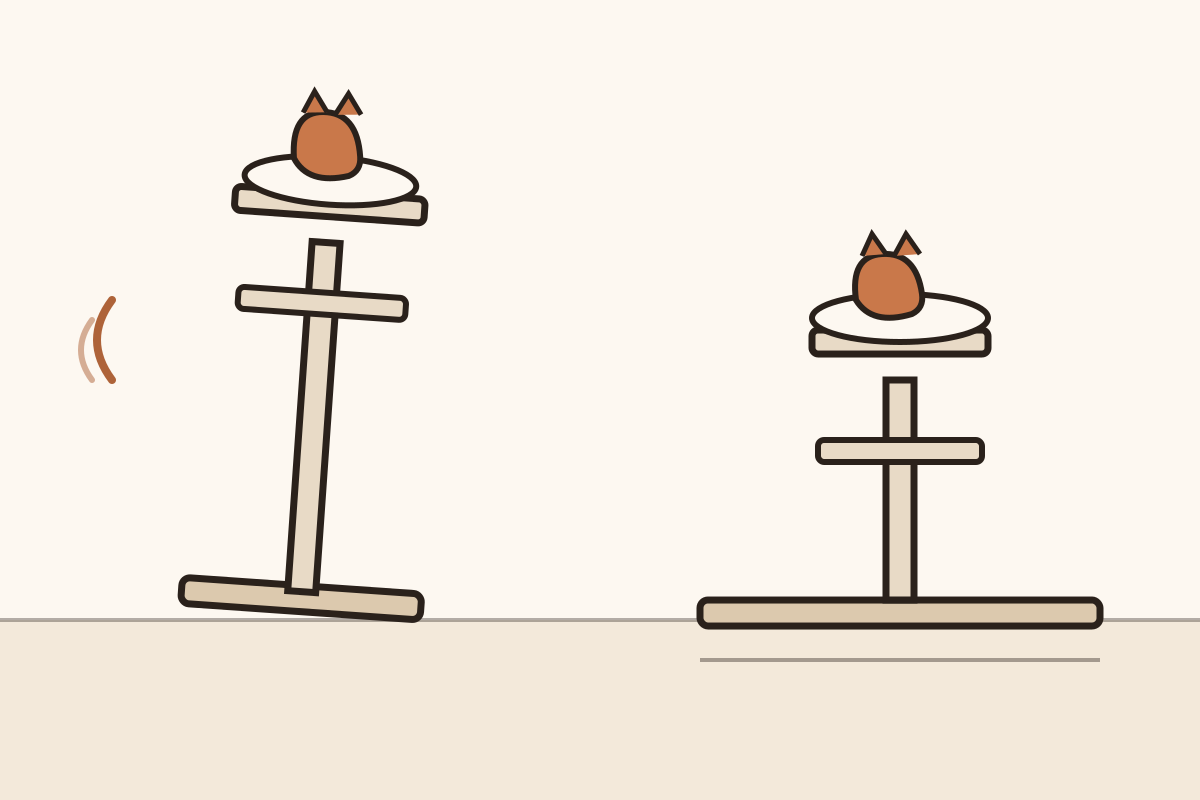
It is also the answer to most of what annoys people about cat trees. When one leans, the fault is usually not the build. It is a tall post on a footprint that was never big enough for it — the same problem wearing a different costume.
What the survey can and cannot support
A 2025 questionnaire study of 565 UK cat households checked adherence to the five pillars and then looked at problem behavior. Its own numbers sat next to each other and refused to line up.
- 84.2% owned a scratching post. Scratching the furniture was still the most common problem reported, and worse in multi-cat homes.
- 55.2% owned a cat tower, the study’s term for a cat tree. 66.4% reported problem behavior of some kind.
- 94.5% provided a resting place with privacy. That is pillar one, and a cardboard box clears it.
The questionnaire asked whether people owned these things. It never crossed ownership against behavior. The paper says so directly: provision variables were kept out of the analysis. So it cannot tell you the post or the tower failed. What it does show is a gap between owning the object and getting the outcome, and that gap is the entire subject of this article.
Three questions, one of which has an equation
“How tall should a cat tree be” is not one question. It is three, and they have different answers, and none of them is a single height.
- Can your cat get up there, and get down again comfortably?
- Is the top big enough for your cat to actually lie on?
- Will it tip over when your cat launches off it?
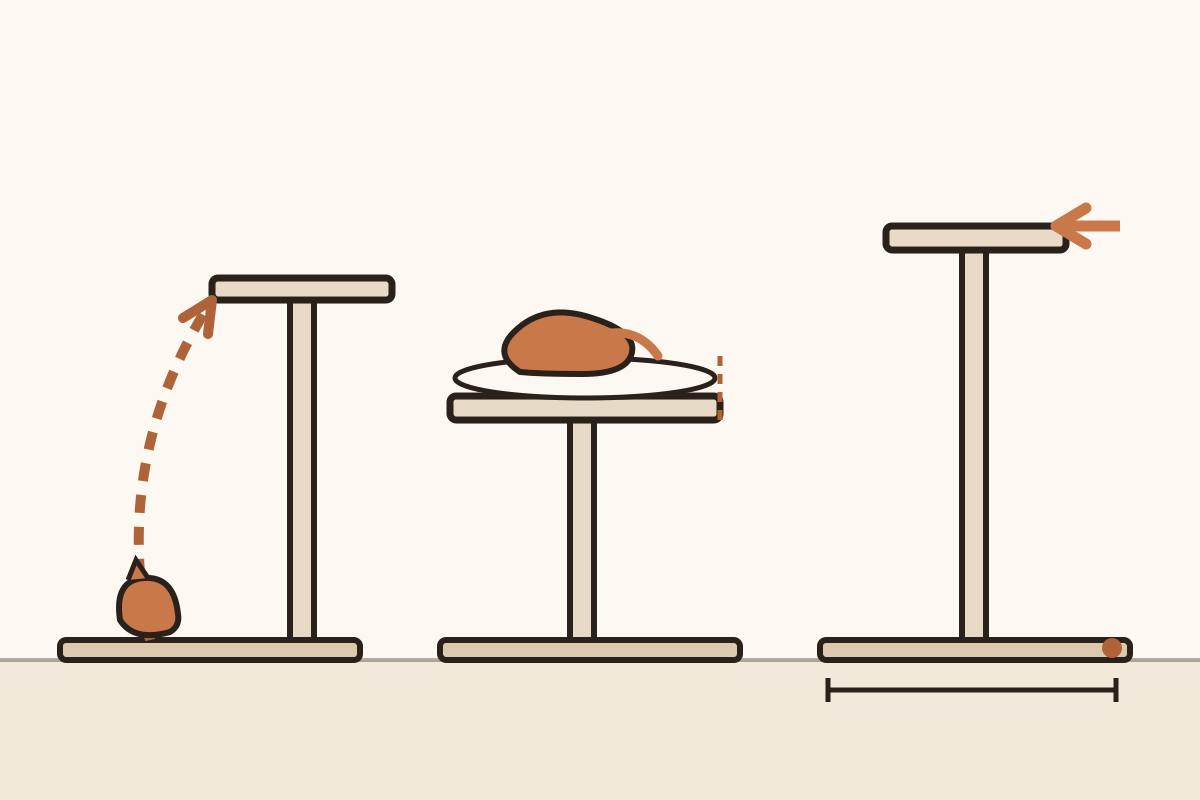
Access, footprint, stability. A tree can be excellent at two of these and fail the third.
Question one: access
The platform you measured a few sections back is the top of the tree you want. Now check whether your cat can still get down from it in ten years.
Jumping down from a height is a controlled fall into a small landing zone, and it gets harder every year, exactly like it does for us. A 2026 retrospective of 120 cats treated for high-rise syndrome found 49.3% of the patients were under one year old, and that 77.5% had a reported history of risky behavior such as jumping at curtains. Young cats do the stupid thing. I have no data on how often old cats do it, and I suspect they simply stop trying; when they do fall, they have less to spare.
So the access question is not “is it too tall for a cat”. It is “is it too tall for this cat, this year”. A tree with generous steps lets a fifteen-year-old with arthritis climb instead of leap. A tree with one jump to the top is a tree you will be lifting a cat off.
Question two: footprint
Put your cat on the floor, let it settle into the position it actually sleeps in, and measure it nose to the base of the tail. Curled, that is the minimum diameter of a platform it can lie on. Stretched out, it is the platform you want.
Most cat trees are built around a platform that looks reasonable in a photo and is small in a living room. The result is a cat that gets up, sits for ninety seconds, and comes back down — you have built a staircase, not a bed. Then you wonder why the cat sleeps on your laptop instead, where the footprint is mysteriously adequate.
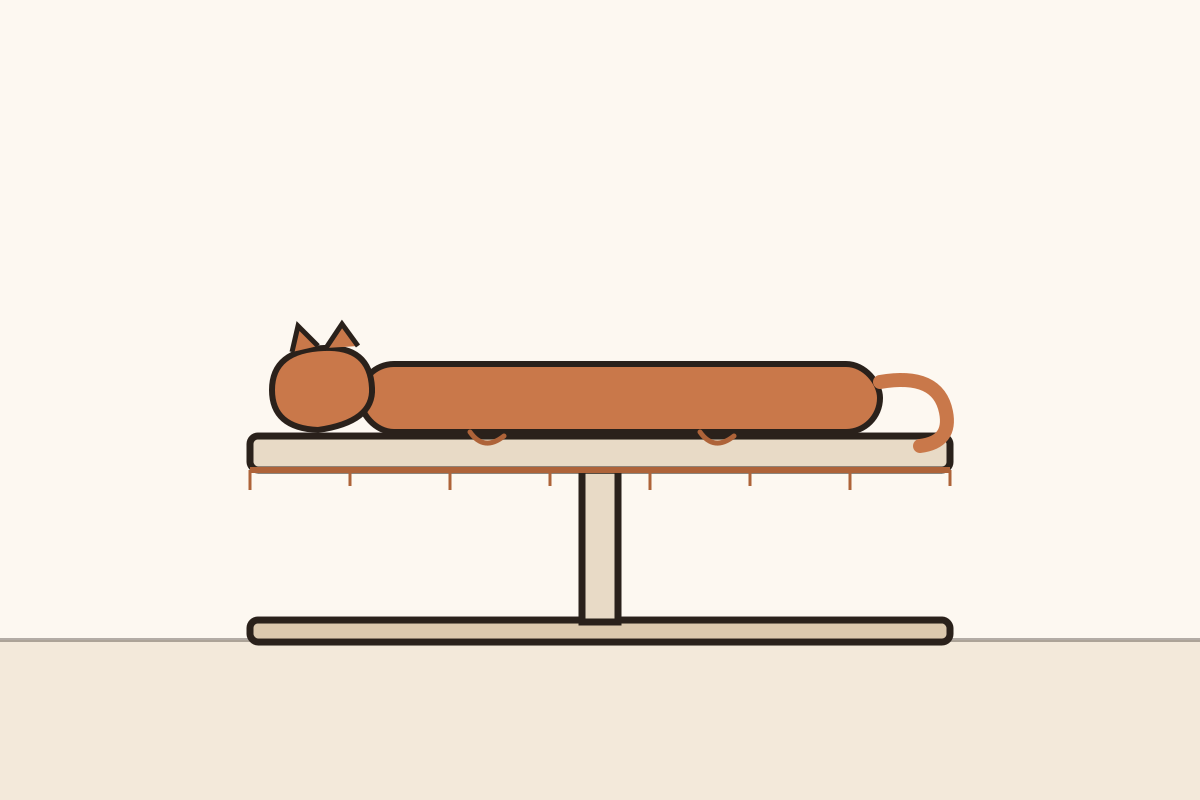
Measure the sleeper, not the shelf. The shelf in the picture is generous; most are not.
There is a related trap: the higher a platform, the smaller it tends to be, because a big platform up high is a lever. So the platform your cat will like most is often the one two levels down. That is fine. Put it there.
Question three: tipping
I could not find anyone who works through the tipping arithmetic, and it is the one part of this with an actual equation.
A cat tree tips over when your cat pushes sideways at the top with enough force to rotate the whole thing around the outer edge of its base. That happens when the turning effect of the push beats the turning effect of the tree’s own weight holding it down. In symbols:
F × h = m × g × (b ÷ 2)
where F is the sideways force at the top, h is the height where it is applied, m is the tree’s mass, g is gravity, and b is the base width in the direction of the push. Solve for F and you get the push it takes to topple the thing:
F = m × g × b ÷ (2h)
Take a 17-pound tree, a base 16 inches wide, and a top platform just under six feet up. In metric, because the equation is metric: 8 kg, 0.40 m, 1.80 m. The push needed is 8 × 9.81 × 0.40 ÷ (2 × 1.80) — about 8.7 newtons, which is roughly two pounds of sideways force. A cat launching off the top clears it without trying. Which is why the tall one wobbles and you have never quite trusted it.
Now shorten the same tree to four feet, same base. The push needed rises to about 13 newtons, close to three pounds. At two feet it is 26 newtons, nearly six pounds — three times harder to knock over than the six-foot version, with no change to the base at all.
Turn the equation around and you get a shopping rule. If we assume a cat can deliver roughly 20 newtons sideways when it pushes off (an eleven-pound cat using about 40% of its body weight, which is an estimate and not a measurement), then for a 17-pound tree:
base width ≥ about half the height.
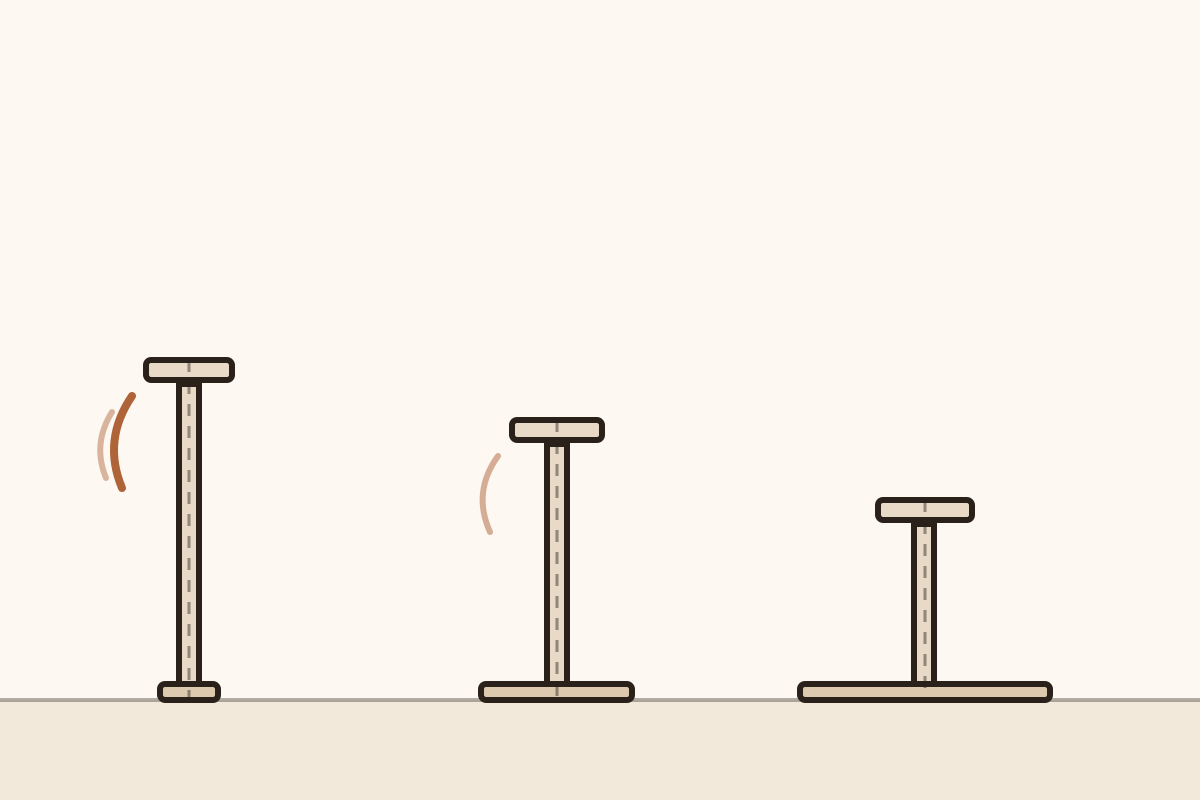
Same post, same platforms. The only change is how far the feet are spread.
I worked the half-height rule out myself, from the same equation, and you can redo it with your own cat’s weight and your own estimate of how hard it shoves. Note that the rule moves with that estimate: assume half the push and you need a quarter of the height; assume double and you need the full height. But it immediately explains something useful. A six-foot tree needs a base about three feet across to be the thing you thought you were buying. When you look at listings, that is the number to check first, and it is usually the number that is not printed.
Where you put it
Everything the falls data can tell you is about what your cat lands on, not how far it fell. Of the 120 cats, 96 came down on tile, asphalt or metal, 15 on garden soil or a tree, and the other nine on cars. The soft group is thin, and these were falls from roughly ten feet and up. Even so, injury severity did split by surface: about 6.2 on hard ground against 3.2 on soft, p = 0.003.
The same study found no significant relationship between fall height and injury severity (p = 0.061) across falls from the first floor upward. A null result is not proof that height stops mattering, and I would not read it down to the gap between a two-foot platform and a six-foot one, which the study never looked at. What it does undermine is the idea that buying shorter buys you safety. Shorter is a comfort purchase. Buy it for that and stop paying a safety premium for it.
Pillar one is privacy, so the tree wants to be somewhere your cat can watch the room without being in the middle of it. A corner, or the end of a sofa, beats the center of the floor. If you have more than one cat, this stops being a preference: perches and visual barriers are what the multi-cat literature keeps pointing to.
Then walk the room, because the landing is where the strange casualties live. Where would a cat coming off the top come down — carpet, a rug, a bed, or tile and the corner of a coffee table? That question is worth asking, and the surface finding is the only real pointer I have to the answer. A short hop onto tile is not a fall from the third floor. The cat does not know that. Walk the room anyway.
What I would actually buy
Go down this list in order and most of the catalog falls away:
| Check | Passes if | Why it comes first |
|---|---|---|
| Base width | At least half the total height | Nothing else matters if it falls over; the ratio assumes the 20 N push |
| Top platform | At least your cat’s nose-to-tail-base length | Otherwise your cat sits for a minute and leaves |
| Peak height | Around where your cat already chooses to sit | Sourced to your cat, per the 2024 guidelines |
| Placement | A soft landing and a corner | Best-evidenced row, borrowed from falls much higher than yours |
| Step spacing | Close enough that an old cat can climb, not leap | My suggestion, not a published figure |
| Post wrap | Sisal, and tall enough to stretch up | Separate problem, covered in the scratching post piece |
If two trees tie on the first two rows, take the one with the wider base. The taller it is, the more of your money is going into the part that can tip.
The gap
I looked for a study that put cats in front of trees of different heights and recorded which they used, and for a veterinary body that publishes a recommended height in inches. The closest thing to an official answer is that phrase about your cat’s preferred levels, which is an instruction to go and measure.
That is a real gap, not a scandal. It also means the honest answer has no fixed value: as tall as your cat already chooses to sit, with a base at least half that height, and a platform your cat fits on. Work those three out at home and you will have a better answer than any of the six articles I read, including this one.
If you are sorting out the floor-level equipment too, the litter box size question works the same way — there is a published number, but the useful part is measuring your own animal. And the scratching post height question is the other half of the vertical-furniture problem, with better evidence behind it.
Sources
- Ellis, S.L.H., Rodan, I., Carney, H.C., et al. AAFP and ISFM feline environmental needs guidelines. Journal of Feline Medicine and Surgery, 2013, 15:219–230. The five pillars.
- Rodan, I., Ramos, D., Carney, H., et al. 2024 AAFP intercat tension guidelines: recognition, prevention and management. Journal of Feline Medicine and Surgery, 2024, 26(7). The “vertical space at different heights, at the cats’ preferred levels” passage, and the explicit mention of cat trees.
- FelineVMA. Meeting the physical and emotional needs of indoor cats: position statement. Journal of Feline Medicine and Surgery, 2025, 27(7). Restates the five pillars as the current standard and gives no height figure.
- Taylor, S., Mackie, I.M., Heath, S., Paramasivam, S.J. Feline management practices and resource provision in the UK: a questionnaire-based study of 565 caregivers. Veterinary Record, 2025, 197(3):e5561. 565 households. 84.2% owned a scratching post and 55.2% a cat tower; 94.5% provided a private resting place; 66.4% reported problem behavior, with scratching furniture most frequent and more common in multi-cat homes. Ownership was not analyzed against behavior.
- Haghi, P., et al. Radiographic and ultrasonographic study of the etiology of high-rise syndrome in cats: a retrospective analysis. Veterinary Medicine and Science, 2026, 12(3):e71002. 120 cats; 49.3% under one year; 77.5% had a reported history of risky behavior; no significant correlation between fall height and injury severity (p = 0.061); landing surface was associated with severity (p = 0.003, mean injury score 6.2 on hard versus 3.2 on soft, from a soft-landing group of 15 cats (a further 9 landed on cars and are not counted in it)); the paper states 81.6% of landings were on hard surfaces, though its own category counts give 96 of 120.
The tipping arithmetic is mine, worked from the static equilibrium condition, and is labelled as such. The 20-newton estimate for a cat’s sideways push is an assumption you should feel free to replace with your own; the base-to-height rule scales linearly with it.