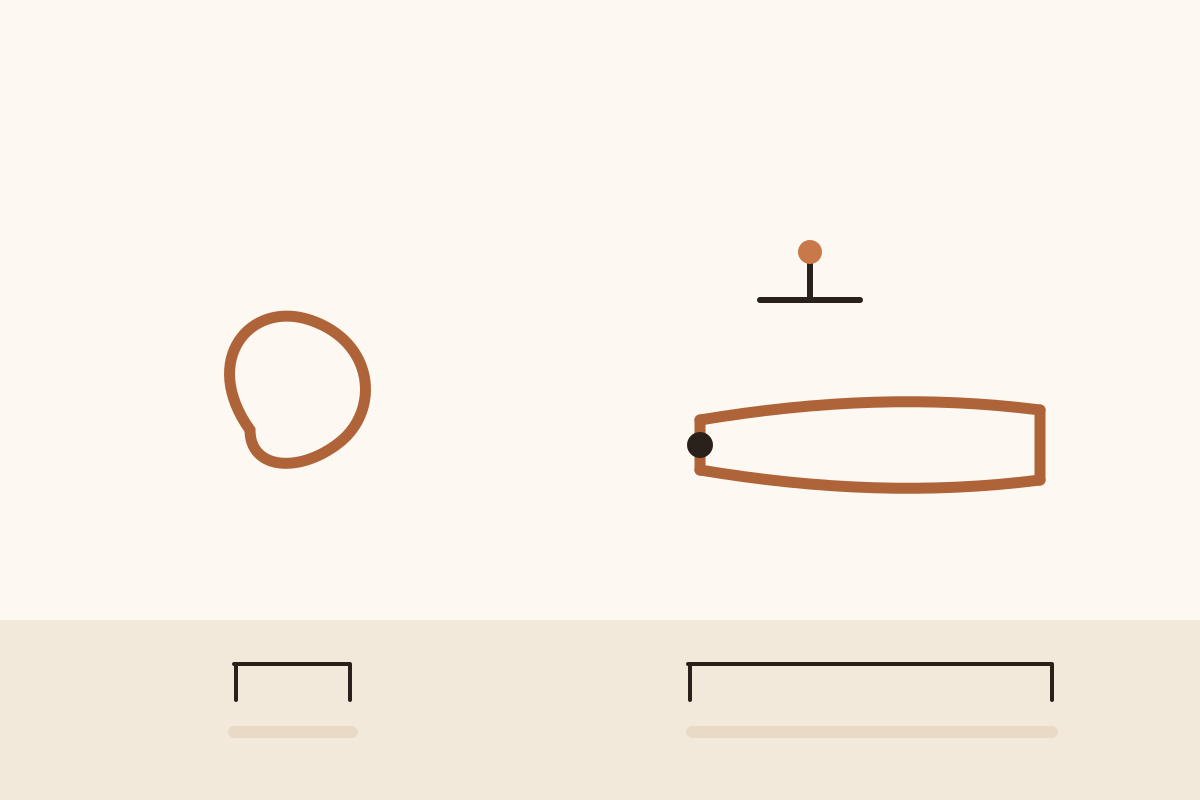
Stand on one end of a loop band, press the other end overhead, and it becomes a different band than the one at your hip. Nothing about it changed except how far you pulled it.
That is the whole trouble with buying elastic by color. Length sets the load as surely as thickness does, and length is the number on the package that tells you the least about how the thing will feel.
Here is the working rule, and it comes out of the measurements rather than a sizing chart: at the end of the rep, the band should be at roughly twice its resting length, and never past three and a half times. Short of that you are hauling slack through the first half of the movement. Past it the rubber has stopped behaving like a spring.
In shopping terms, three sizes cover almost every home exercise: a 41-inch loop for standing work, a 4-to-6-foot flat band or tube for anything anchored high, and a 12-inch mini loop for hips and ankles. Which of the three you need is a measurement, not a preference, and it takes one tape measure.
Measure the gap before you buy anything
One measurement per exercise. It is the distance from where the band is anchored to where your hand or foot is at the far end of the movement. Call it D.
You want the length of band actually working — the strand between anchor and limb, not the loop lying on the table — to land between about 0.4 and 0.6 of D. Do that and the end of the rep puts you at 1.7 to 2.5 times resting length, which sits inside the range the published measurements cover, and inside the range where elastic feels like resistance instead of a knot.
An example, and this part is my arithmetic rather than any paper’s. A 41-inch loop is 104 cm around, so each strand running from your foot to your hand starts at about 20.5 inches. With your hand at hip height, that strand is about 39 inches long: 1.9 times its resting length, comfortably inside the measured range. The force you feel is roughly double the single-strand figure, because both strands pull on your hand.
Press that same loop overhead and the strand runs out to nearly 6.5 feet, close to four times resting length. Uchida’s table stops at 250% elongation, three and a half times, and the manufacturer’s own chart stops earlier still, at three times. A 41-inch loop is roomy underfoot and cramped overhead, which is why long flat bands exist and why a door anchor at chest height is the honest answer for pressing and rowing.
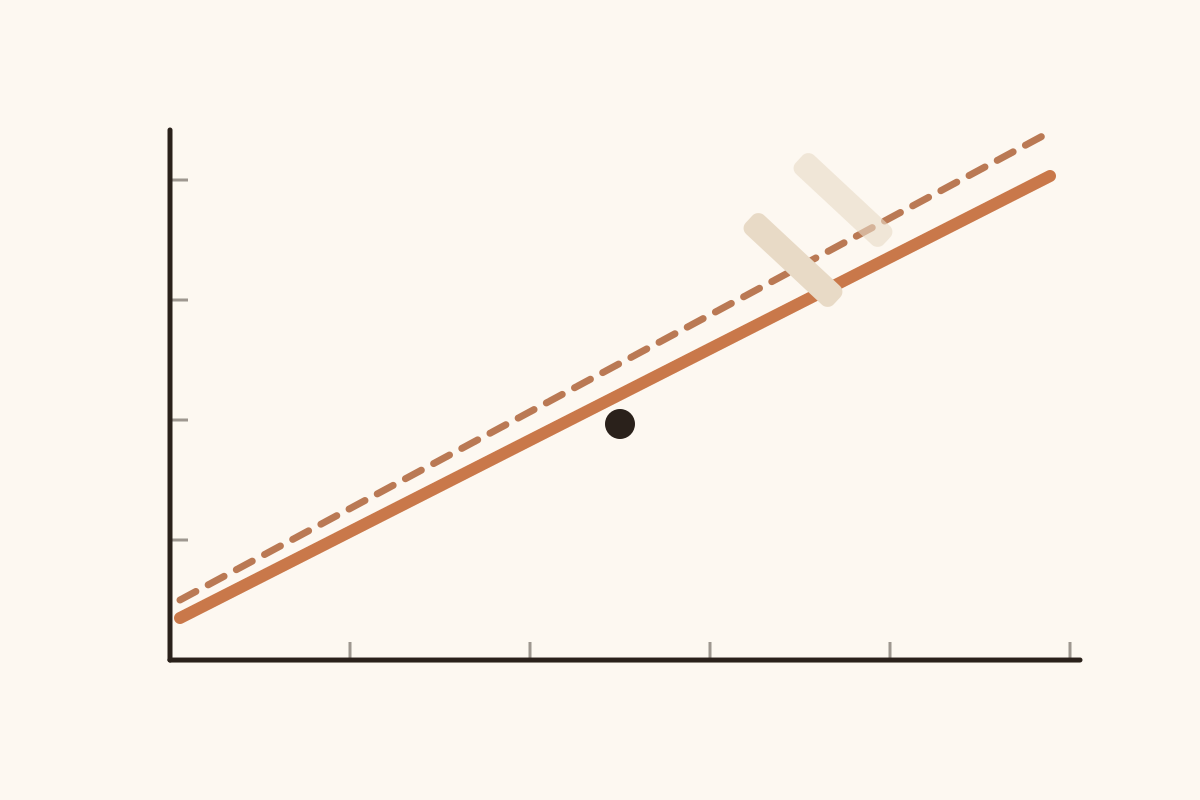
Force against stretch, drawn from the measured values. The dashed line is what the manufacturer’s chart implies; the dot is where the quoted number is taken.
Test it in one session
Before buying a second band, run this. A surprising number of people already own the right one.
Pick the exercise. Set the anchor. Put the band in your hands at the start position, then pull to the end of the range. Three outcomes:
- Slack at the start, fighting you only at the end. Too long for this movement. Choke up until it is tight from the first inch.
- You cannot reach the start position without leaning. Too short. Move the anchor closer, or switch to a longer band for this movement.
- Tight at the start, hard at the end, and you can do twelve clean reps. That is the one. Add reps until twenty is easy, then choke up or go up a color.
Two things make the test faster: a door anchor you can move in seconds, and a band a foot longer than you think you need.
What the three sizes are actually for
12-inch mini loop (about 30 cm). Hips, glutes, ankles, lateral steps. It has no length to spare once a large joint gets involved: the movement is short and the band is short with it. Buy a set of three tensions and expect to use the lightest most.
41-inch loop (about 104 cm). The default. Good underfoot for curls, lateral raises, squats, and face pulls off a low anchor. Full overhead extension puts it at the top of its range, so if overhead pressing is the goal, this is the wrong band.
Flat band, 4 to 6 feet (1.2 to 1.8 m), or a tube with handles. Long bands can be anchored high and still finish a movement at a sane stretch. Flat bands have no handles, so your grip gives out before the muscle does; tubes with handles fix that, and the handles add a few inches at each end that the sizing arithmetic has to include.
Door anchors give up length before the band starts — the strap and the loop around the band come out of your working length. I could not find a published figure for how much, so measure your own. If your arithmetic was tight to begin with, the anchor is what breaks it.
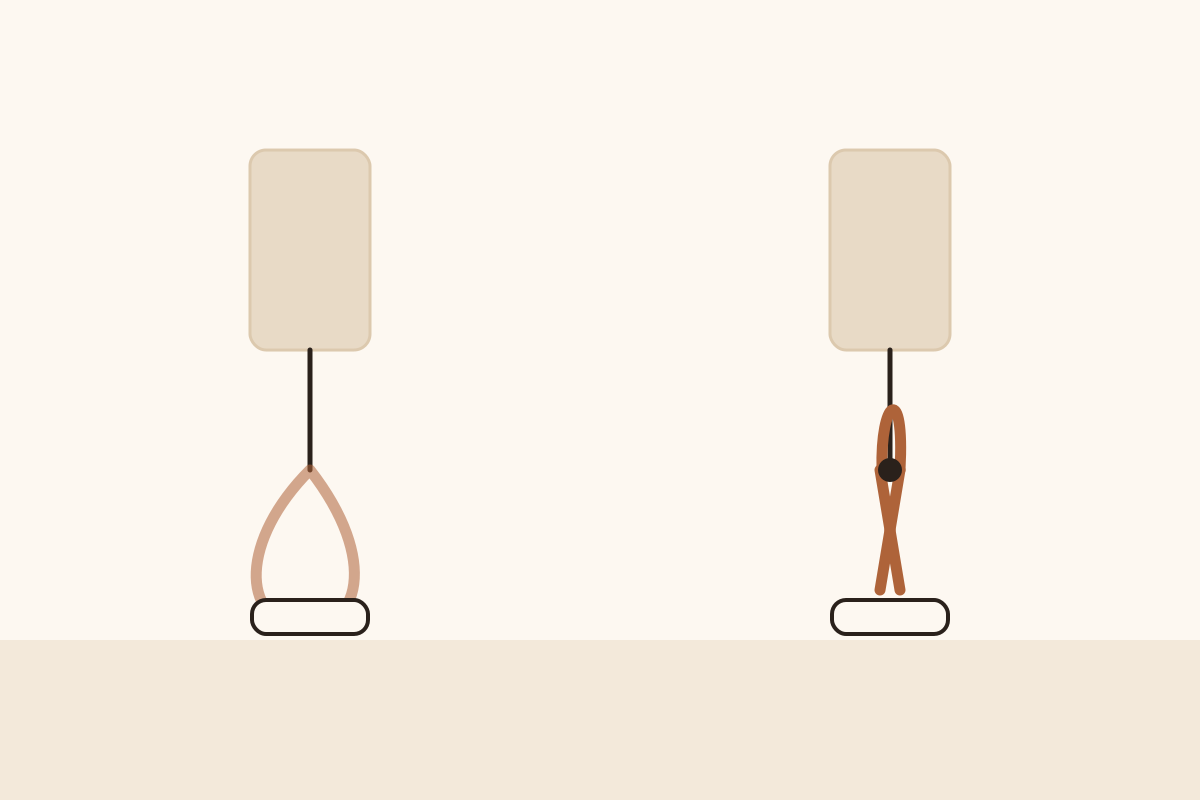
Same band, same anchor, two working lengths. Choking up is free resistance.
A shorter band is heavier than a longer one
Hold the color constant, hold the stretch constant, and shorten the band. The force goes up. That took me a second pass to believe too.
Saint-Martin and colleagues measured it on an Instron tester: six color-coded TheraBand bands at two resting lengths, 10 cm and 40 cm, each stretched to 1.25, 1.5 and 1.75 times its own length (Frontiers in Veterinary Science, 2026, 13:1799600). The 10 cm bands produced significantly higher mean forces than the 40 cm bands, p < 0.0001, and force rose linearly with both elongation and color stiffness, R² above 0.95 in every color.
The paper was written for canine rehab dosing, and 10 cm is shorter than any working length you will use, so it says less about your shopping than it first appears — the direction is what transfers to your living room, not the size of the effect. What it establishes is that resting length belongs with stiffness and stretch in the set of things that decide the load. The same band, cut shorter, is not the same band.
The practical use is immediate. If a band is too easy, the cheapest fix is to take a loop in your hand or double it under your foot: the same band now starts shorter and reaches a higher force at the end of the same movement. One extra step of resistance without a second purchase. The reverse does not work, which is why a band that is too short is a worse mistake than one that is too long — you cannot put length back.
The figure on the box is a single point on a curve
Elastic resistance is not a number. It is a slope. Pull further and it pulls harder, close to linearly for these materials, and the “20 lb” on the packaging is the force at one particular amount of stretch — usually quoted at 100% elongation, meaning double its resting length.
This is where most of the confusion lives. A band sold as “light, 3 to 5 lb” is not pulling 3 to 5 lb while it hangs in your hand. That 3 to 5 covers the whole span of stretch; the bottom of the range is what you get at double length. It pulls less at the start of the rep and more at the end, and no single number on a label can tell you both.
The most useful published measurements are Uchida and colleagues’, who put eight color-coded Thera-Band bands in a tensile testing machine and recorded force at ten levels of elongation from 25% up to 250% (Journal of Physical Therapy Science, 2016, 28:1266–1271, open access at PMC4868225). Their samples started at 30 cm of resting length and reached 105 cm at the top end. Two trained observers, ten samples per step.
Here are three rows of their table, in pounds with the paper’s kilograms-force alongside:
| Band | at 100% (×2 length) | at 200% (×3) | at 250% (×3.5) |
|---|---|---|---|
| Tan (thinnest) | 2.4 lb / 1.08 kgf | 3.5 lb / 1.58 kgf | 4.1 lb / 1.84 kgf |
| Red | 3.5 lb / 1.60 kgf | 5.0 lb / 2.26 kgf | 5.8 lb / 2.61 kgf |
| Black (stiff) | 7.2 lb / 3.28 kgf | 11.5 lb / 5.23 kgf | 14.0 lb / 6.33 kgf |
The black band at double its length is heavier than the red band at three and a half times its length, so a jump of three colors can outweigh a large change in stretch. That holds for distant colors; between neighbors the step is small, and black against silver is only about a fifth in force. And the red band gains roughly two thirds between double length and three and a half times, which is both the appeal of elastic and the reason “how heavy is this band” has no single answer.
The chart the manufacturer prints runs high
Uchida’s team then turned their own data on the manufacturer’s reference values and found theirs lower for almost every color. They tested the slopes of the two curves against each other rather than comparing single points, and the difference was significant in five colors: yellow, green, blue, silver and gold. Their comparison table carries no reference values for tan, so the honest denominator is seven. Their conclusion, in their words: “the tension force values for Thera-Band elastic bands provided by the manufacturer are overestimates.”
Gold is the case to hold in mind, because it is the stiffest band sold and because it is where the two columns disagree most — at 100% elongation and again at 250%. At 100% the reference value is 9.80 kgf against a measured 5.66 kgf: about 21.6 lb against about 12.5 lb, so the reference column claims about seven tenths more than the band delivered, the largest gap of the seven at that elongation.
At 250% the reference value is 18.19 kgf against a measured 8.93 kgf — about 40 lb against about 19.7 lb, which makes it the largest gap of the seven there too. The reference column is claiming more than double what the band gave. Those are figures the authors print in kilograms themselves.
None of this is a scandal. Charts are typical values for a rubber product, and a band that has spent a year in a hot car is not the band that was measured. The useful reading is narrower: treat the printed number as an upper bound and a label rather than a load. If your program calls for 10 lb and you buy the band whose chart says 10.2 lb, you have bought something lighter than the plan assumed.
What I could not verify
There is no study I could find that measures force at the lengths sold to home users — 41-inch loops and six-foot flat bands. Both papers above used short laboratory samples, 30 cm in Uchida and 10 to 40 cm in Saint-Martin, and the length effect was significant at those lengths. Whether it holds at 104 cm is an extrapolation, and I have marked it as one.
The sizes here — 12-inch mini, 41-inch loop, 6-foot flat — are the categories actually sold, not measurements. The 0.4-to-0.6 ratio is my rule of thumb assembled from the elongation ranges those two papers cover.
Is any of this worth the trouble
Only if you are training against a number. If you are doing three sets of whatever feels hard, the color on the band is enough and the length only has to fit: long enough to reach, short enough to be tight at the start.
The moment a program names a load, or a physical therapist gives you a dose in pounds, length stops being a detail. The quoted force assumes one amount of stretch, the machine measurements come in under the chart, and the same color at a shorter starting length is genuinely harder. Those three facts explain most of the gap between what a band program promises and what it feels like in a living room. And if you are setting up the floor under all this, how thick a mat you want decides whether you can brace a foot while a loop is under it.