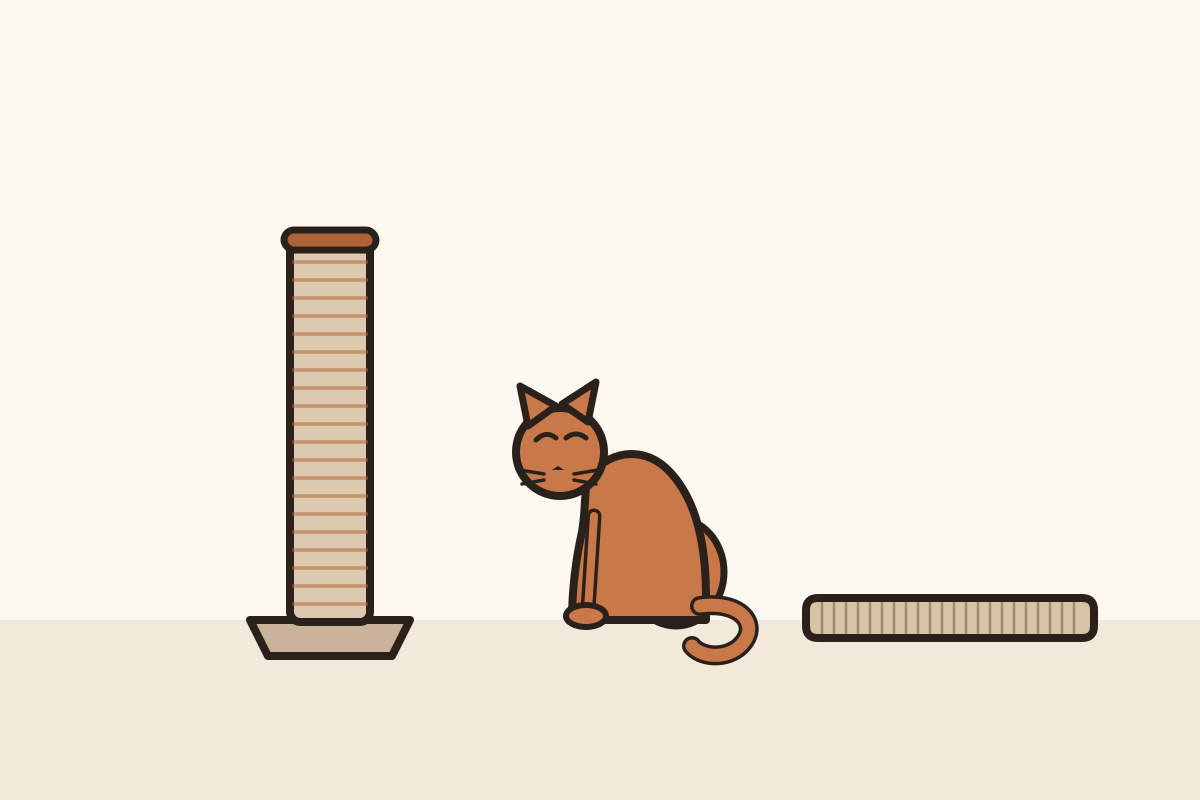
Pads and posts get argued about as if they were two answers to one question. They are not, quite. A sisal-wrapped post the cat can stretch out against and a flat corrugated pad on the floor do different jobs, and most houses end up with one of each.
The comparison everyone quotes — cardboard beats sisal — came from a study that used hemp rope, and beat it on a post 30 cm tall, about a foot. The same study also ran a rope post 77.5 cm tall, roughly thirty inches, and that one tied with the cardboard. So the headline was built on the half of the result that got repeated.
Then someone did run it. Zhang’s doctoral work tested covering materials on standing scratchers in adult household cats, fourteen houses, and rope and cardboard both drew more scratching than the same post wrapped in sofa fabric, with carpet in between. The two materials came out level with each other. That is the finding nobody quotes, and it is a better answer than either side of the argument: the covering matters, and which of the two coverings matters much less than whether the post is worth using at all.
Forty-three hundred owners, no laboratory
Wilson and colleagues asked 4,331 owners in 39 countries what their cats had in the house, and what got scratched, over four months (DOI 10.1177/1098612X15594414).
The options included rope, cardboard, carpet and wood. Carpet was the surface provided most often. Rope was the surface cats used most often when it was in the house. The surface people buy most and the surface cats choose most are not the same surface.
Inappropriate scratching got less common as the number of different types and styles of post in the home went up, so the answer to “which one” may simply be “several”. And cats between ten and fourteen preferred carpet, while every other age group put rope first.
A second survey, of 2,465 owners in the US and Canada, went looking for what predicts complaints (Cisneros and colleagues, Animals 2022). Fifty-eight percent of them reported problem scratching, which is the honest baseline for this whole subject. In the regression models, reports were less frequent among owners who provided sisal rope (p < 0.0001) and among those who provided flat scratching surfaces (p = 0.037). Reports were more frequent among owners who used verbal or physical correction.
Both surveys are cross-sectional, which limits them to correlation and is why neither can tell you which way causation runs. People whose cats are calm may simply be the ones who buy sisal. What the two establish is that “cats prefer cardboard” is not what the biggest datasets found — both of them put rope on the favorable side.
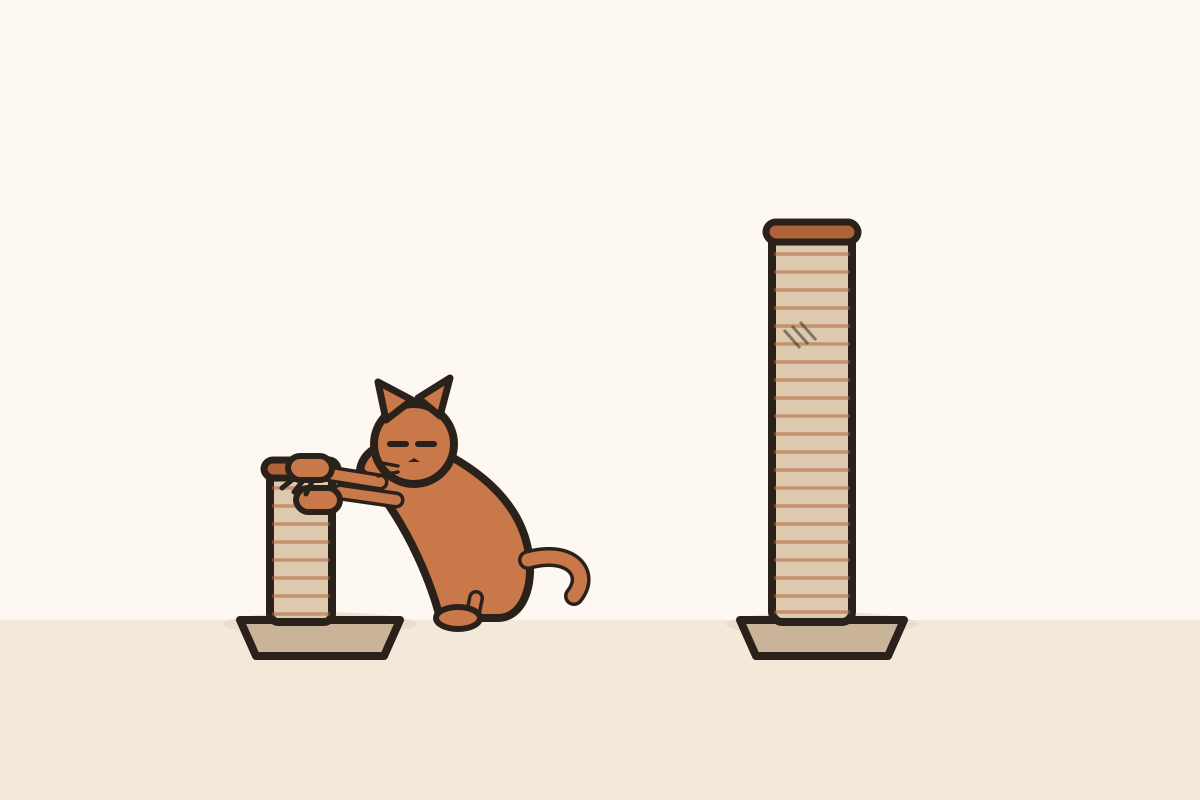
The two posts, to scale in height. Everything the “cardboard wins” claim rests on was measured against the short one.
The one experiment that put cardboard against rope
Zhang, Plummer and McGlone ran two-choice preference tests with 40 kittens under eight weeks old, published in the same journal in 2019 (DOI 10.1177/1098612X18795258). A researcher set each kitten down on each scratcher at the start of a twenty-minute session in a staged living room, then a camera measured how many seconds went into each one. Six experiments ran this way, most with six kittens per comparison.
The headline numbers, all in seconds of scratching during that twenty minutes:
- S-shaped corrugated cardboard 99.33, hemp post with a toy on top 14.92 (P = 0.03). That is not a preference, that is a rout.
- Cardboard 37.50 against a raised scratcher in long-fiber carpet 5.00.
- Cardboard 37.17 against window screen laid flat 12.50, and 23.50 against short-fiber carpet laid flat 8.50.
- Cardboard 28.00 against a long flat cardboard 7.67; 28.67 against a rectangular cardboard pad 14.00, which fell short of significance at P = 0.06.
- Cardboard 26.50 against long-fiber carpet laid flat 11.17 — P = 0.125, no significant difference.
The S-shaped pad was 47 × 24 × 12 cm, about eighteen and a half by nine and a half by four and three-quarter inches. The hemp post was 30 cm tall on a 10 cm column — a foot of post on a four-inch column, a pint glass with ambitions. The tall post was 77.5 cm high, a little over thirty inches, on a column 30 cm across and a 40.5 cm base — a foot and sixteen inches.
Dried catnip, a catnip-oil spray and hair brushed from other cats changed nothing at all. The paper explains why that is no surprise: the catnip response usually turns up after three months of age, and these were younger than that.
Two things that make it less decisive than it gets quoted
Cardboard drew 53.83 seconds against the tall rope post; the tall post drew 60.33; P = 1.00. No difference. So when rope lost, it lost as a short post, and when a rope post was tall enough to be worth using, the kittens split their time evenly between it and the cardboard.
The authors do not attribute the hemp post’s loss to its height. Their own numbers do put a tall rope-covered post level with the S-shaped pad, and the tall post is the only rope post in the paper that a kitten could stretch out on.
These were also kittens under eight weeks, tested one at a time in a room they had never seen. The authors say outright that they cannot conclude kittens and adult cats interact with scratchers the same way. The Wilson survey covers adult cats, and every age band but the ten-to-fourteen one put rope first. Set the two side by side and the disagreement is about who was asked.
Hemp is not sisal
The only controlled comparison of cardboard against a rope post that I could find used hemp. The surveys say “rope”, and Cisneros specifies “sisal rope”, but those are owners describing their own houses. I could not find a single study that put a sisal-wrapped surface against a corrugated pad under matched conditions.
Hemp is a bast fiber from the stem and sisal is a leaf fiber from Agave sisalana, and they are not the same object in the paw. A post sold as sisal is usually a paler wrap that shreds into fibers as it is used; sisal itself is the stiffer, coarser of the two, and hemp the softer. Whether a cat treats them as one surface or two has not been tested, so anyone telling you cardboard beats sisal is quoting a study about hemp and hoping you will not check.
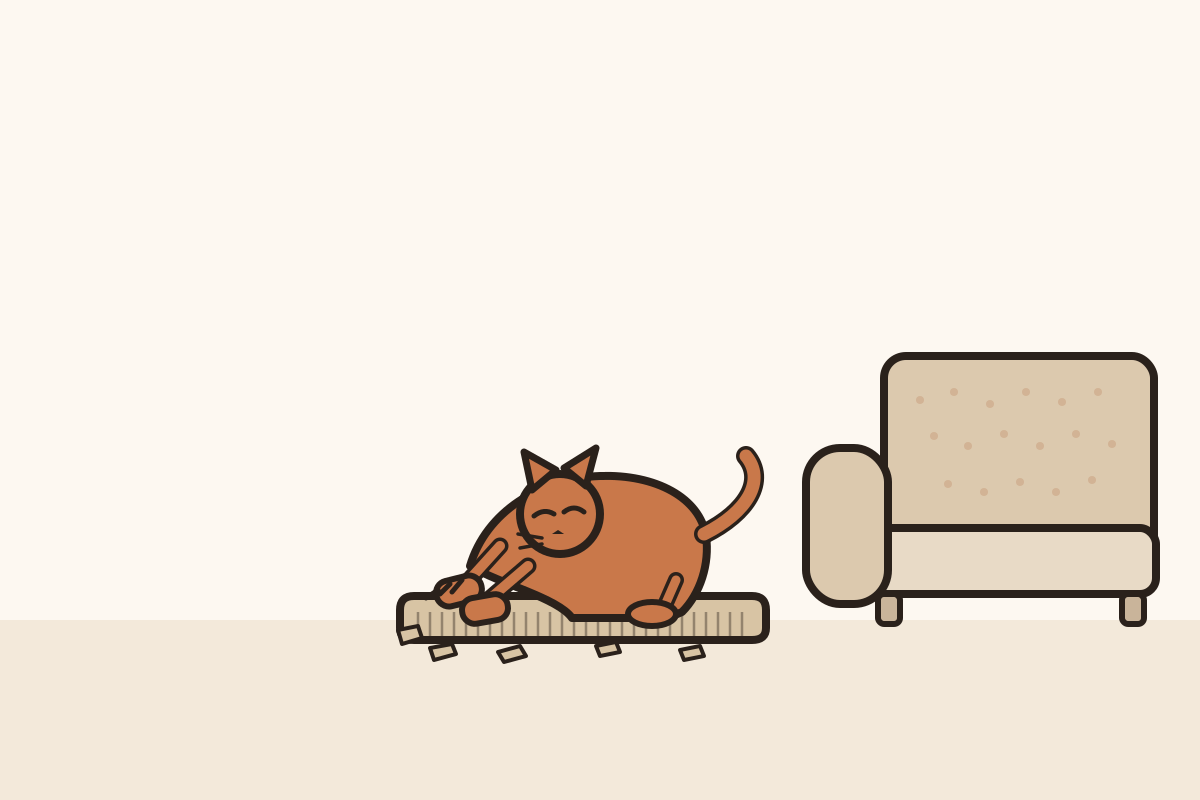
The pad is on the floor next to the thing it is meant to rescue. Placement does more work than the material in most houses.
Flat beat upright — in kittens, on window screen
The flat-versus-upright question has the cleanest possible test in the same study, though it was run on window screen rather than on cardboard. A scratcher covered in window screen was offered standing up and lying flat. Flat took 21.67 seconds, upright took 10.50, P = 0.03. Identical covering, identical size, one difference: whether the cat could put its weight on top of it. The paper’s abstract gets that comparison backwards. Its results table and its discussion both score it for the flat orientation, and the discussion comes back to it.
The authors are careful about how far that travels. They warn that it does not follow that every surface is preferred horizontal, and the same lab’s adult work is the reason for that caution. In household cats, a standing cardboard scratcher scored higher than a laying S-shaped cardboard one across seven houses, P < 0.01. Same material, same lab, opposite direction, different age group. Orientation is not a property of cardboard; it depends on who is using it and what the surface lets them do.
So the pad’s case is a kitten’s case, and a cheap one: a flat pad is the cheapest way to add a second and third scratching site for an animal that is still learning what the object is. Fifteen dollars and a bit of floor space get you corrugated cardboard in a shape a cat will stand on. A survey result that says problem scratching dropped as the variety of posts went up argues for scattering targets through the house. One monument in the hallway is a different offer.
Cardboard’s other virtue is replacement. A pad that has been shredded into a fuzzy mound goes in the recycling and a new one goes down, and the cat gets a fresh surface with the nap still crisp, which is what cats go at. Corrugated pads are usually sold as refills for a frame, and a frame plus three refills costs less than one wrapped post.
What cardboard cannot do is take a full-body pull. A cat scratching flat keeps its weight low and its claws shallow. The big stretch — front claws at the top of the reach, back legs braced, whole spine pulling down and back — needs a vertical surface taller than the cat. How tall that has to be is a separate arithmetic problem, and it is the reason a floor pad will never replace a post for a cat who likes to lean into the work.
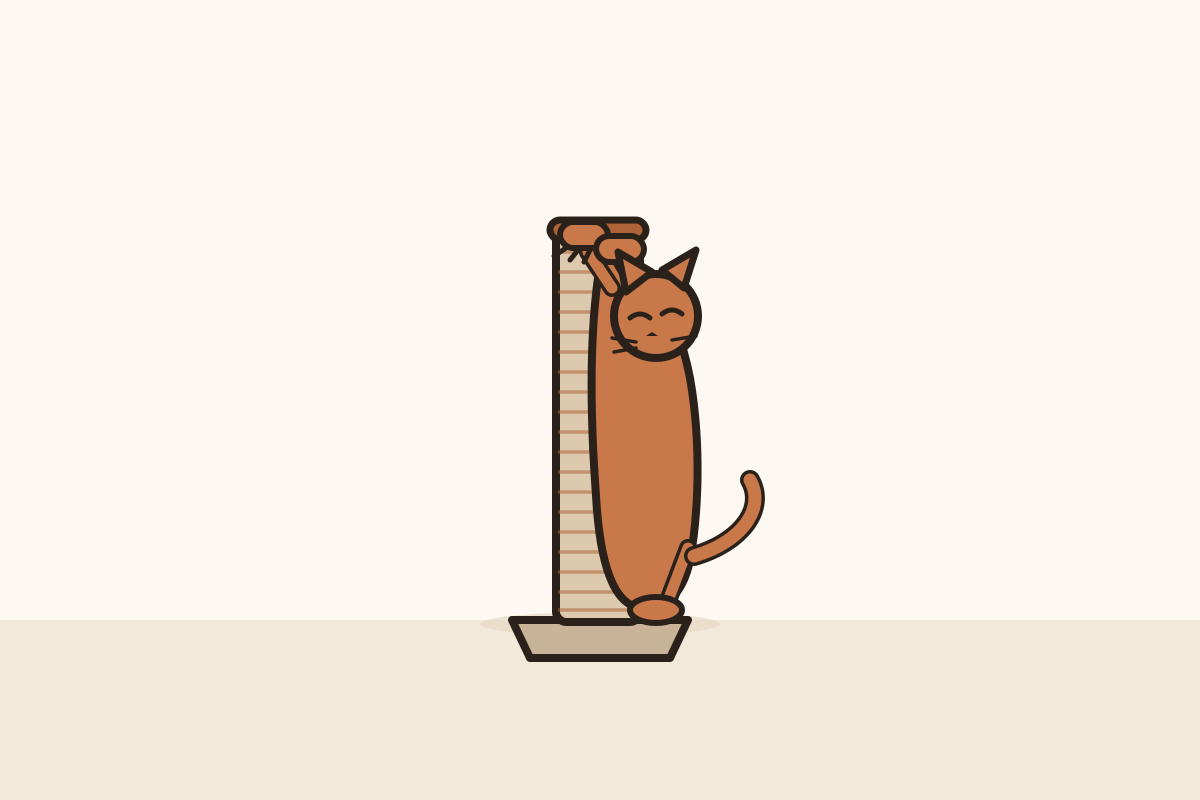
The movement a flat pad is the wrong shape for. This is the case for a tall post, and it has nothing to do with the wrap.
What sisal is genuinely better at
Sisal rope outlasts cardboard by a wide margin. No study I found counts how many weeks either survives under a real cat, so I am going on how the two materials behave in a house. Twisted rope on a solid column frays, sheds a little, and keeps its grip. Corrugated cardboard delaminates, leaves flakes in the carpet, and then stops catching claws at all, at which point the cat goes back to the sofa and you blame the cat.
Rope also holds up to the mid-scratch grab. When a cat hits a post at speed and hooks in, the surface has to resist being pulled sideways. Cardboard pads are usually jammed into a frame or lying loose, and a loose pad skates across a wooden floor, which is a wonderful way to teach a cat that the target is unreliable.
The trade is mess. A sisal post sheds fiber into the base of the post and onto the floor around it, and there is no fixing that. Cardboard sheds more, and the flakes are bigger and travel further.
Reading a listing without being taken
Most of the decision is in the dimensions, and most listings hide them in a bullet halfway down.
Height. Nose to tail base, doubled. For an average adult cat that lands near 90 cm, about thirty-five inches; a big cat needs more. A post under about 60 cm — two feet — is a kitten toy being sold to adults.
Column diameter. Between 8 and 9 cm, roughly three and a quarter to three and a half inches, is the working range for a rope-wrapped post. No study I found sets that number; it comes from how a paw closes on a cylinder — wide enough to hook around, narrow enough that claws close on it. Much thicker and the cat ends up patting the surface instead of digging in.
Base. The taller the post, the more this matters. A 90 cm post on a 30 cm base is three feet standing on one, which makes it a lever, and a cat that launches at the top will find out. Solid, wide and heavy, or bolted to a wall, or wedged into a corner.
Wrap. Continuous, tight, no visible seams going the wrong way, and staples either covered by the wrap or buried. A post with a visible staple line where a paw will land is a post that will get abandoned.
Refills. For a cardboard pad, check that refills exist and that the pad is reversible. Both sides get used and a reversible pad doubles the interval between purchases.
A cat tree counts. If you are buying a tree anyway, the Wilson survey found cats scratched rope more often when the tree had two or more levels and stood at least three feet high. The height of the whole structure is its own question, but the columns on a cheap tree are usually wrapped in carpet, and that is a reason to keep a separate post at floor level.
For the cat you actually have
A kitten is the case where a flat pad has direct experimental support, and it is the only case — the forty kittens in that study preferred cardboard in most comparisons, and flat beat upright in the window-screen test. The exceptions matter: no significant difference against the tall post (P = 1.00), the boat-shaped pad, the rectangular pad (P = 0.06) or long-fiber carpet laid flat. Buy a pad now and a post later, when the cat is big enough for the height to mean something.
A cat between ten and fourteen may be the exception the survey found: that band preferred carpet, alone among the ages, which is also why every other age group in the table above is on rope. A carpet-covered board is a real option for a stiff old cat who will not climb. The kitten study found long-fiber carpet laid flat statistically indistinguishable from cardboard, and that is the only experimental support carpet has — thin, but not nothing.
A cat who only scratches one sofa needs the new target placed next to that sofa. A post the cat cannot see from the sofa gets used, at best, by accident.
A cat who ignores everything is a different article — claws, nail length, and how the cat is handled all get a vote, and trimming without a fight is worth reading before you conclude the cat is fussy. The most common cause is still placement and height, in that order.
What this page rests on
- Wilson, Bain, DePorter, Beck, Grassi and Landsberg, “Owner observations regarding cat scratching behavior: an internet-based survey,” Journal of Feline Medicine and Surgery, 2016, 18:791–797, DOI 10.1177/1098612X15594414. Source of the 4,331 owners, the carpet-offered-versus-rope-used finding, the geriatric carpet preference, and the result that damage fell as the variety of posts rose.
- Zhang, Plummer and McGlone, “Preference of kittens for scratchers,” Journal of Feline Medicine and Surgery, 2019, 21(8):691–699, DOI 10.1177/1098612X18795258. Source of every seconds-of-scratching figure on this page, and of the flat-beats-upright window-screen result. Note what it used: hemp rope, not sisal, and kittens, not adults.
- Cisneros, Litwin, Niel and Stellato, “Unwanted scratching behavior in cats: influence of management strategies and cat and owner characteristics,” Animals, 2022, 12:2551, DOI 10.3390/ani12192551. Source of the 2,465 owners, the 58% figure, and the associations with sisal rope and flat surfaces.
- Zhang, L., “Enrichment strategies that modify cat behavioral pattern: Their applications in improving welfare,” doctoral dissertation, Texas Tech University, 2019, handle 2346/85030. Study I is the adult-cat comparison: standing versus laying cardboard across seven houses, P < 0.01 for the standing one, and rope and cardboard both ahead of sofa fabric across fourteen houses, P < 0.05. Read from the author’s own abstract; the repository blocked the full text from this network, so the per-house figures and the rope fiber are not verified here.
- Not tested anywhere I could find: a controlled comparison of sisal specifically against corrugated cardboard — Zhang put rope against cardboard and the abstract does not name the fiber — plus any measurement of how long either surface lasts under a real cat. That second gap is why the durability section above is my judgment rather than a citation. If a study exists, it needs rewriting, and I would like the reference.