You switched to pine pellets for a good reason. The bag was cheaper, it did not weigh as much as a bag of clay, and the internet said it did not track. Then the cat urinated on the bath mat, and you are standing there wondering whether you ruined something that was working.
Here is the short version. When researchers let cats choose between pellets and clumping clay, the cats chose clay. That does not make pellets a bad product. It makes them a product for a problem the cat does not have.
What happened when the cats got a vote
Two studies published in 2025 asked the same question in different ways, and they agree.
The stronger one came out of Japan. Iwabuchi-Inoue, Hattori and Kikusui gave indoor cats a choice of litter boxes and varied two things at once: how big the box was, and what was in it. The cats preferred boxes at least 50 centimetres long, and they preferred clumping clay litter. When the researchers then gave the cats a box that combined both, normal urination went up, house-soiling went down — urine and faeces both — and three separate behaviours that cats do when they are unhappy in the box got rarer (Journal of Veterinary Medical Science 87:614–620).
The second came from a behaviour practice, and it is smaller and stranger. Cassiday and Cassiday put seven litters in front of nine cats: clay, cereal, pea husk, grass seed, tofu, coffee ground and olive pit. The cats vastly preferred clay, for urinating and for defecating. Among the six non-clay options there was no strong preference at all, though the cats leaned toward grass seed for urine and coffee ground for faeces (IAABC Foundation Journal).
Nine cats is not a lot of cats, and a small preference test is not a trial. But it is nine cats choosing freely rather than nine owners remembering, and it lands exactly where the Japanese study landed.
Pellets were not in either test. That is worth noticing: the thing you bought because it was cheap is not, as far as I could find, in a published head-to-head with clay, and the closest relatives it does have — pea husk, cereal, tofu — lost.
The veterinary consensus said this before either study existed. The 2014 environmental needs guidelines from the American Association of Feline Practitioners and the International Society of Feline Medicine put it in one line: cats most commonly prefer fine-textured, unscented clumping litters (DOI 10.1177/1098612X14539092).
Fine-textured. That is the part pellets cannot do anything about.
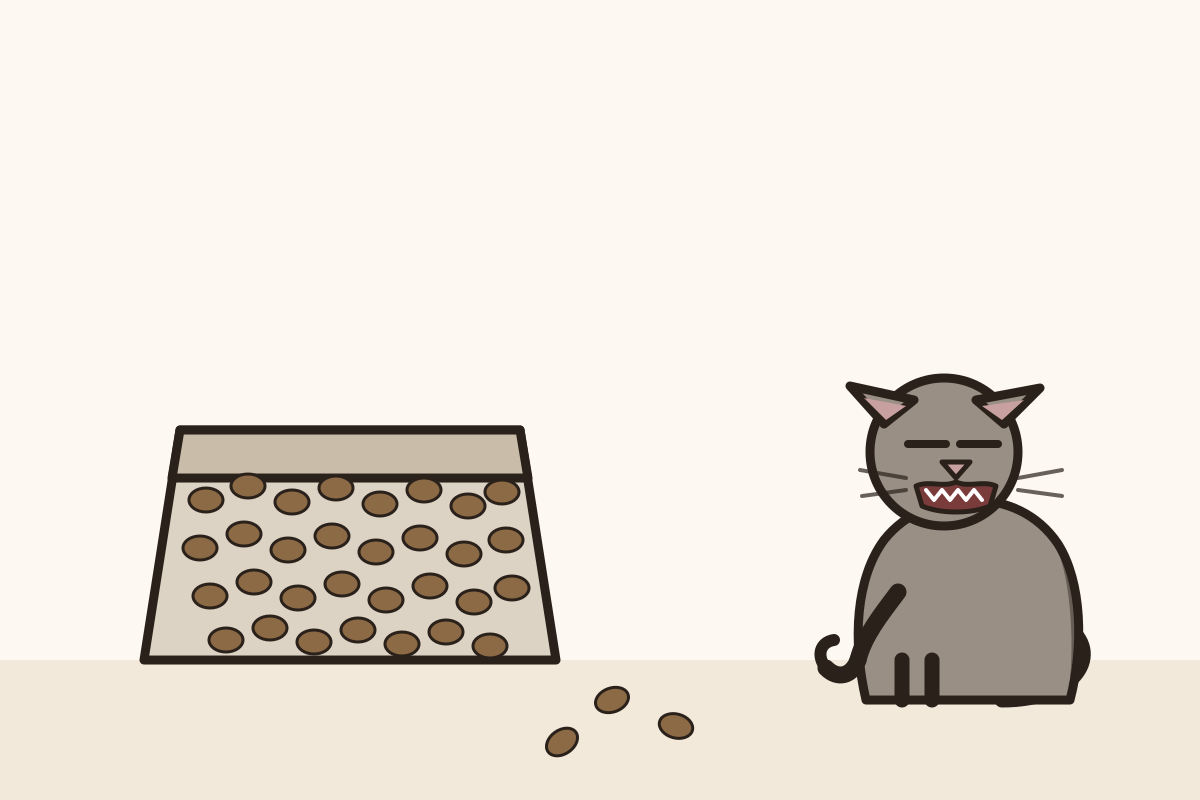
The nose is fine. It is what is under the paw.
The texture is the whole argument
A cat’s paw pads are not built for walking on marbles. Pellets are big, hard and they roll. When a cat digs in fine litter, the paw goes in and the litter closes around it; that is the surface a cat is looking for, and it is also how the cat buries what it just did.
A pellet the size of a pencil eraser gives the paw nothing to close around. Some cats dig anyway and flick pellets out of the box, which is its own kind of message. Others stand on the rim, do the job, and leave without covering, because covering is not possible.
And then the pellet gets wet and turns into sawdust. That part is the design — the sawdust falls through a sifting box and the pellets stay on top — but the cat experiences it as a floor that changes underfoot. Half the box is now wet powder that sticks to the paw. Your cat might not care. Plenty of cats use pellets happily for years, especially cats who arrived already using them.
The cats who do not are the ones you hear about, and they do not complain. They urinate somewhere else. That is why this decision is worth more than the price difference.
Where pellets genuinely win
Be fair to the product. If clay is what cats prefer, pellets are still better at four things, and the first two are real.
Weight and volume. Clay is dense. A bag of pine pellets of the same weight takes up much more space, so for the same bulk in your cupboard you are lifting less, and the bag is easier to get up the stairs.
Price. Pine pellets are sawdust compressed under heat and pressure. Wood fuel pellets for a stove are usually the same thing — sawdust compressed under heat and pressure — with a different picture on the bag, and they cost a fraction as much. Check that the bag says 100 % wood with no accelerant or additive, and you have bought cat litter. That is where the saving actually lives.
Dust. Clumping clay is sodium bentonite, and bentonite contains crystalline silica. Whether that matters at the levels in a normal household is a real question with an uncomfortable answer, which is the next section.
Tracking. Pellets do not cling to a paw the way fine grains do. The sawdust does, so this advantage is smaller than the internet claims, and it disappears entirely once the box has been used for a week.
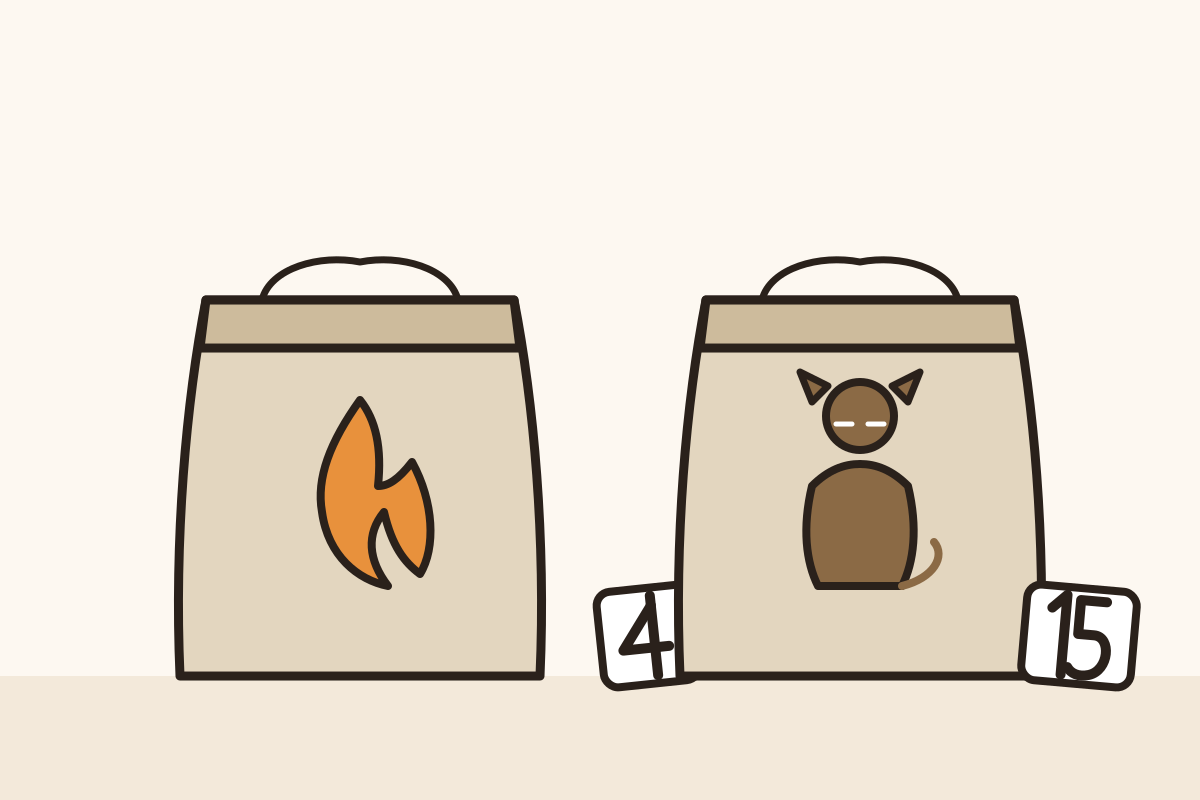
Nearly the same sawdust. One of them has a cat on the bag.
The dust question, honestly
There is a case report, posted as a preprint, of a 44-year-old woman with chronic silicosis and end-stage renal failure. She had never worked with stone or sand. She had kept nine cats in a 44-square-metre flat for eighteen years, with nine litter boxes, all filled with bentonite clay litter. Silica was found in her lung tissue and in her litter (Hubska and colleagues, 2022).
That is one case, at an exposure level almost nobody has. Nine boxes in forty-four square metres, for eighteen years, is a room where the air is clay dust. If that is your flat, this paragraph is for you and you should ventilate and probably switch something.
If you have two cats in a house with a window, the honest reading is that this case tells you clay dust is not nothing, which is different from clay litter being dangerous. Nobody has measured the risk at normal household levels. Pellets throw far less dust into the air when you pour them, and if dust is the thing that decided it for you, pellets are the right answer and your cat is paying for it. The sawdust they turn into is still dust, just dust that stays out of the air and in the box.
The cost nobody adds up
Pellets look cheaper per bag and often are not cheaper per month, because of how they fail.
Clay clumps. You scoop the clump and the rest of the box is still litter. Pellets do not clump: urine soaks into the pellet, the pellet collapses into wet sawdust, and the sawdust sits at the bottom of the box holding the smell. To get it out you need a sifting box, and even with one you are emptying the whole box far more often than you scoop a clay box.
So measure your own bag rather than the shelf price. Time how long a bag lasts now, on clay. Then estimate how long the same volume of pellets would last, given that everything wet goes out instead of being scooped around. If a bag lasts three weeks today and would last ten days on pellets, you will be buying roughly twice as many bags, so pellets have to cost less than half as much per bag to break even. In most shops the fuel-pellet trick clears that bar easily, which is the actual reason to use them.
If you still want to try it
Switch in one box, not all of them. Keep every other box on the litter that works. That way a refusal costs you one box and one week instead of a carpet.
Put the new box next to the old one and let the cat pick. Do not remove the old box until the new one has been used for a week.
Do not mix pellets into clay to “transition gradually”. The mixture is worse than either one: you get clay that will not clump properly and pellets that cannot be sifted out.
If the cat uses the pellet box for a week and then stops, the answer is not more time. Cats do not acquire a taste for a floor.
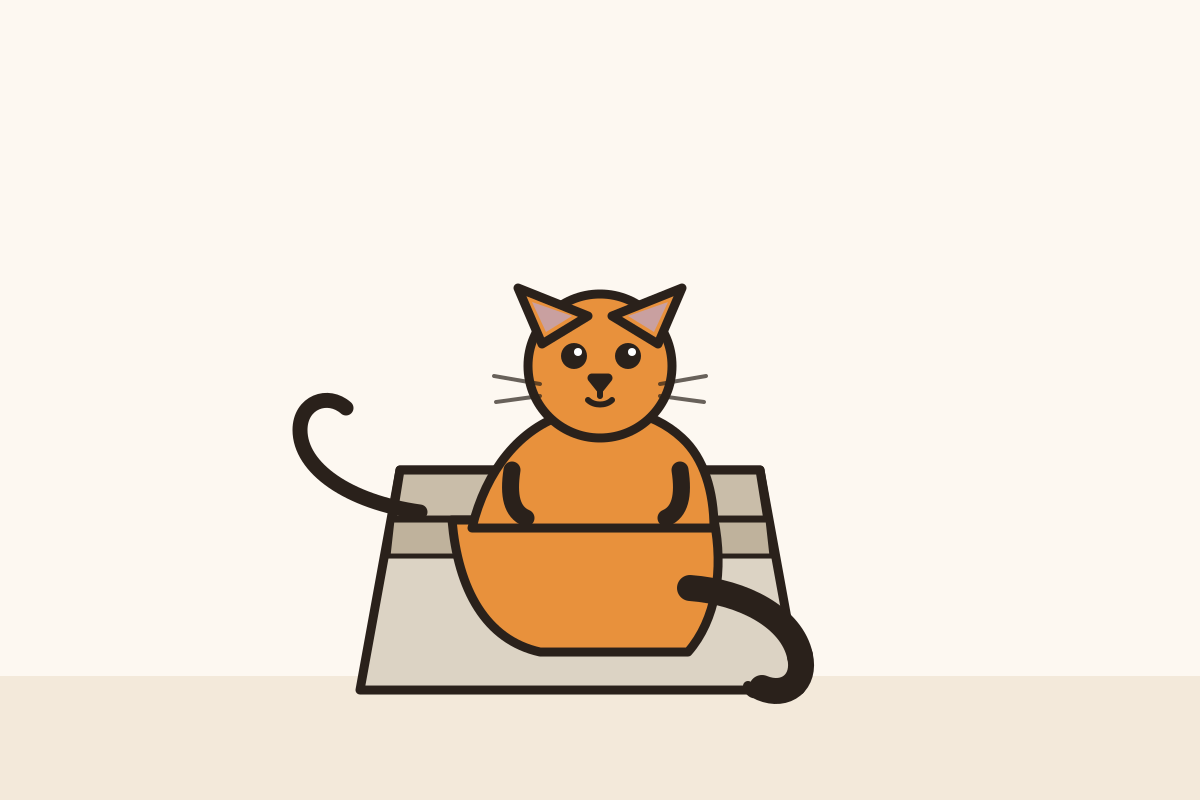
This box is smaller than the cat. That is a separate problem from the litter.
What to buy
Clumping clay, unscented, fine-grained, if you are choosing litter for the cat. That is what both 2025 studies found and what the 2014 guidelines say. Unscented matters separately: the smell is for you, and the cat has a better nose than you do.
A box at least 50 centimetres long, and ideally one and a half times the length of the cat from nose to base of tail. The Japanese study found 50 centimetres was the threshold; the older guideline gives the formula. Plenty of boxes sold for cats are smaller than that.
Pine pellets if you have a specific reason: dust sensitivity in the household, stairs, a cat who already uses them, or a budget that genuinely does not stretch. Then buy fuel pellets and a sifting box, and expect to change the whole box every week or so.
Not silica gel crystals as a compromise. They are not clumping, they are not fine, and the cats in either 2025 study were not offered them, so nobody knows whether they like them.
How to tell you got it wrong
The sign is not the smell and it is not the mess. It is a cat standing on the rim of the box with all four paws, or a cat who leaves without covering, or a cat who urinates on something soft and absorbent next to the box.
Those are not preferences. They are a cat telling you the box is not usable, and a cat who has decided the box is not usable will keep that opinion after you change the litter back, for a while. Which is why the cheapest move is to change one box at a time and keep a working one in reserve.
The bag price is the smallest number in this decision.