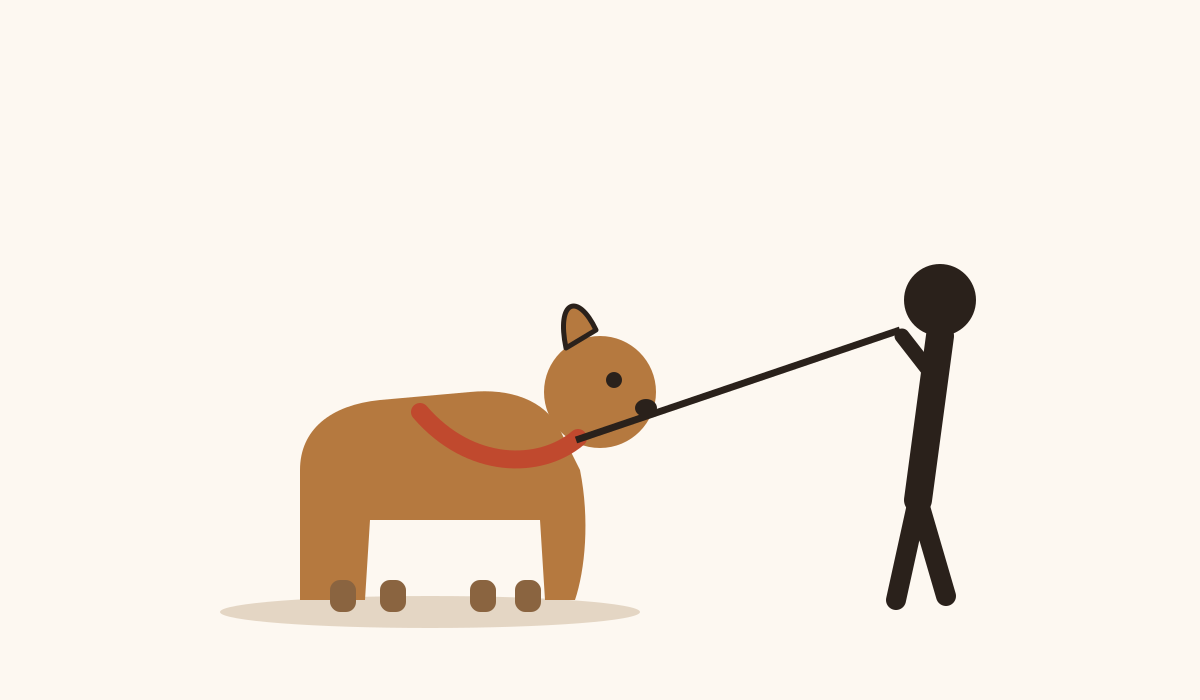
You bought the harness because the dog was walking you. Now the dog walks you slightly less, and every few months someone in a forum posts a diagram of a shoulder blade with an arrow through it, and you wonder whether you traded one problem for another.
The honest answer is: possibly. The harness is not a scam. It is a compromise, and the two things you want from it pull in opposite directions. Almost nothing you can read online will tell you which way the trade actually goes.
There is now decent research on it. Three things are worth knowing, and they do not agree with each other, which is the interesting part.
What the 2025 review found
Cavalli and Protopopova published a review in Animals in July 2025 covering 21 papers and two conference abstracts on collars, harnesses and head collars (full text at PMC12345489, open access). Their search was done in Google Scholar in early 2025 — one database, which is a limitation of the review and also why it is as current as it gets.
Their conclusion for pullers is the one line to take away: for dogs that pull, non-tightening front-clip harnesses appear to offer the best balance between discomfort and reduction in pulling.
Read the qualifier carefully. “Non-tightening” rules out the harnesses that cinch under load. “Balance” is doing real work — it is not saying the front-clip is the most comfortable choice, only that it is the least bad compromise between two things that cannot both be maximized.
And something uncomfortable follows from their logic: a harness that never bothered a dog would not stop it pulling. That is not a scandal, but it is not what the packaging promises either.
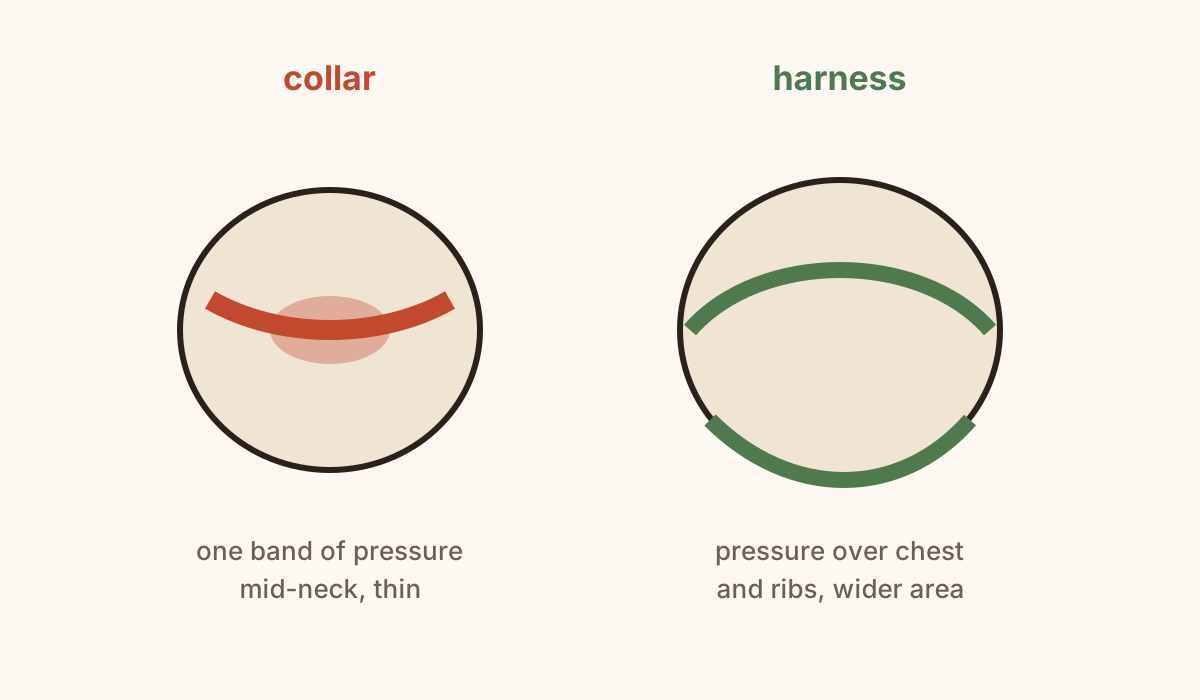
The collar concentrates everything into one thin band. The harness spreads it, which is not the same as removing it.
What the gait study found
In 2024, Dowdeswell and Churchill at University Centre Reaseheath filmed 30 dogs walking on a leash in six harness types and a base collar, 21 videos per dog, and measured shoulder and elbow flexion and extension (Reinvention, full text).
Two results matter here.
For clarity about the pair the rest of this rests on: the straight-front runs its chest strap straight across the chest and fastens behind the shoulders; the front-clip puts the leash ring on a loop at the centre of the chest, and the strap angles toward that ring.
The straight-front harness allowed the most shoulder and elbow movement of the other five. The front-clip harness allowed the least.
That is the front-clip. The one the review just recommended for pullers.
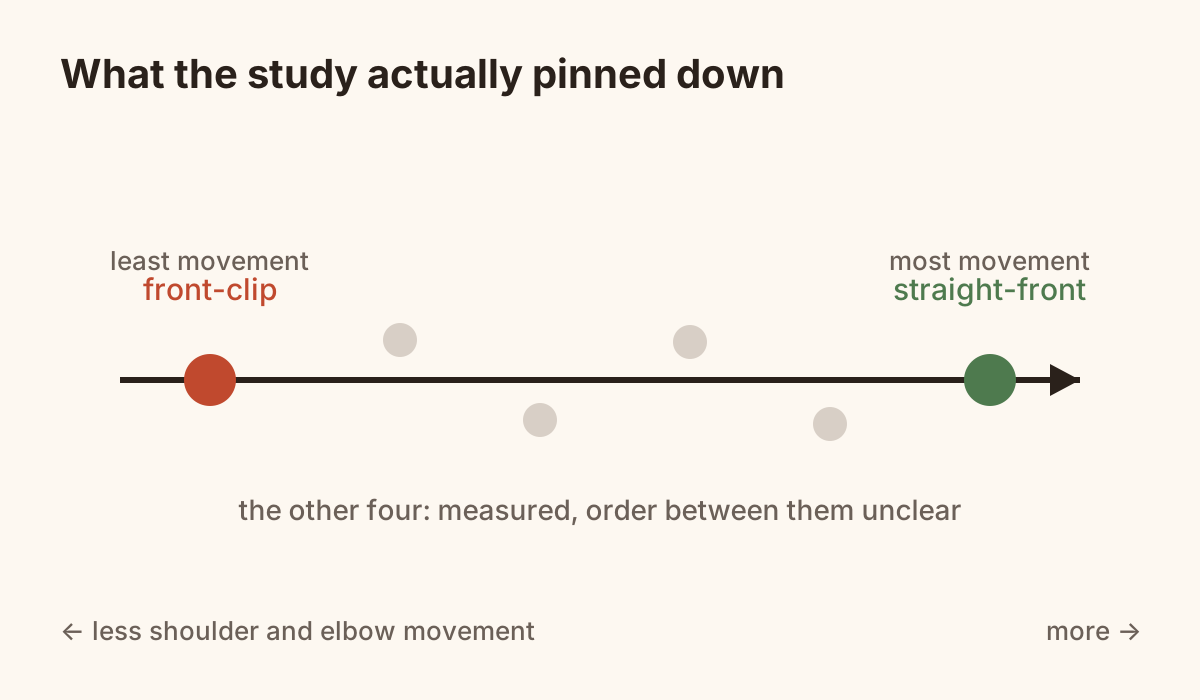
It fixed both ends. What sits between them is not something this study settles.
It is worth being precise about what this does and does not mean.
It means the design the review recommends for a dog that pulls is also the design that leaves the shoulder the least room. It does not mean the front-clip injures shoulders, or causes arthritis, or that you should throw yours away. A difference in range of motion is not the same thing as harm, and I do not know of one that measures harm rather than range of motion.
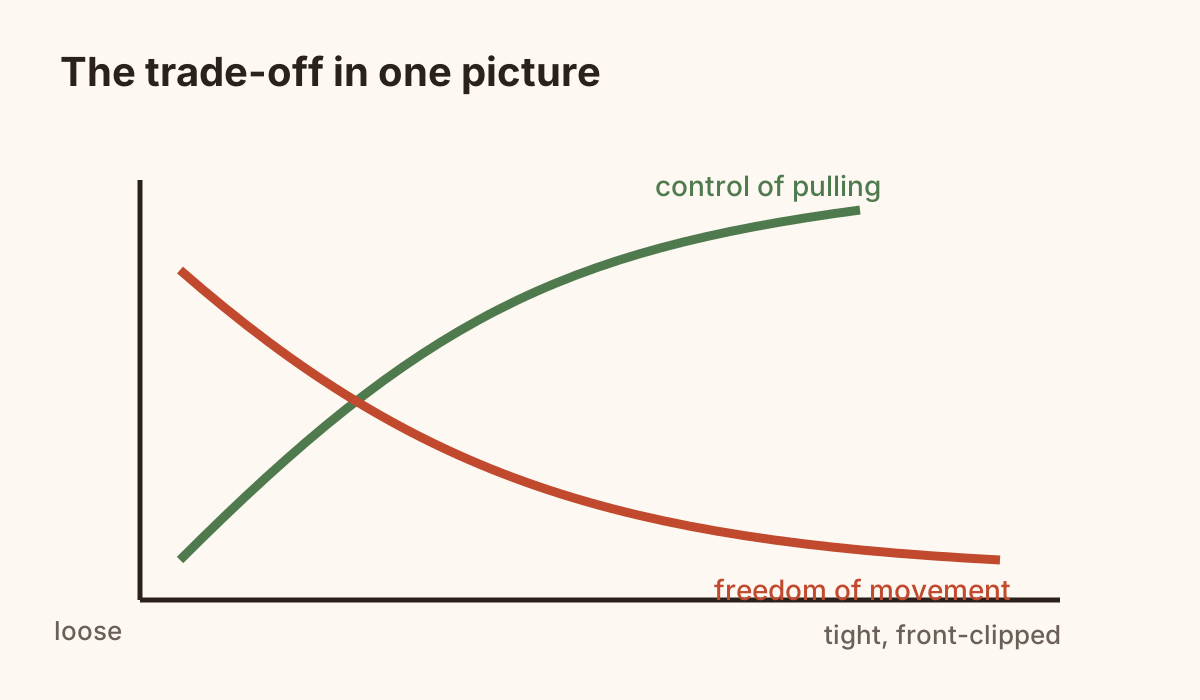
A sketch, not a measurement: two things you want, one dial. Turning it up for one turns it down for the other.
The part where the research argues with itself
The two findings above are compatible only if you accept the trade-off. But the review found the pulling data themselves are a mess, and that is worth saying out loud.
Some studies found more pulling with a chest-strap or Y-shaped harness than with a flat collar. Others found more pulling with a collar that tightens than with a front-clip. Cavalli and Protopopova read the first pattern as evidence that pulling goes down when the device is uncomfortable — the dog pulls less because pulling has a cost. Their explanation does not cover the second result nearly as well. A collar that tightens is uncomfortable, so by that same logic it should reduce pulling more than anything else, and the study that found more pulling with that collar says the opposite of what the logic predicts. I would rather leave the two results sitting next to each other than pretend one explanation covers both.
The 2024 study cites an earlier team (Pálya and colleagues, 2022), who tested two “restrictive” and two “non-restrictive” harnesses and explicitly declined to recommend one, because the results depended on the individual dog’s build and on what the harness was being used for.
Two more results belong here. One cuts against everything above: Nagymáté and colleagues (2018) tested three harnesses and found no significant differences between them and off-leash movement at all. So the same question has come back with a null result and a trade-off, on small samples of dogs filmed for a few strides each.
So the strongest honest statement is not “buy the front-clip”. It is closer to: the front-clip is the best-documented compromise for a dog that pulls hard, and the amount of shoulder movement it costs you is not something anyone has measured against an outcome that matters.
If the dog never pulls, none of this applies, and the choice comes down to which clip and how tight.
What this means if your dog does not pull
Then the recommendation flips, and this is the part most people miss because they only read the pulling section.
The review’s suggestion for dogs who already walk on a loose leash is a chest-strap or Y-shaped harness with a back clip. No control needed, so no reason to accept the restriction. You are buying fit and comfort, and the front attachment that helps a puller buys you nothing.
If your dog walks nicely and you put it in a front-clip because that is what the shop had, you are paying a reduction in shoulder movement you have no use for.
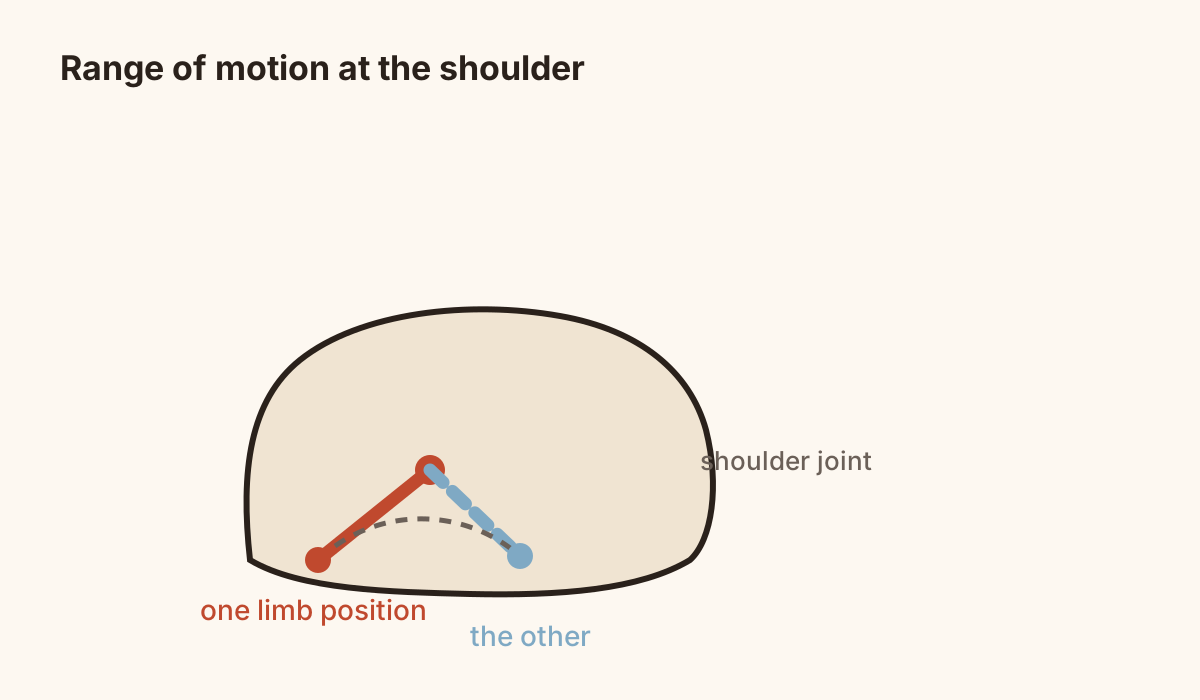
Range of motion is what the studies measure. It is also what a harness, any harness, changes.
Where collars actually lose
Collars are not automatically cruel and harnesses are not automatically kind. The review is clear about where collars do worse, and it stays specific rather than moral.
All the collars they looked at were capable of causing injury, particularly ones with a small surface area pressing mid-neck. Padding does not reliably fix this. In some of the designs tested, the padding may concentrate pressure and raise the injury risk rather than lower it.
Neck pressure rises when you walk in circles, and leash tension rises on a complex route. Which describes, more or less, every walk.
Eye pressure. Studies found intraocular pressure higher when dogs pulled in a collar than in a harness, and for brachycephalic breeds the difference appeared in collars and not in harnesses. The review does not go on to give advice about glaucoma or eye disease in general, so neither will I. What it supports is narrower: for a flat-faced dog, a harness produced the smaller pressure change.
Where head collars land
A head collar works by turning the dog at the head, which is why trainers reach for it on a strong dog. What the review actually measured was welfare: compared with a flat collar, dogs in head collars crouched more, carried the head and ears lower, and pawed at their faces more. Among head collars, no design beat another. The dogs adapted within sessions, and the review notes that the behaviors were still there in the last one — so “adapts quickly” and “stops doing it” are not the same finding. Control itself was not what was being measured.
Nearly every device helps you control the dog by doing something to the dog. The differences are in how much, and where.
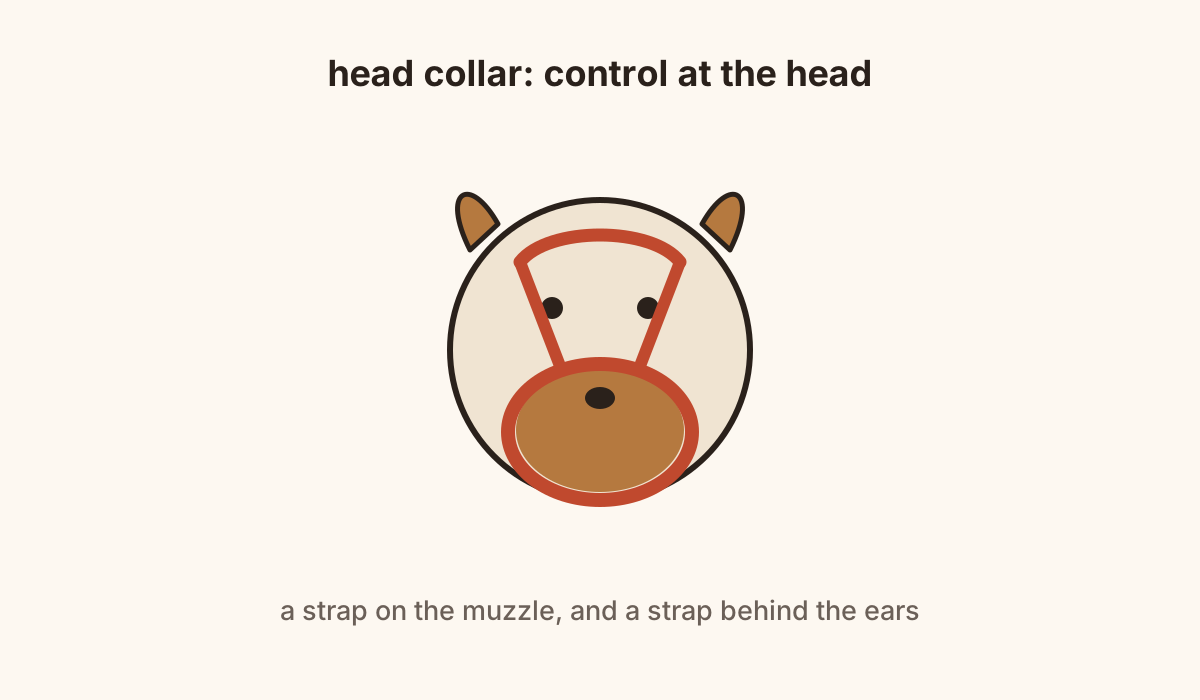
The head collar solves the pulling problem by moving it. It does not make it disappear.
What to actually buy
If your dog pulls hard: a non-tightening front-clip harness. Not a tightening one, not a “no-pull” one that cinches when the dog leans in. Fit is the variable the studies keep naming, and one of the few things you can check at home: check it with the dog standing, sitting and lying down, and check that the straps do not tighten when the dog leans into the leash.
If your dog walks loose: a Y-shaped or chest-strap harness with a back clip, or a flat collar if the dog genuinely never loads the leash. Not because the collar is better in the abstract, but because the review only supports collars for dogs that consistently walk without tension, and you know whether yours does.
There is a knot in that advice that the review does not untie. One of the studies it cites found a Y-shaped harness limited shoulder extension more than a chest-strap. I have that from the citation, not from the original. On this one measure, it makes the chest-strap the freer of the two. The review still names both, because the evidence is too thin to drop either. If you are choosing between just those two, that is the difference nobody has settled for you.
If your dog is flat-faced: on eye pressure while pulling, the collar is the weaker option. That is the measure the review reports for these dogs, and it is not the whole story about collars and flat faces.
And whichever you pick: the harness is not the training. A front-clip makes a hard-pulling dog easier to hold this week. What changes the walk is loose-leash work done over months. The review recommends reward-based training alongside the gear, and it names the training first.

The dog in this picture is not testing anything. It is just not pulling, which is the state every device on the market is trying to produce.