You have read that cats prefer running water. Maybe you have watched your cat ignore a full bowl for two days and then drink from the faucet. So you bought a fountain, and now you are wondering whether the thing on your kitchen floor is doing anything except humming.
The honest answer is a strange one. Across the average of the cats measured, moving water did not make them drink more. Across individual cats, some of them clearly did care — and they did not care in the same direction.
What was actually measured
Three sources do most of the work here, and they do not contradict each other as much as they look like they do.
The first is a small crossover trial in pet homes. Thirteen healthy cats had their water intake, urine osmolality and urine specific gravity measured over 24 hours, once with a bowl and once with a fountain (abstract, Grant 2010, Journal of Feline Medicine and Surgery). One cat developed excessive barbering — over-grooming to the point of hair loss — along with vomiting and a refusal to drink from the fountain, and was withdrawn. For the remaining twelve, intake was slightly higher from the fountain — but urine osmolality was not significantly different. The authors’ own conclusion is blunt: the fountain failed to substantially increase intake or dilute the urine.
The second is the one worth reading in full. Sixteen healthy cats on a dry diet, individually housed with urine collection, went through a randomized crossover with three water systems: still, circulating, and free-falling. Two weeks per system, with a week of acclimation between each (full text at PMC10814304, 2019). Fourteen cats completed it. Water intake was measured daily by weighing the bowl, with spillage and evaporation accounted for.
Average daily intake, urine volume, urine specific gravity, and the saturation of urine for both struvite and calcium oxalate were not significantly different between the bowls.
One measure did differ. Urine osmolality was significantly higher in the circulating bowl than in either the still or the free-falling one. The authors say plainly that the implication is unknown, since intake itself did not differ. I am not going to build a theory on it either.
The third is a scoping review of 32 publications from 1975 to 2025 on water intake and hydration in cats (full text at PMC12893781, Journal of Animal Science). Its summary line on this question is the cleanest thing anyone has written: water intake was not affected by fat content or by water source type, static or flowing.
One caveat about the count. The 2026 review covers 32 papers published since 1975, and it is very likely that Grant 2010 and the 2019 trial are among them. So this is not three independent confirmations. It is two measurements and a review that has probably already read both.
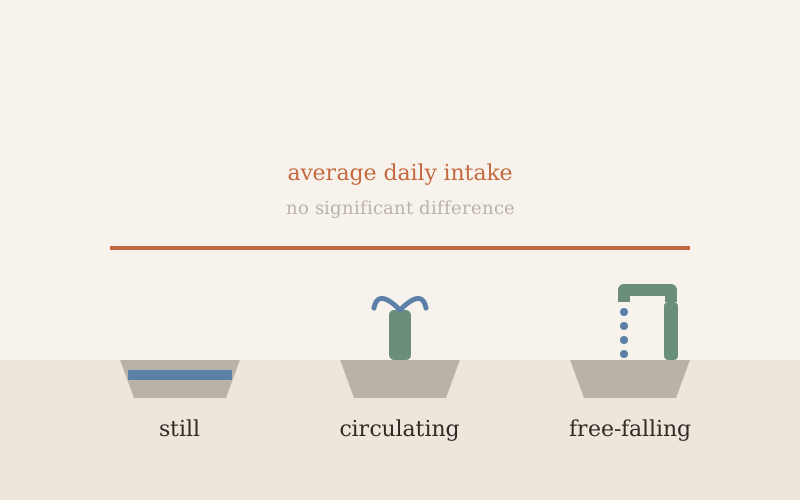
Three ways to present water, and one flat line underneath all of them.
The part the averages hide
Here is where the article stops being a debunk.
In that crossover trial, three individual cats showed a statistically significant preference for one system. Cat 4 preferred circulating to still. Cat 10 preferred free-falling to circulating. Cat 11 preferred still to circulating.
Three cats, three different answers. One of them chose the plain still bowl.
Fourteen cats is small. Three with a detectable preference could be noise, and the authors do not claim otherwise. But it fits something you have probably noticed: cats are not one animal with one preference, and a fountain that transforms one cat’s drinking can sit untouched in another house for a year.
So the question “do fountains work” has no single answer, and the averages are not lying to you. The finding is that the effect sits in the cat, not in the fountain. For most cats it is close to nothing, and for a minority it may be real and points in a direction you cannot predict from the label.
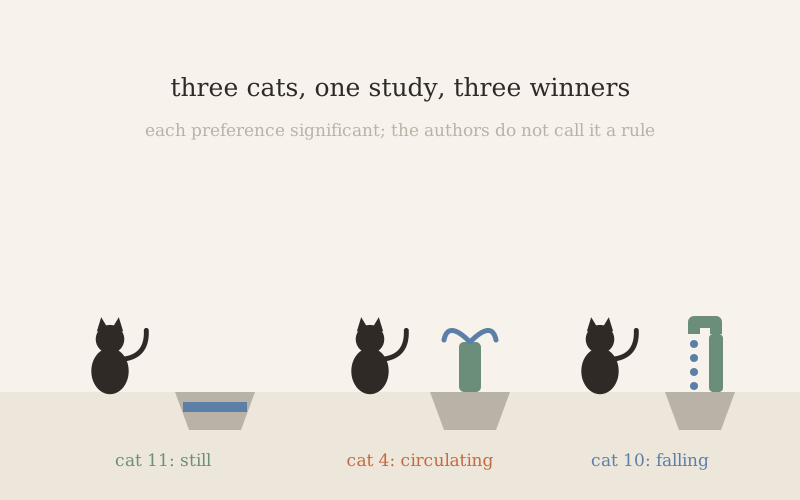
Three cats from the same study, three different winners.
What actually moves the number
If you want a cat to take in more water, the lever with evidence behind it is not the bowl.
The scoping review found total water intake across five groups of healthy domestic cats at 23 to 51 mL per kg of body weight per day, with eight further papers reporting 70 to 293 mL per day. It also notes the number varies widely within and between studies, and that no optimal intake has been established. So there is no target figure to hit, which is uncomfortable but honest.
What did move intake: diet format. Cats on a dry diet had lower total water intake and higher urine specific gravity. Among the cats taking in 42 to 51 mL per kg, urine specific gravity was usually under 1.035 — a common marker people aim for — and the review says that was reached only with a wet diet, or with a dry diet plus water that had nutrients added to it.
That is a bigger lever than any fountain. A pouch of wet food is water your cat eats. Which is also why the fountain question is so often asked by people whose cats are on dry food and who would rather buy a device than change the food.
I am not going to pretend those two things are equally easy. Some cats will not touch wet food, and some households cannot afford it. But if the goal is water intake, the fountain is the expensive way to probably not get there.
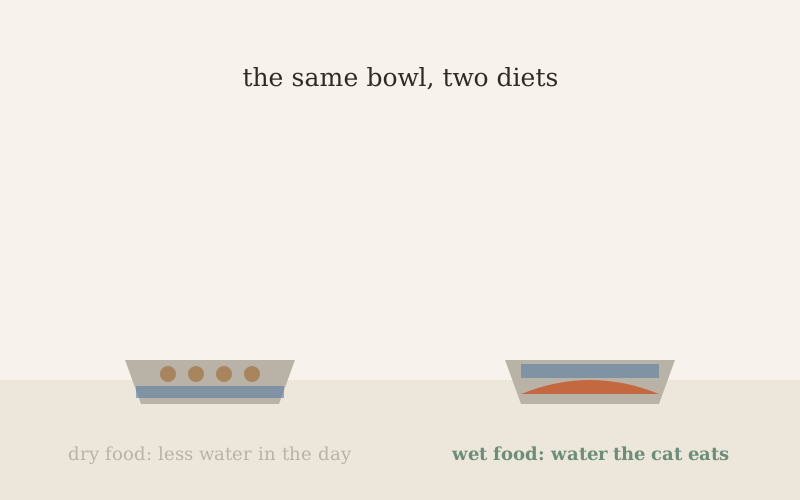
A pouch is water the cat eats.
The things buyers ask about that nobody measured
Fountains come with claims. Most of them are not in any of these three papers, and I would rather say so than quietly imply the research covers them.
“Cats prefer running water because it is fresher.” Not tested in these studies. The review’s finding is about intake, not preference, and it found no intake effect from flowing water.
“A fountain stops crystals forming.” The crossover trial measured struvite and calcium oxalate saturation directly, in urine, and found no significant difference between the bowls. Saturation is the value used to estimate the risk of crystals forming, and the study could not detect a change in it.
“Filtered water is healthier.” None of these studies compared filters. The 2019 trial compared how water was presented, not how it was cleaned.
“My cat only drinks from the faucet.” That one is real behavior and the studies do not explain it. A cat can prefer a running faucet and still not drink more overall when you put a pump in a bowl, and the second measurement is the one that decides whether the fountain is worth its price and its cleaning.
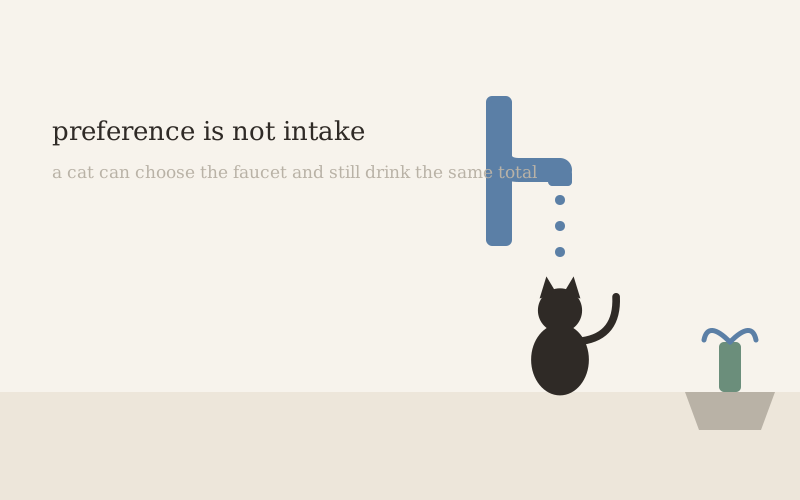
What a cat reaches for and what a cat drinks in a day are two different measurements.
How to find out about your own cat
Since the average is uninformative and the individual effect is real, the only way to know is to measure your own animal. It takes three weeks and a kitchen scale.
Weigh the water you put down and the water left after 24 hours, for seven days with the bowl, then seven days with the fountain, with a week in between when both are out. The 2019 trial did something close to that, and for a reason: without the buffer you are mostly measuring the switch, not the bowl. Account for what the fountain loses to evaporation. A pump and a falling stream lose more than a bowl does, and that loss looks like drinking if you only weigh what disappears.
Then judge on something other than volume if you can: how often you scoop the litter box, and whether the clumps got bigger. Urine specific gravity is the measure the studies trust, but that needs a vet and a sample, and it is not a fair thing to ask of yourself at home.
If the numbers come out the same, you have bought a fountain for the sound. That is allowed, as long as the sound does not convince you the cat is better hydrated.
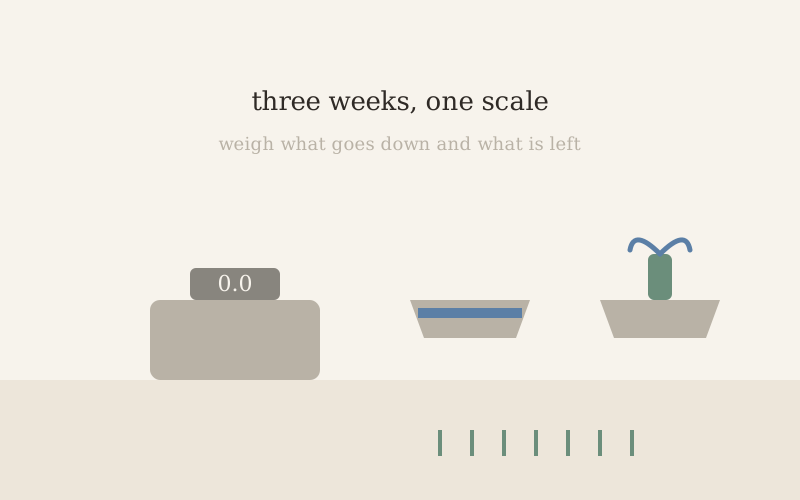
Three weeks, one scale, and a number that belongs to your cat.
The same shape of question turns up with raised dog bowls: a product sold on a health claim, two studies that disagree, and a disagreement that carries more information than either result alone.
What I would actually do
If your cat is on dry food and you are worried about hydration: change the food before you change the bowl. That is where the measured effect is.
If you already have a fountain and the cat uses it: keep it, and clean it properly. A pump, a filter and a reservoir are three places for biofilm, and none of these studies looked at what a dirty fountain does. The cleaning burden is the real cost of the device and it does not appear in any comparison table.
If you are about to buy one: buy it for the reason that survives the evidence. Some cats do prefer moving water. In that study, three of fourteen cats showed any detectable preference: one chose the plain bowl, one chose one moving system over another moving one, and one preferred moving water to still. Yours may be that last cat. Do not buy it expecting the average cat to drink more, because in the trials that measured it, the average cat did not.
If your cat has had crystals or cystitis: this is a conversation with your vet about urine specific gravity and diet, not a shopping decision. The review’s own framing is that water intake targets are poorly established, which is exactly why a device cannot be the plan.
The machine is doing its job. The cat has his own schedule.