
A bowl stand is a cheap piece of plastic, and most of them carry the same line on the box: easier on the neck, better digestion, helps prevent bloat.
That last claim is the one worth checking. Bloat — gastric dilatation-volvulus — can kill a dog in hours. If a plastic stand prevented it, it would be the cheapest life-saving device in the house.
So I went looking for the evidence. When Louise Buckley reviewed it in 2017 there were exactly two studies, they disagreed with each other, and the one that found an effect found the risk going up, not down.
It ends with something you can do that costs nothing, which for once is not a figure of speech.
What bloat actually is
The stomach fills with gas and twists on its own axis. The blood supply to the stomach is cut, the dog goes into shock, and without surgery the outcome is usually death. It is a disease of large, deep-chested dogs, and it is one of the few things in a dog’s life where the timing of your decision is measured in hours.
Two studies, and a disagreement
Buckley’s review for Veterinary Evidence, a peer-reviewed journal from the RCVS Knowledge library, is blunt: only two studies address the question and their findings conflict (Buckley 2017, DOI 10.18849/ve.v2i1.57, open access).
The first is a genuine piece of fieldwork. Glickman and colleagues followed 1,637 dogs from eleven large and giant breeds for up to 58 months, from 1994 to 1999, and 98 of those dogs developed bloat (DOI 10.2460/javma.2000.217.1492). It was a prospective cohort: owners were asked about the bowl at enrolment, and the dogs were then watched. That design is worth a lot, and it is why this study carries the argument.
Feeding from a raised bowl raised the risk. The adjusted relative risk across the whole cohort was 2.10, with a 95 percent confidence interval of 1.4 to 3.30.
The second study is an internet survey by Pipan and colleagues (DOI 10.2460/javma.240.12.1456), with 2,551 respondents. Here is the part that rarely gets mentioned: its finding on raised bowls appears only in the discussion, with no numbers attached anywhere in the results. Buckley’s verdict is that this makes it impossible for a reader to check the conclusion. So “the other study found nothing” is true as far as it goes, and softer than it sounds: Pipan’s team did report that raised bowls were not significantly associated with bloat, in the discussion, and did not put the numbers in the results where a reader could weigh them.
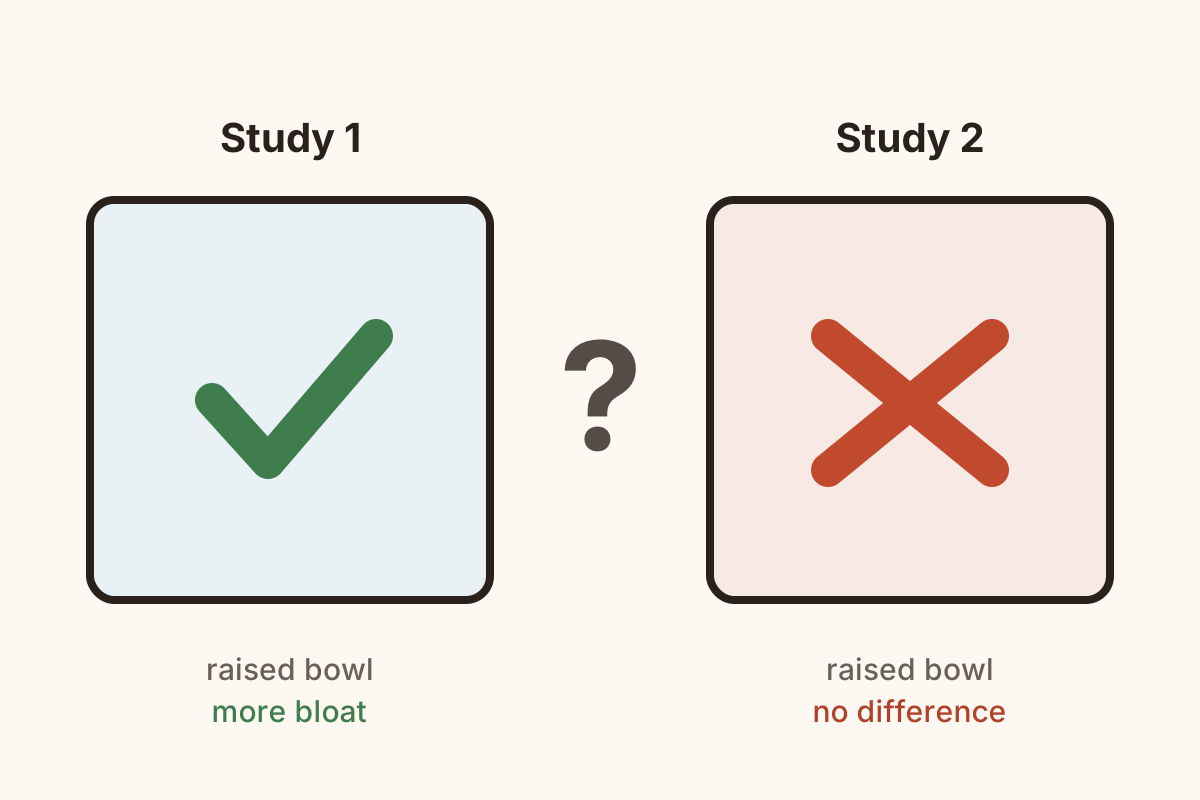
Two studies. One finds a risk, the other reports a finding without the numbers. That is the whole evidence base.
The detail almost nobody reports
Within Glickman’s cohort the direction split by the size of the dog, and the split is sharper than the summaries suggest.
For the large breeds, a bowl about a foot — 30 centimeters — or lower carried a relative risk of 3.06 against dogs not fed from a raised bowl, with a confidence interval of 1.60 to 5.87. A bowl higher than that was not significantly different from the floor, which is a weaker statement than it looks: the rate in that group was still 29 per 1,000 dog-years against 18 on the floor. No difference was detected. The number was not lower.
For the giant breeds it reversed. A bowl of a foot or lower was no different from the floor. A bowl higher than a foot carried a relative risk of 2.29, interval 1.15 to 4.58.
Read that carefully, because it does something awkward to the shopping advice. For a large breed, the low stand is the one that stands out and the tall stand is the one where no difference was detected. For a giant breed, the tall stand is the one that stands out and the low stand is the one where no difference was detected. The same 30 centimeters divides the two, and which side is dangerous depends entirely on which dog is eating.
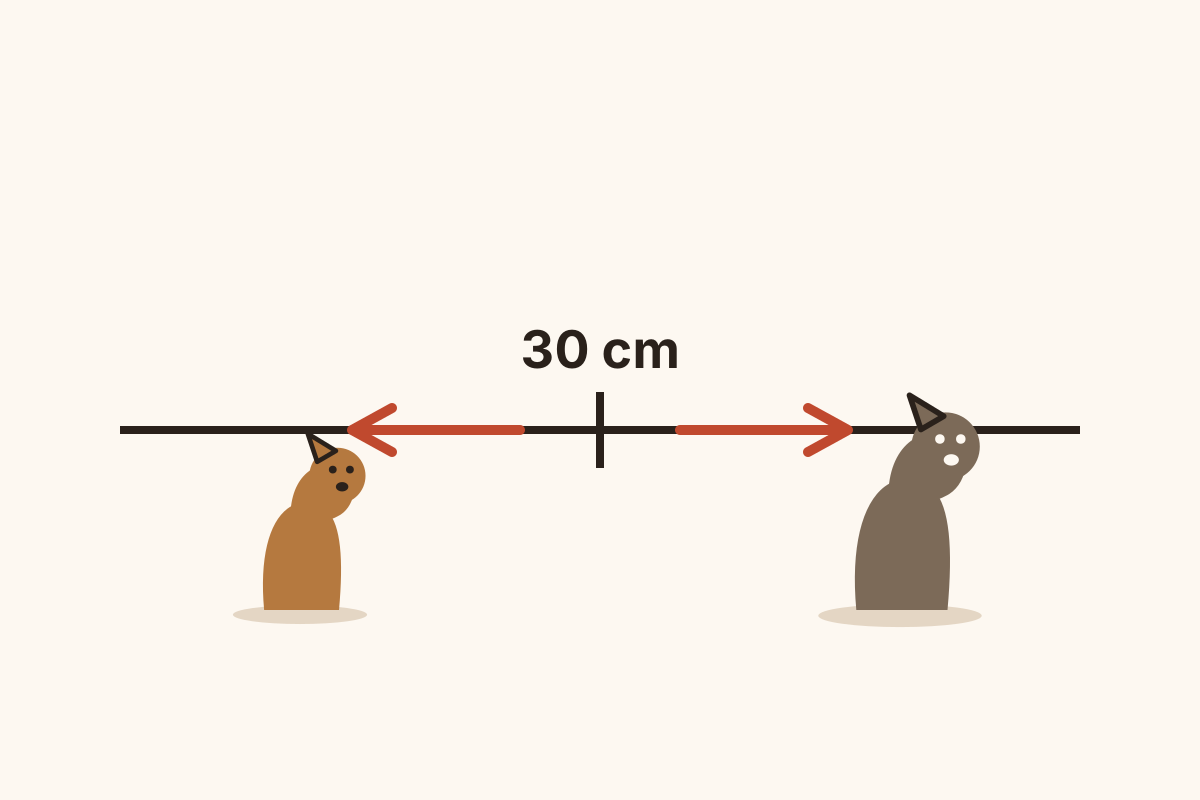
About 30 centimeters. Risk sits on one side for a large breed and on the other side for a giant one.
From what I see for sale, a stand marketed as the right height for a large breed usually lands around or under thirty centimeters. That is the band that carried the extra risk for exactly those dogs. I have not measured a single product, so take the market half of that sentence as an impression rather than a survey.
The authors offered no explanation for the reversal, and Buckley notes that the numbers of dogs in each of these sub-groups were small enough that chance cannot be ruled out. The source says “one foot”; thirty centimeters is my conversion, so do not read it as a precision measurement.
What the numbers look like per thousand dogs
Relative risk is abstract, so the review also reports incidence — how many dogs out of a thousand, followed for a year, developed bloat. These are the review’s own figures, not my arithmetic.
In the large breeds: 18 per 1,000 dog-years among dogs fed on the floor, 40 among dogs fed from a raised bowl, 56 among the dogs fed from a bowl a foot or lower, and 29 for the taller stands. In the giant breeds: 17 on the floor, 34 for raised bowls as a whole, and then the split runs the other way, 15 for a foot or lower against 39 for the taller stands.
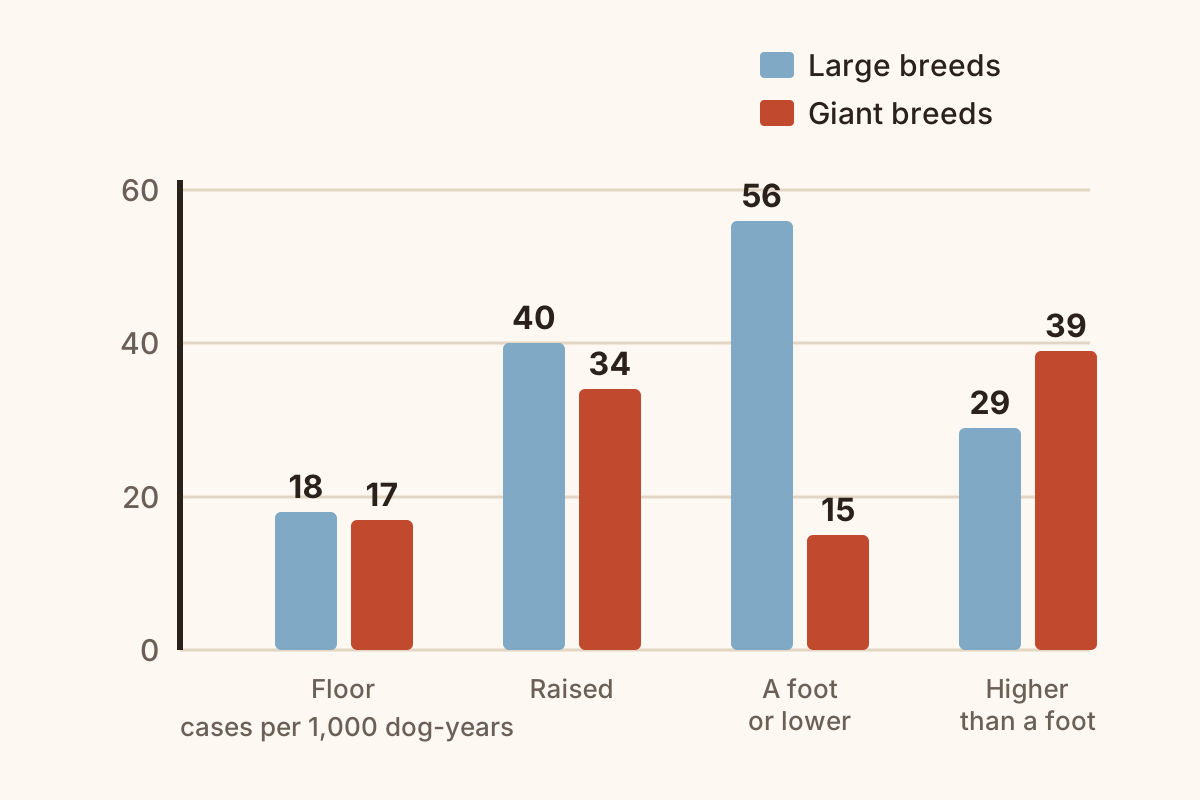
Per thousand dog-years. Look at the third pair and then the fourth: the blue bar drops and the red one rises. That is the crossover.
Those are not the numbers a bowl stand’s packaging is built on. They are also not enormous. A dog fed from a raised bowl is roughly twice as likely to develop bloat as one fed from the floor, which is a real difference and a long way from a guarantee of anything.
The weakness that does matter
The limitation Buckley dwells on is not the one you would guess. Owners were asked about the bowl once, within thirty days of enrolling, and then the dogs were followed for up to five years. Nobody re-asked. If a household switched from a stand to the floor partway through, the study would never know, and that blurs any effect it was trying to measure.
The second problem is dogs leaving the study. The paper does not report how many were lost to follow-up, and 13.3 percent had already been dropped for missing data before this analysis started. If the dogs that developed bloat dropped out at a different rate from the ones that did not, the numbers move.
Neither of those problems makes the result wrong. They make it a result that should be read as a direction rather than a size, and the direction is the part the article leans on.
What the reviewer concluded you should do
Buckley’s own recommendation is unusually concrete for a review: the safest option, absent better evidence, is to feed at-risk dogs from a bowl on the floor. It may not reduce the risk, but there is no evidence that it increases it. Neither study found floor feeding to be a risk factor for bloat.
And there is a second half to her advice that gets dropped. If a dog has a condition that makes floor feeding hard — arthritis, reduced mobility — she does not say “floor anyway”. She says consider the height of the dog relative to the height of the feeder, and advise accordingly. In other words, size the stand to the animal in front of you, and stop pretending the height is a universal constant.
Where a raised bowl is still reasonable
None of this makes the stand useless, and I would rather say so than win an argument.
If your vet raised the bowl for a diagnosed condition, that is a different conversation with different evidence. Swallowing and the esophagus raise questions that these two studies never looked at, and with a megaesophagus a raised bowl is often the standard of care. A blog post should not overrule that.
For water, the evidence is thinner still. I could not find a study of water bowl height and bloat at all. A tall dog drinking from a bowl on the floor is making no mistake; it is a comfort question.
For an older dog with neck pain or arthritis, a raised bowl may genuinely make eating easier, and quality of life counts. That is the trade-off Buckley leaves to you and your vet.
The bowl was never the hard part. Deciding what to do with it is.
What to buy
A wide, shallow bowl that sits on the floor. The width part is my inference, not a finding: neither study measured bowl width. What is published is that eating fast appears on Glickman’s list of risk factors, and a deep narrow bowl makes a dog work its muzzle down into a tunnel.
A slow feeder, if your dog inhales its food. This is the one purchase here I would make without hesitating for a fast eater. Be clear about what it does, though. It slows eating, and fast eating is on that list. Nobody has shown that a slow feeder prevents bloat. It addresses a mechanism, not an outcome.
Not a stand, for a deep-chested breed, unless your vet says otherwise. A bowl on the floor is not a compromise; on this evidence it is the option with the least explaining to do.
And know the emergency signs. A dog retching without producing anything, a hard distended abdomen, restlessness, drooling. That is a vet visit now, not in the morning. Every owner of a big dog should have the number saved and know where the nearest out-of-hours clinic is. That single piece of preparation is worth more than every bowl on the shelf.
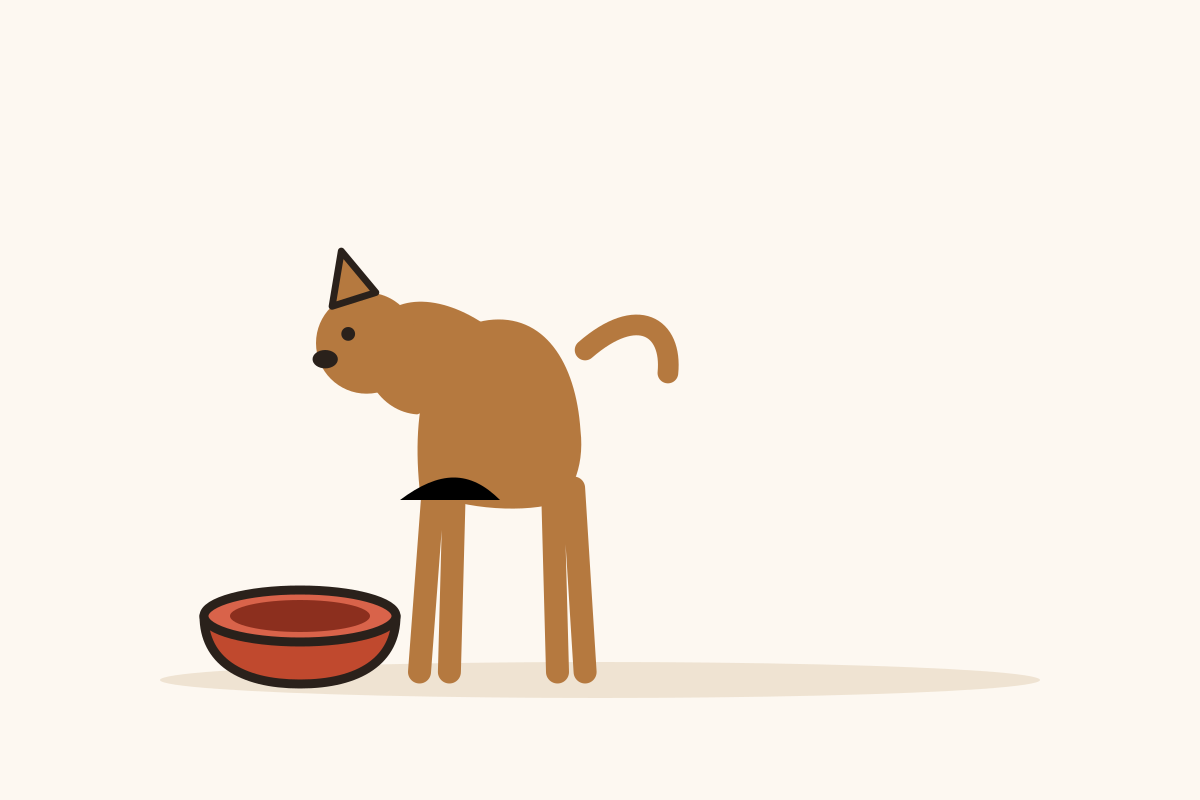
The cheapest thing in the shop, and the one the evidence leaves least exposed.