You have the harness on. It looks fine. Then the dog backs out of it in a car park, or you notice a bald patch behind the front leg, and you realise you have been guessing.
The honest answer to how tight it should be: I could not find a published measurement of it. There is no study that took a hundred dogs, tightened harnesses in millimetre steps, and reported where movement starts to suffer. The two-finger rule that every fitting guide repeats is a convention, not a finding.
What has been measured is more useful than a number. Two studies looked at what a harness does to a dog’s front legs, and one of them compared six designs head to head.
What the two-finger rule is, and isn’t
You will find it in manufacturer fitting guides, in shelter handouts, in vet clinic blogs: you should be able to slide two fingers flat under the strap. Usually it comes with a second half — no more than two fingers, or the harness is too loose.
That rule is doing two jobs at once, and it is worth knowing which is which.
Too loose and the strap slides, which means the load lands somewhere different every stride, and a dog can reverse out of it. Too tight and the strap sits on tissue with nothing to cushion it, which shows up as rubbing, then as a bald patch, then as a dog who slows down at the door.
Two fingers is a compromise between those two failures. I found no study that establishes where the optimum sits, so treat it as a starting point.
There is also a structural problem with applying it uniformly. A harness has straps in different places doing different jobs, and the same clearance is not right in all of them.
What the measurements do show
A 2019 study in Veterinary Record put nine dogs on a treadmill at walk and trot, filmed them with reflective markers, and measured shoulder extension with no harness, then with a restrictive harness, then with a non-restrictive one, with and without added weights (Lafuente, Provis and Schmalz, DOI 10.1136/vr.104946).
Both harness types reduced shoulder extension compared with no harness. The exception was the restrictive harness with weights added, where the difference was not significant. Nine dogs is a small sample, so that is an absence of evidence rather than evidence of no effect.
Then the result that undercuts the way these are sold: shoulder extension was 2.6° less at walk and 4.4° less at trot under the non-restrictive harness than under the restrictive one. The harness the paper labels non-restrictive restricted it more.
The authors were careful about what that means. Adding weights did not consistently restrict more, and the mechanism was not obvious from the data. What they could say was that harnesses limit shoulder extension, and not in the direction the labels imply.
A 2024 study went wider: thirty dogs, six harness styles plus a plain collar, filmed at 60 frames per second over a four-metre walkway, with roughly 2,500 individual angle measurements (Dowdeswell and Churchill, Reinvention 2024).
Every one of the six harnesses significantly reduced shoulder extension compared with the collar. Shoulder extension with the plain collar came out at 97.4°. The straight-front and the Y-front came closest to it, at 93.8° and 93.5°; the front-clip sat lowest at 84.7°.
So on that one measure the gap between the most and least restrictive harness is about nine degrees, in the same dogs, walking the same walkway. That figure separates medians, not dogs. Each design’s own interquartile range is 13.5 to 18 degrees wide, wider than the nine-degree gap itself, and together the six cover roughly 77°–103° with almost complete overlap, so on one individual dog the difference is barely visible. Overlapping ranges and a significant difference are not a contradiction: every harness was compared with the collar in the same dogs, which is a paired comparison.
The study’s own summary is blunt about the ends of that range: the straight-front allowed the most shoulder and elbow movement, the front-clip the least. The paper does not rank the six against each other in so many words, but its table of medians is that ranking, and the conclusion recommends two models outright. So treat “least restrictive” as a statement about shoulder extension, not a verdict on the whole harness.
Two things about that study are worth knowing before you act on it. It is published in a university journal, not a veterinary one, and the authors state the sample and the manual angle measurement as limitations. And the harnesses were supplied by Ruffwear and EzyDog, two of the brands tested — which is a conflict of interest that points the other way, because the study’s harshest finding lands on the Ruffwear front-clip.
The two studies disagree, and that matters
Lafuente and colleagues found the non-restrictive harness restricted shoulder extension more than the restrictive one. Dowdeswell and Churchill found the Y-front (the usual “non-restrictive” shape) restricted less than the front-clip.
Both can be right. The label does not identify a shape: Lafuente’s non-restrictive harness and Dowdeswell’s Y-front are not the same object, and neither paper defines the term the same way, so the two results may not be about the same thing.
What both studies agree on is the part you can use. Every harness but one, across both studies, reduced shoulder extension compared with no harness or with a collar, and the amount depended on the design. None of the six designs was restriction-free. Even the best of them cost a few degrees of shoulder extension.
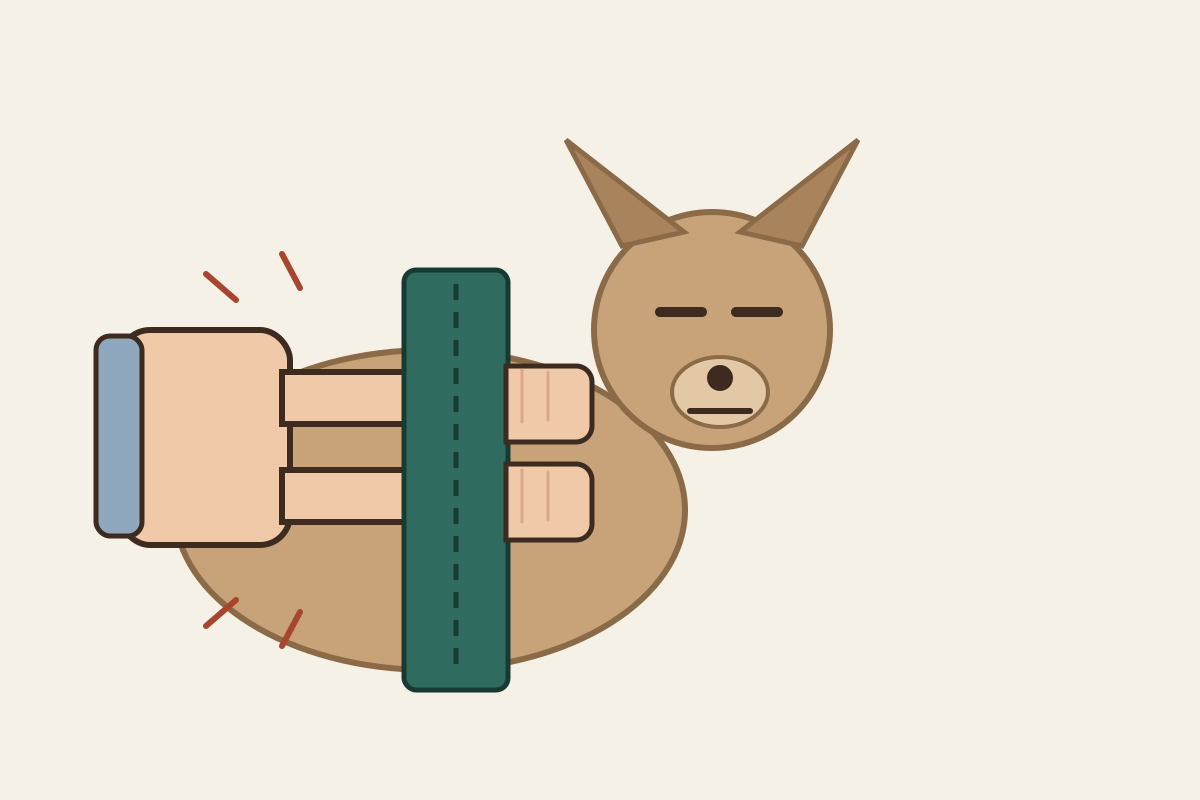
What you are checking is the gap.
How to check a harness: four checks
Forget one number for the whole harness. Check three straps and then watch the dog move, because they answer different questions.
The girth strap, the one behind the front legs. This carries most of the load when the dog pulls, so it needs to be snug enough not to slide forward into the armpit. Two fingers flat under it is about right. If you can fit a whole hand, it will slide.
The chest strap, across the front of the chest. This is the one that decides how much shoulder the dog has. It should sit below the point of shoulder, not across it. Find the bony point at the top of the front leg where the shoulder blade ends, and check that the strap crosses in front of and below that point, not on top of it. A strap sitting on the point of shoulder is pressing on the joint every stride, and no amount of loosening fixes the placement.
The neck opening. Tight enough that the dog cannot back out, loose enough that it does not sit on the throat. Check by gently pulling backwards on the harness with the dog standing: if the neck loop slides up towards the ears, it is too loose.
Then the range of motion, which is not a strap at all: it is the step that shows whether the straps are actually working, and most fitting guides leave it out. Walk the dog on a lead and watch the front leg from the side. The elbow should swing back past the ribcage and the paw should land under the nose, roughly. If the front leg looks like it is chopping, the harness is interfering, and the honest next step is to try a different design rather than a different tightness.
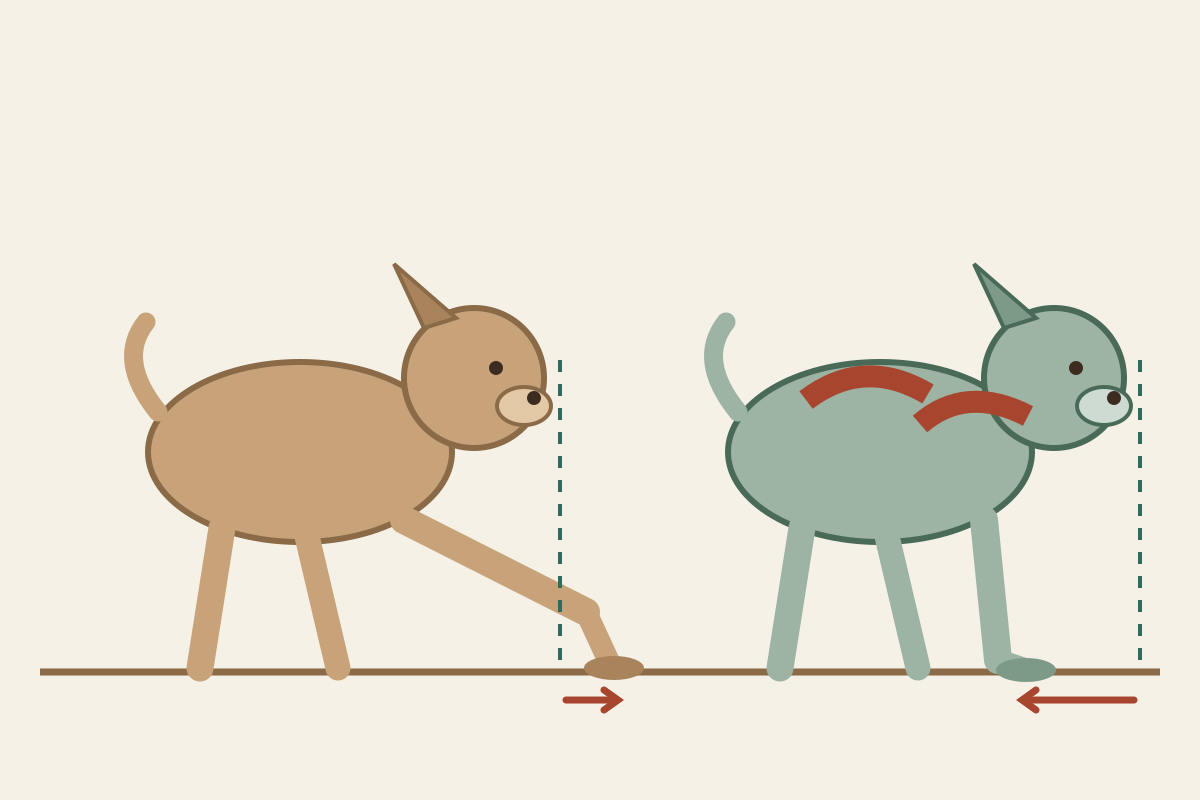
Past the nose, or short of it. You can see the difference from here.
What too tight actually looks like
Not a dog who complains. Dogs are poor reporters of discomfort in equipment, and many will keep walking.
Look for:
- A bald patch or thinning hair behind the front leg, where the girth strap sits. This is the classic sign, and it can appear in weeks.
- Damp or matted fur under the straps after a walk in dry weather.
- A dog who plants at the door or slows on the way out, especially one who used to be keen.
- A shortened front stride, which you will see before you see any of the above if you look.
Loose has its own signs, and they arrive faster: a dog who backs out at a road, or a strap that has swung round to the side where it does nothing.
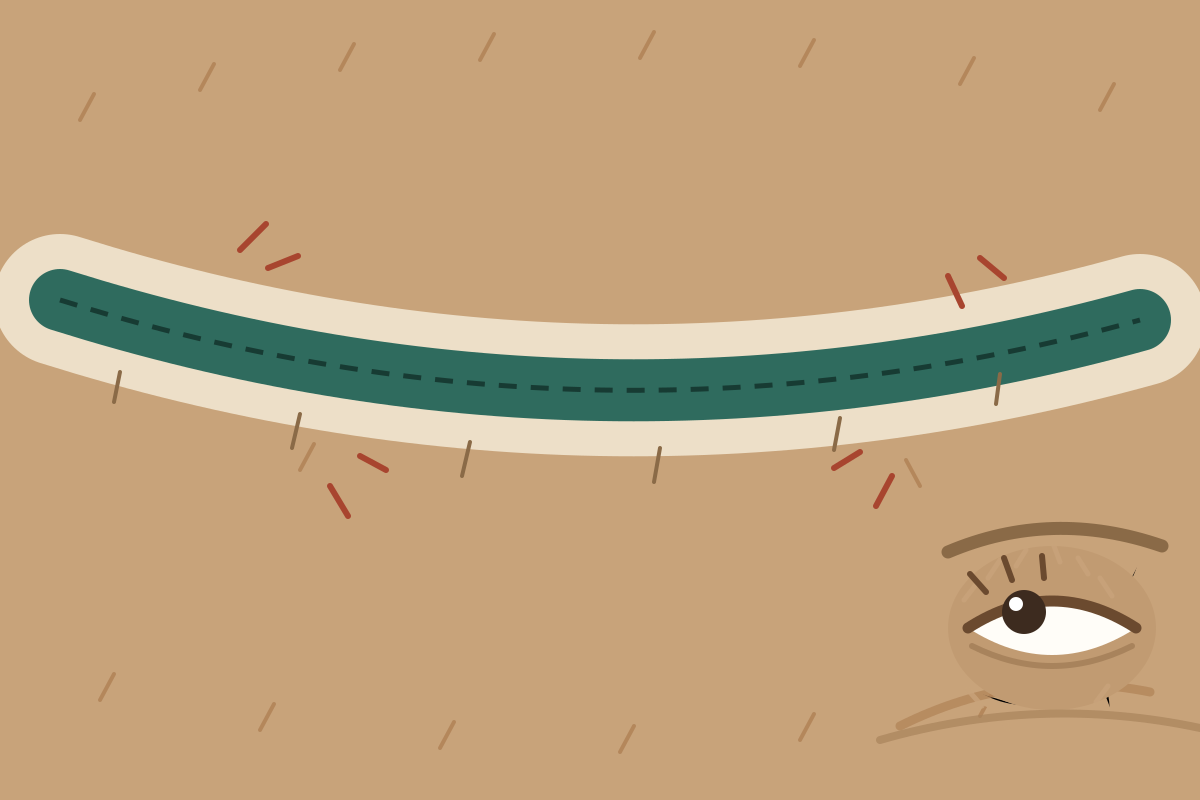
You find this one while brushing, not while walking.
Harness or collar, if you are deciding that too
Two studies make this less of a matter of taste than people assume.
A 2006 study measured intraocular pressure in 51 eyes of 26 dogs while pressure was applied through a collar and through a harness. Pressure rose significantly from baseline with the collar, and not with the harness. The authors’ recommendation was specific: dogs with weak or thin corneas, glaucoma, or any condition where a pressure rise is harmful should wear a harness rather than a collar, especially during exercise (Pauli, Bentley, Diehl and Miller, DOI 10.5326/0420207).
A 2020 study put seven collars and a slip lead on a canine neck model with a pressure sensor underneath, and applied the forces a dog generates on lead: a firm pull at 40 N, a strong pull at 70 N, and a jerk averaging 141 N. Neck pressure ranged from 83 to 832 kPa depending on the collar. Collar type and force both changed the pressure; collar type, but not force, changed the area it was spread over (Carter, McNally and Roshier, DOI 10.1136/vr.105681).
That is a model neck, not a dog, so it tells you about relative pressures rather than injury thresholds. But a spread from 83 to 832 kPa across collars and pulls is wide, and it is why the answer to “collar or harness” is not the same for every dog.
What to buy
A harness, if your dog pulls, is flat-faced, or has any eye condition. The pressure goes across the chest instead of the throat, and the eye-pressure finding is one of the more direct results in this area, because the pressure was read in the eye rather than inferred. It is still a change in a number, not an injury, and it comes from 26 dogs.
A straight-front or Y-front design, if you are choosing by the measurements. Those two came within half a degree of each other on shoulder extension, 93.8° and 93.5° against the collar’s 97.4°, and the front-clip managed 84.7°.
Avoid a front-clip as your everyday harness if the dog is sound and moving well. It was the most restrictive of the six tested. That is an argument about a few degrees of shoulder movement rather than about injury, and it is worth saying plainly that a front-clip is also the design sold for a dog that pulls hard. If you need it for safety, use it — and know what you are trading.
Check the chest strap placement before you check the tightness. No study has varied strap position either, so this is judgement, not measurement. But a strap that is slightly loose in the right place is the easier of the two mistakes to live with, and the one you can fix in ten seconds.
Measure the dog, not the label. Chest girth behind the front legs, and neck. Sizing is not standardised across brands, so the same dog can be a medium in one and a large in another.
The short version
Two fingers under the girth strap is a starting point. It does not get you finished. The chest strap’s position matters more than its tightness. Nobody has put a number on either, and design is the only one of the three anyone has measured — and the label non-restrictive does not tell you which one restricts less.