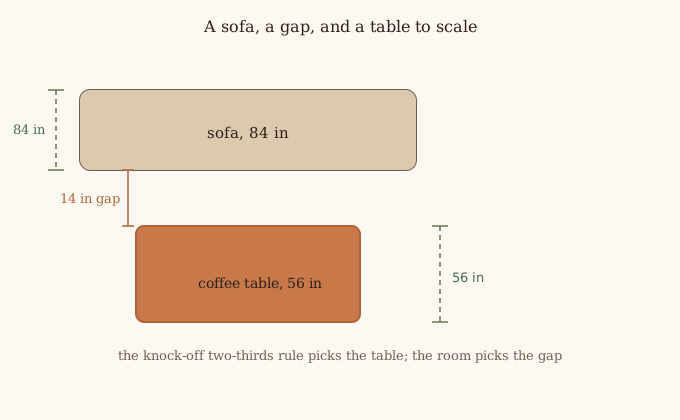
Somewhere in a living room there is a coffee table that was chosen in seconds and lived with for a decade. It matched the rug. It was on sale. It made eye contact with a sofa across the aisle and they eloped on the spot. Nobody measured anything, and now the room is not a room, it is a hallway with a table stuck in the middle.
The rule everyone repeats is: coffee table length should be about two-thirds of your sofa. That is real, but it is a range dressed up as a constant. It runs from about half to about two-thirds, and the right point inside that range is decided by measurements nobody takes. This guide is that checklist.
The two-thirds rule is a range, and here is why it has to be
The official line, stated everywhere: coffee table length should be about two-thirds of the sofa’s length — some guides stretch it to half, some to 70 percent, but two-thirds is the middle everyone quotes. An 84-inch sofa pairs with a roughly 48 to 56-inch table, which lands at 57 to 67 percent of the sofa. Standard. Safe. Useless until you know which end.
The range exists because you are not fitting the table to the whole sofa. You are fitting it to the seat width — the bit of sofa between the two armrests where the cushions actually are. Nobody in the history of sitting has rested a coffee cup on the sideways edge of an armrest. So the sofa’s overall length, measured across the arms, includes a chunk of reach that does not participate in the ratio — on a mid-size sofa that outer margin is usually 10 to 12 inches across the two armrests.
So measure the seat deck: armrest center to armrest center, across the seating area. Apply the two-thirds to that. An 84-inch sofa often has a 72-inch seat deck, which calls for a 43 to 50-inch table, not the 56 that a straight sofa-length version suggests. That half-foot is usually the difference between a table that fits and a table that blocks the walkway past the couch.
Height comes first, because height is the one that feels wrong
Sit on your sofa. Put your hand flat between your knee and the table edge. That vertical gap is the whole height question.
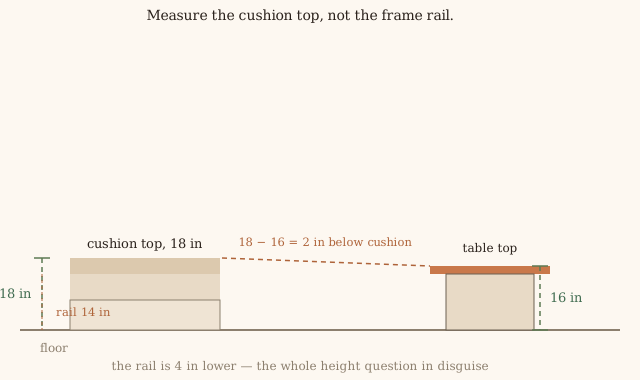
The tabletop should sit level with the top of the seat cushion, or one to two inches below it. Never above. A table higher than the cushion turns the couch into a breakfast counter, and you will reach down for a mug and feel the table edge against your forearm, a low-grade annoyance you cannot name until it is gone.
Standard coffee tables run 16 to 18 inches high, which covers almost everything in the aisle. The catch is that your sofa’s seat height is not constant. It drifts with the frame, the cushion fill, and how long the couch has been sat on. Two sofas from the same brand can land two inches apart. Measure the floor to the top of the cushion, where you sit, not the floor to the frame rail the cushion sits on. On a normal cushion-and-deck build the two can sit several inches apart — enough to flip the right table height from an inch low to an inch high — and that gap is the whole height question in disguise. The precise number depends on your cushion, so take the one in front of you.
The 16 to 18 inches: the gap nobody measures
The gap between the front edge of the seat cushion and the near edge of the coffee table should be 14 to 18 inches. That is: you sit, you lean forward a little, your knees clear the table, and your arm, fully extended, still reaches the mug without standing.
The range exists because it is really “knees plus reach,” and both change with you. Taller people sit at the far end of the gap, shorter people at the near end; a low, deep sofa tolerates less. The constant is not the number of inches, it is that you can reach a drink without shifting your hips and you can cross your legs without a whack.
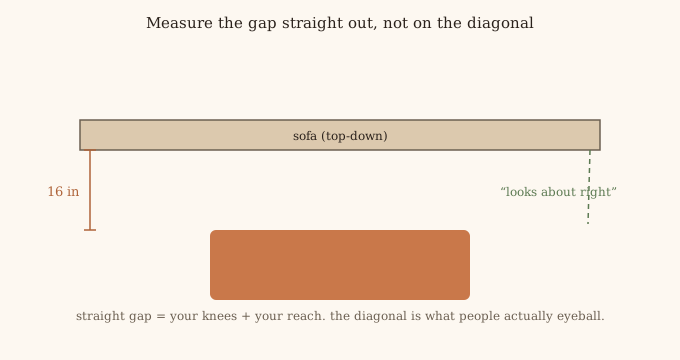
Measure it straight out from the cushion, perpendicular to the sofa, not diagonal. Most people eyeball the diagonal and come back two inches low. And in a tight room, the gap is the one number you can legally shrink: drop it to 12 inches and you trade the walkway for the reach. Just don’t drop the gap and keep the oversized table — that is how you end up stepping over it on the way to the kitchen, a fine party trick for about one night.
The walkway is the gap nobody told you about
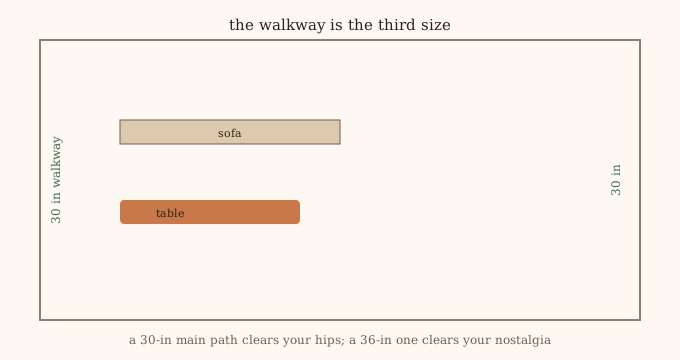
The coffee table is not the only thing in the room. The walkway, the clear path you move through around the furniture, matters as much as the edge-to-cushion gap. Guides call for about 30 inches of clear path around a table and 36 at a main traffic line. Drop below that and the room becomes a maze you shoulder-shimmy through.
A rectangular table runs about 24 inches deep. That, plus a 14 to 18-inch gap, plus the sofa, in a room that is, say, 12 feet across, is where the table budget actually gets paid. The big table you really want does not just occupy its own top; it claims the strip of floor you use to walk past the couch. So measure the room before the sofa. If the walkway is the binding constraint, the table you can afford is the one the room still lets you move around.
Two families of clearance figure float around, and they are not the same thing. The furniture guides quote the sofa gap — the 14 to 18 inches from the cushion edge to the table edge, the one that governs whether an armspan reaches. A reference site like dimensions.com gives a different number, a 24 to 30 inch clear zone around the table’s whole perimeter, which is closer to the walkway than to the reach. Use the first for the reach, the second for the path around it, and stop worrying that the two disagree.
Shape changes the arithmetic
Rectangles get the two-thirds rule and the 24-inch depth. Round and square tables size differently.
A round coffee table is sized by diameter, and it follows the same two-thirds-of-seat rule on the diameter, not on a length. The difference is corners: a round table has none, so it can sit closer — the 14-inch end of the gap is comfortable and even 12 works. The catch is reach: the widest point of a circle is its center, so from the middle of a wide sofa the near edge of a round table is close enough to reach, but the far edge sits further than on an oval — which is why a round top suits a loveseat more than a long sofa.
An oval table is a rectangle with rounded ends: apply the two-thirds to the long axis. A square table only works in the middle of a square seating pit; against a sofa it leaves the two corners you will walk into.
The reverse table the vendors won’t give you
Every guide promises you the reverse math — “here is your sofa, here is the coffee table that fits it” — and then stops at the two-thirds, because the vendors own the guide and they will not publish a table that tells half their customers the size they were just about to buy is wrong. So do it yourself. It is two tape measurements and one multiplication:
1. Seat deck: armrest center to armrest center.  ______ inches
2. Multiply by 0.6 -- that is your target length.  ______ inches
3. Cushion top to the floor.                      ______ inches
4. Tabletop should measure level, or up to 2 below. ______ inches
5. Gap: 14 to 18 from the cushion, straight out.  ______ in
Two measurements and one multiplication, about ninety seconds, and the difference between a coffee table that stays and one you relist on a marketplace with the words the gap was wrong in the description.