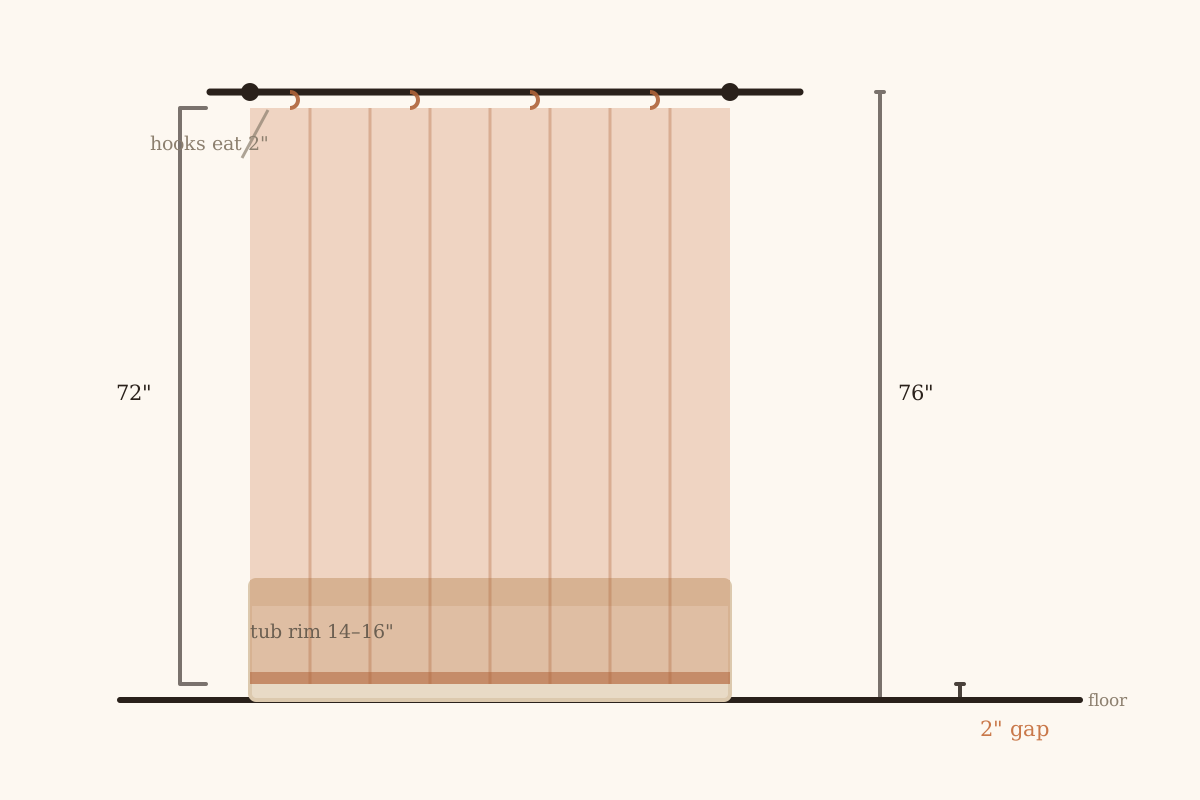
The old apartment had a 72-inch rod and a 72-inch curtain, which sounds like a matched set and is not. The curtain arrived, went up, and settled its bottom two inches onto the tile. Two inches of wet vinyl on a bathroom floor is not a decoration problem. It is a place where the water you just stood in gets to stay.
The number I should have looked up first was not the curtain length. It was the rod height, because on a shower curtain those two numbers are not independent — one is the other plus two smaller numbers, and every shopping guide quotes the first one and forgets the other two.
Here is the whole thing as one line:
Rod height = curtain length + hook drop + the gap you want under the hem.
That is it. Everything else in this article is just working out which of those three numbers you actually control, and the answer is embarrassing, because it is all three.
Seventy-two is a tub with a foot of slack added
A standard American alcove tub is 60 inches long and 30 to 32 inches wide, and Kohler’s spec sheet for the Villager — a tub that has been in the catalog so long it has its own generation of homeowners — lists exactly that: 60 inches long, 30-1/4 wide, 14 high.
Now take the rule that every shower curtain guide prints, which is to measure your opening wall to wall and add twelve inches. Sixty plus twelve is seventy-two. That is where 72 × 72 comes from. Nobody chose it in a meeting. It is the most common tub in the country plus a foot of slack, and the slack exists so the curtain has something to fold into when you close it.
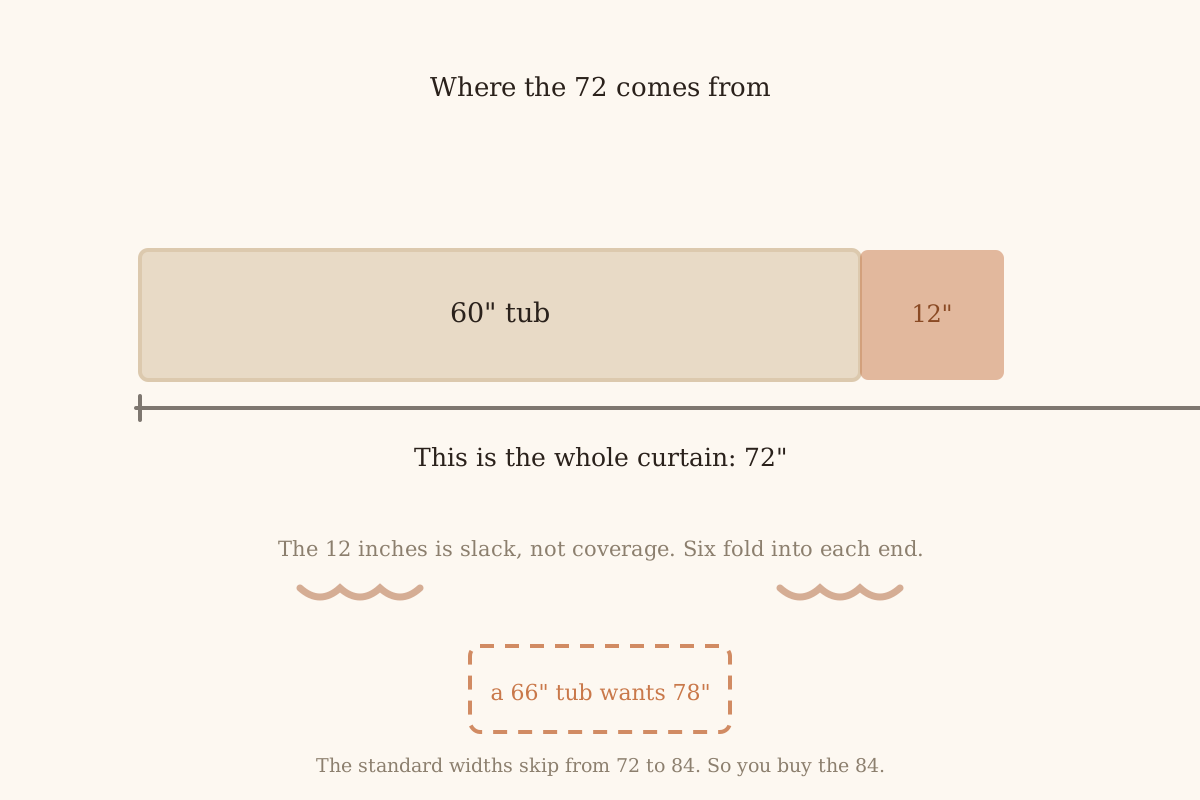
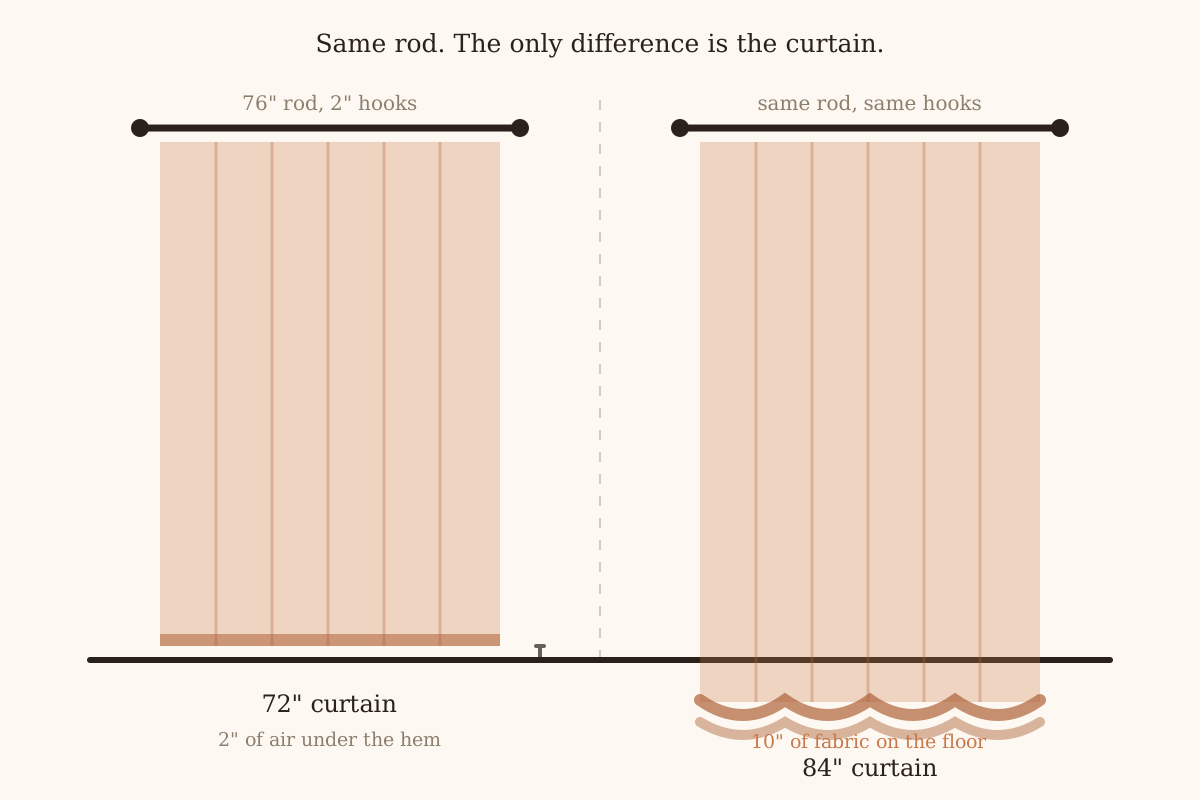
Which means the moment your tub is not 60 inches, the 72 stops being your number. A 66-inch tub wants 78, and the standard tub-curtain widths skip straight from 72 to 84, so you buy the 84 and carry six more inches of fabric than the wall needs. That surplus is width, it folds into the ends, and it is fine. The trouble starts if you also buy the tall version, because then the surplus is length, and length goes to the floor.
The hem is the only thing that has to be right
Curtain length gets argued about as though it were a style question. It is not, or not mostly. There is one hard constraint and a lot of taste.
The hard constraint: the hem cannot touch the floor. Not because of how it looks, but because a hem that sits in standing water stays wet, and a shower curtain that stays wet is a biofilm with a curtain wrapped around it. A 2004 study in Applied and Environmental Microbiology put vinyl shower curtains under a microscope and found what the authors called lush microbial biofilms, including two genera that are known to contain opportunistic pathogens, and concluded that frequent cleaning or disposal is indicated. They were not studying length. They were studying what grows when a curtain stays damp, which is precisely what a hem on the floor guarantees.
What is genuinely taste is the size of the gap. Retailers tend to say one to two inches so the fabric does not pool. A Swedish manufacturer of custom curtains recommends at least two centimeters, which is the same advice in metric clothing. One designer who writes about her own bathroom goes to half an inch and says she wants no puddling at all. Moen, asked directly, declines to give a number and says rod height is personal preference.
So the honest range is half an inch to two inches, and it does not matter much which end you choose, because the difference between them is an inch and a half of fabric. Choose one, drill, and stop thinking about it.
The rule everyone quotes almost never binds
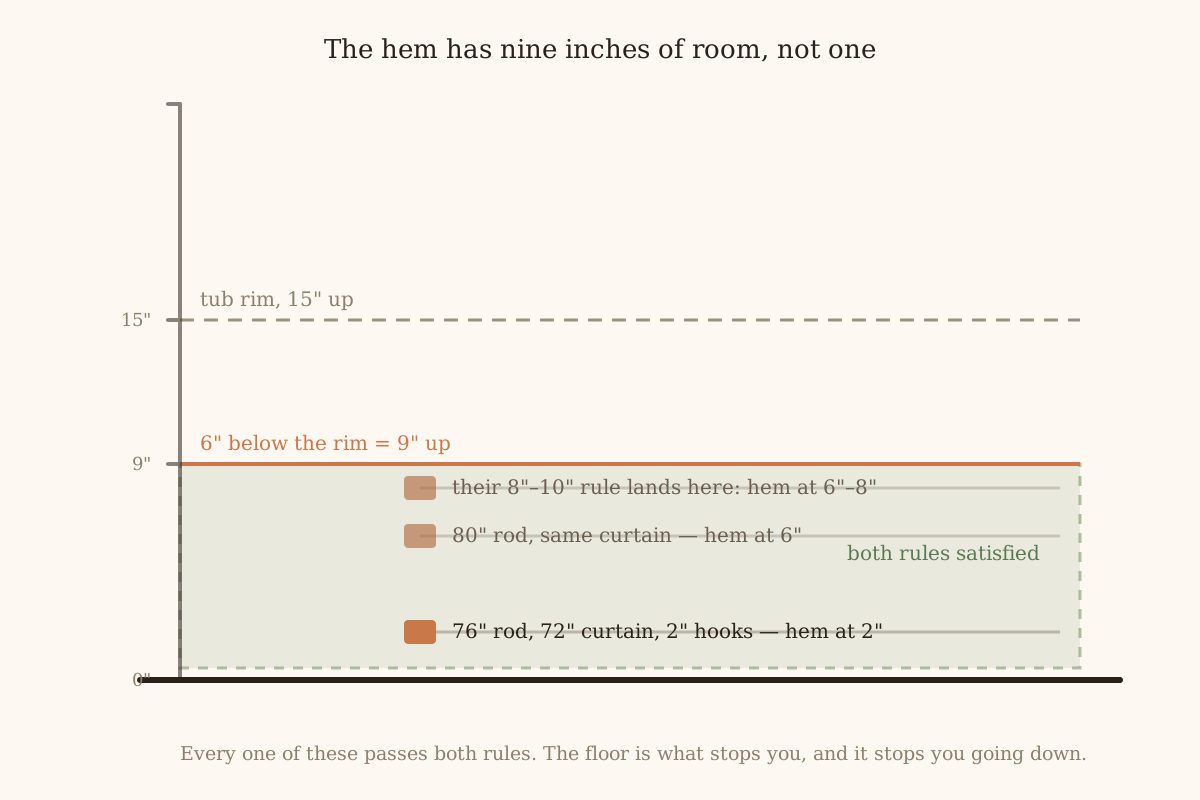
The other rule you will meet is that the hem should hang at least six inches below the tub rim, so water running down the curtain has something left to run down before it reaches the outside. One large retailer states it plainly, and it is the kind of number that gets repeated. On an ordinary tub it is also free.
Run the numbers. A tub rim sits 14 to 16 inches off the floor, which is industry convention rather than anything in a code. Six inches below a 15-inch rim means the hem has to be no higher than 9 inches off the floor. A 72-inch curtain on a 75-inch rod with two-inch hooks puts the hem at 1 inch. One inch is well under nine. You could raise that rod another eight inches before the rule would break, and lowering it never breaks the rule at all — it just puts the hem underground.
So the six-inch rule is worth knowing and not worth optimizing against. The constraint that actually bites is the floor, and it bites from the other direction.
Working backwards from your rod
So flip the equation around and run it as a checklist, because this is the order that keeps you out of trouble.
Measure the rod. Not where you plan to put it — where it is, if it is already up. If you are installing one, read the next section first.
Count the hooks. Curtain rings and hooks eat somewhere between one and three inches, depending on the ring, and this is the number that quietly ruins the arithmetic. A hook is not a rounding error when your margin is an inch and a half. Nobody measures a curtain ring before buying one. It is two inches of metal you will not think about again until the hem is on the tile.
Subtract the hooks from the rod height. What is left is your maximum curtain length. If the rod is at 76 and the hooks take 2, you have 74 inches of curtain before the hem touches the floor, and you want a gap, so the real answer is 72 or 73.
The guides run the same subtraction with a much larger allowance. One retailer says to subtract eight to ten inches from the rod-to-floor measurement to get the curtain length. Another says to subtract up to ten. On a 76-inch rod that lands at 66 to 68, where the arithmetic above lands at 72 or 73. By their own numbers they are subtracting rings plus a deeper gap than either of them names, and the extra inches are not a mistake: a curtain that comes up short never puddles. It just leaves you with a hem well off the floor and nothing explaining why.
If you are installing the rod, the floor decides
Nobody will tell you the correct rod height, because there is not one. I looked. The 2024 International Plumbing Code’s fixture chapter covers shower compartments in detail — 900 square inches of cross-section, 30 inches minimum in the least dimension, a 22-inch opening — and says nothing at all about how high a curtain rod goes. The residential code’s only mention of a shower curtain rod is a rule about where a grab bar may sit horizontally relative to one, which is a different question entirely.
What you get instead is a range, and the range is wider than you would like. One custom drapery shop says 72 to 78 inches. A retailer working backwards from the standard curtain says 75 to 77 if you want to hang a 72. Moen’s worked example puts the rod at 78 and the hem six inches off the floor, which is a fine outcome and not the one most people get, because Moen’s example leaves the hooks out.
That is a ten-inch spread, and it exists because each source is answering a different question. The drapery shop is thinking about proportion on the wall. The retailer is thinking about a 72-inch curtain. Moen is thinking about a diagram that is easy to draw.
The one you should use is the retailer’s, and only because it is the only one that does the arithmetic. Your rod height is whatever makes your curtain end where you want it to end. Mount it at 76, use two-inch hooks, buy a 72, and the hem lands at two inches. Mount it at 80 with the same curtain and the hem lands at six — which is a real look, high water, and a longer gap to splash through.
Four situations that want four different answers
A tub with a rim. The hem goes below the rim and above the floor. On any normal tub the second condition is the tight one. The liner goes inside the tub and the decorative curtain stays outside it — that is the whole division of labor — which means the liner has to be short enough to not sit in the tub’s water and long enough to still be inside the tub.
A shower pan with a threshold. Different target. The advice here is to get the curtain edge at least an inch below the lip of the pan, which is a much lower bar than the tub’s six inches, and for the same reason: the pan floor is closer to the floor than a tub’s inside is.
A doorless stall. Here the guidance flips hard. The same publisher that says an inch below the lip elsewhere says the curtain and liner should go all the way to the floor for a stall with no door, because there is no door doing any of the containment. Both statements sit on the same website, pages apart, neither mentioning the other. Both are right. You are the one who has to notice which room you are standing in: a pan with a lip wants an inch, a stall with no door wants the floor.
A freestanding tub. Everything above is wrong here, because there is no wall on three sides. A tub manufacturer’s own guidance for clawfoot and freestanding tubs is a curtain about 180 inches wide so it can encircle the tub, hanging from a ring or U-shaped rod, at about 68 inches tall so it clears the floor from a ceiling mount. If you are doing this, nothing you buy at a big-box store is involved.
The part I could not verify
Two things I could not find, and the piece is worse for it.
The first is any code, standard or government guidance on the gap between a hem and the floor. I have the retailer numbers, the manufacturer’s number and the designer number, and they disagree by more than five inches. There is no ANSI figure. If you want a defensible default, one to two inches is what the largest number of sources converge on, and that is a description of consensus rather than a citation.
The second is any measurement of how much water actually escapes a shower when the curtain is an inch too short. Everybody asserts it. A plumbing code proposal from 2018, based on an informal survey of hotel rooms in the US and Canada, does describe the failure from the other end — grab bars positioned close to the curtain’s end bracket made it very difficult to seal the curtain against the wall, in more than half the combinations surveyed — which is the closest thing to field evidence I found, and it is about grab bars, not length.
What to actually buy
Start from the tub, not the curtain. Measure the length of the tub and add twelve. That is your width, and if the answer is near 72, the standard size is your size.
For length, measure from the rod to the floor, subtract two inches for hooks, subtract another one to two for the gap. Round down to the nearest standard size, because rounding up is how hems end up on the floor.
If the arithmetic gives you something between 72 and 84, buy the 72 and mount the rod lower, or buy the 84 and mount it higher. Do not buy the 84 and mount it at the height the old one was at. That is the two inches of wet vinyl I started this article with, and it took standing in the water, not a math degree, to notice.